Answering Service
Dental answering service for busy practices
How a dental answering service catches new-patient calls while everyone's chairside, triages a knocked-out tooth, and costs about 6¢ per answered minute.
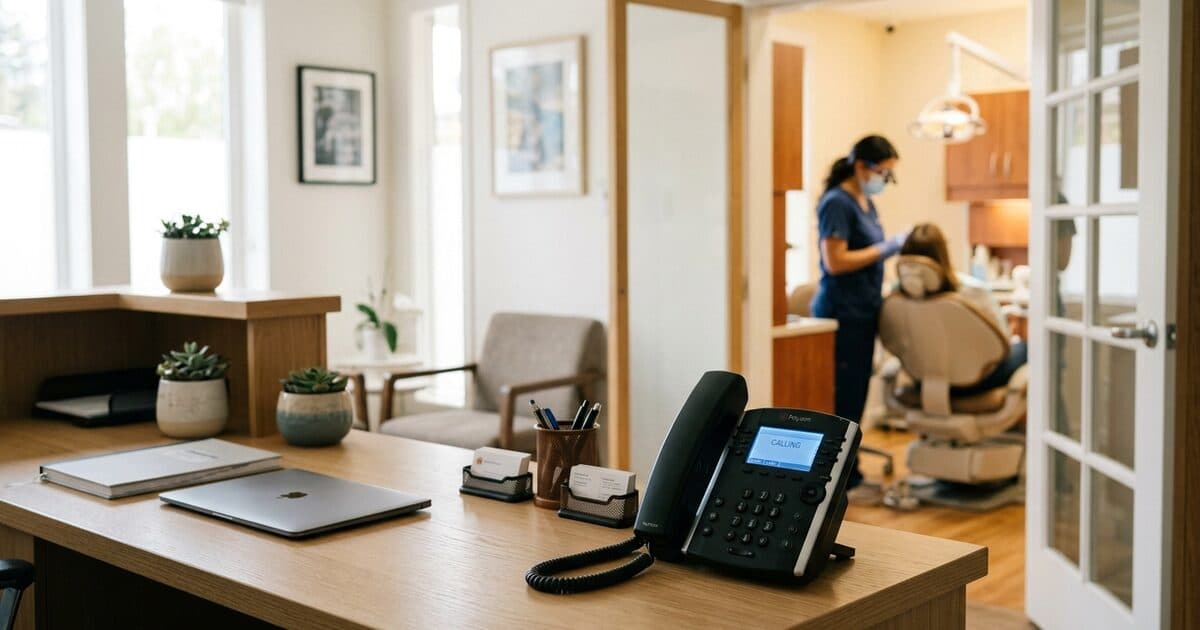
A dental answering service exists for one recurring moment: the phone rings while the front desk is checking in a patient and everyone else is chairside. The calls it catches are the expensive ones — new patients worth years of recurring visits, and true emergencies like a knocked-out tooth that need a calm, instant response. The right service books into your real calendar, keeps recall and confirmation calls from turning into no-shows, and escalates emergencies instead of parking them in a message queue.
Picture Tuesday at 9:15am. The hygienist has a patient in the chair, the assistant is with her, you are mid-procedure, and the front desk is checking in the 9:10 while a second patient waits with a question about their insurance card. The phone rings. Nobody can get it, and it goes to voicemail.
The caller might be a new patient comparing two practices, who simply phones the other one. Or a parent standing on a touchline with a kid's tooth in a tissue. Voicemail loses both of them, and you never find out either call happened. A dental office answering service is bought for exactly these fifteen minutes, repeated several times a day.
The missed-call math in a dental practice
The new-patient call is the obvious one. A patient who picks your practice tends to stay for years — hygiene twice a year, the occasional filling or crown, often the rest of the household too — so one answered call is commonly worth thousands of dollars over the relationship, not the value of a single exam. When that call hits voicemail during the morning rush, the caller does not wait. They book with the next practice on the list, and the loss is invisible because nobody ever tells you they rang.
The emergency call is the other one: rarer, but the caller needs an answer in seconds, and "leave a message" fails completely. Both call types arrive on their schedule, not yours, and they cluster in the hours your team is busiest.
The Saturday-morning knocked-out tooth
Real dental emergencies are uncommon enough that a small practice might see a handful a month, which is exactly why they go wrong: nobody rehearses them. A knocked-out permanent tooth is the classic case. The standard guidance is simple and well known — handle the tooth by the crown, not the root, do not scrub it, keep it moist in milk or inside the cheek, and get to a dentist fast, ideally within the hour. What the caller needs is that guidance delivered calmly, plus the certainty that the dentist is being reached right now.
A dentist answering service should do both from your own uploaded instructions, worded the way you want them worded. A call from a Saturday-morning soccer game:
Milo: Brightside Dental — this is Milo. How can I help?
Caller: Hi — my son just got a tooth knocked out at his game. What do we do?
Milo: Okay, we'll get you help fast. If it's an adult tooth, pick it up by the white part — the crown — not the root, and don't scrub it. Keep it moist: a small container of milk is best, or inside his cheek. The sooner a dentist sees him, the better.
Caller: It's his permanent front tooth. We're at the field on Route 9.
Milo: Got it. Keep the tooth in milk and start heading this way. I'm alerting Dr. Alvarez right now with your number — she'll call you back within the minute to tell you where to meet her. Can I get your name?
Caller: Rachel Donnelly.
Milo: Rachel, the doctor is being alerted now. Keep the tooth moist, and call this number back if anything changes.
You get a text with the name, number, and summary while you are still pulling on your coat. The parent got calm, standard guidance instead of a voicemail box, and the practice kept a patient who will tell that story to every other parent on the team.
The emergency flow only works if the service stays inside its lane: deliver your standard first-aid wording, capture the details, escalate. "That sounds fine, come in Monday" on a swelling call — improvised reassurance — is a liability, not a feature. The same administrative-versus-clinical line, applied to a GP or specialist practice, is covered in the medical answering service article.
Recall and confirmation calls are the quiet volume
Emergencies make the case, but the day-to-day workload is recall and confirmation traffic. Your reminders go out, and the responses come back as phone calls: "I got a text that I'm due — can I book my cleaning?" and "I need to move Thursday." These calls are short, routine, and directly tied to whether your chairs stay full.
The failure mode is the unanswered reschedule. The patient knew days ahead they could not make it, tried to call, hit voicemail during the rush, and gave up. The slot stayed booked until it sat empty, and your team found out at 10:30. A dental office answering service breaks that chain: the call gets answered every time, the move takes ninety seconds against your live calendar, a confirmation text closes the loop, and the freed slot is visible for the next caller who wants an earlier one. The scheduling mechanics behind that — booking, moving, confirming — are covered in depth in virtual receptionist.
Routine questions ride along in the same calls: hours, parking, whether you take a particular plan, what a first visit involves. Those should be answered from your own uploaded documents, word for word — and a fee question you have not priced should get a polite refusal and a booked consult, never an invented number.
What to test before signing
- 1
Call it as a new patient at 9:15am
Ask to book a first exam. It should offer real open slots from your calendar and book one, not take a message. Then check the confirmation text actually arrived.
- 2
Call it with the knocked-out tooth
Use the real words a parent would use. Time how long until your phone buzzes, and check the alert contains name, callback number, and what happened — plus that the caller heard your first-aid guidance, not an improvisation.
- 3
Ask it for a price
“How much is a crown?” The right answer declines to quote a fee it was never given and offers a consult or a callback. The wrong answer invents a number your front desk will spend a month walking back.
- 4
Call it about a recall reminder
Confirm a cleaning, then move it. One call, the slot updated on your calendar, a confirmation text sent. If any of the three is missing, that is your no-show rate leaking.
What this costs in practice
Human answering services marketed to dental practices typically start around $250 to $400 a month with a minimum you pay whether calls arrive or not, and per-call overages on top. That buys a person rostered in case the phone rings.
Dial Milo bills the other way: per second of answered call time, roughly 6¢ a minute on a US number, with no subscription, no monthly minimum, and no charge for missed, blocked, or spam calls. Seventy answered calls a month at two minutes each is about $8.55 — less than one recovered new patient's first visit by a wide margin. It books into your connected calendar, answers hours, parking, and insurance questions from the documents you upload, texts you the moment a call is urgent, answers in multiple languages, and refuses to quote fees it was not given. Forward your existing practice line for free — overflow only, if that is all you want — or take a dedicated number for $3 a month. Setup takes minutes, and the $1 trial credit on a new account buys about 16 minutes of real answered calls, enough to run every test above before you spend anything.
The full pricing-model comparison, including where human services genuinely win, is in answering service cost. The rates themselves are published at /pricing rather than quoted on a sales call, because the math is the pitch.
For your business
The phone rings most at 8am Monday. So does your check-in line.
Milo picks up while your front desk is checking patients in. She books and reschedules appointments straight into your Google Calendar, answers hours and parking questions from your own documents, and takes structured messages for everything clinical — never advice.
Get Milo answering your practice lineFrequently asked questions
- What should a dental answering service do with a real dental emergency?
- Recognise it from the caller's actual words — knocked-out tooth, broken tooth, facial swelling, uncontrolled bleeding — then give the standard first-aid guidance from your own instructions, like keeping a knocked-out tooth moist and getting seen fast. It should capture the name and callback number and text you an urgent summary immediately, not park the call in a message queue. What it should never do is improvise clinical advice beyond the guidance you gave it.
- Can a dental answering service handle recall and confirmation calls?
- Yes, and this is most of its daily volume. When a patient calls back after a recall reminder to book their cleaning, or calls to confirm or move an appointment, the service answers, checks your live calendar, and books or reschedules on the spot with a text confirmation. That matters because an unanswered reschedule call quietly becomes a no-show and an empty chair.
- What does a dental answering service cost?
- Traditional human services typically start around $250 to $400 a month with a minimum you pay whether calls come in or not. Pay-as-you-go AI services bill per answered minute with no minimum: at Dial Milo's published ~6¢/min, a practice fielding 70 answered calls a month at two minutes each pays about $8.55, and missed or spam calls are not billed.
- Can it book new patients straight into the schedule?
- A good one can, and this is the feature that pays for the service. Dial Milo connects to your calendar, offers real open slots, and writes the booking while the caller is still on the line, with an SMS confirmation going out immediately. For fee questions it was not given answers to, it declines to quote and captures the details or books a consult instead of inventing a number.
- Does a dental answering service replace the front desk?
- No — it covers the moments the desk physically cannot answer: mid check-in, when everyone is chairside, at lunch, and after hours. Most practices forward their existing number for free and use it as overflow, so the desk keeps handling patients in front of them while callers get a real answer instead of voicemail.
Keep reading
Answering Service
Medical answering service for small practices
How a medical answering service handles front-desk overflow, after-hours patient calls, and reschedules — and the line it should never cross.
ReadAnswering Service
Chiropractic answering service for small clinics
How a chiropractic answering service books the new-patient call you miss mid-adjustment: a first visit on the calendar for about 6¢ a minute, no $250 minimum.
ReadAnswering Service
Answering service cost: what you'll actually pay
What answering services really cost: a receptionist at $3,000–4,000 a month, traditional plans from $250 plus overages, or pay-as-you-go AI at cents a minute.
Read