Industries
Restaurant phone systems and the dinner rush
Why restaurant phones get missed at exactly the wrong moment, what a phone system can and can't fix, and how to stop losing reservations during service.
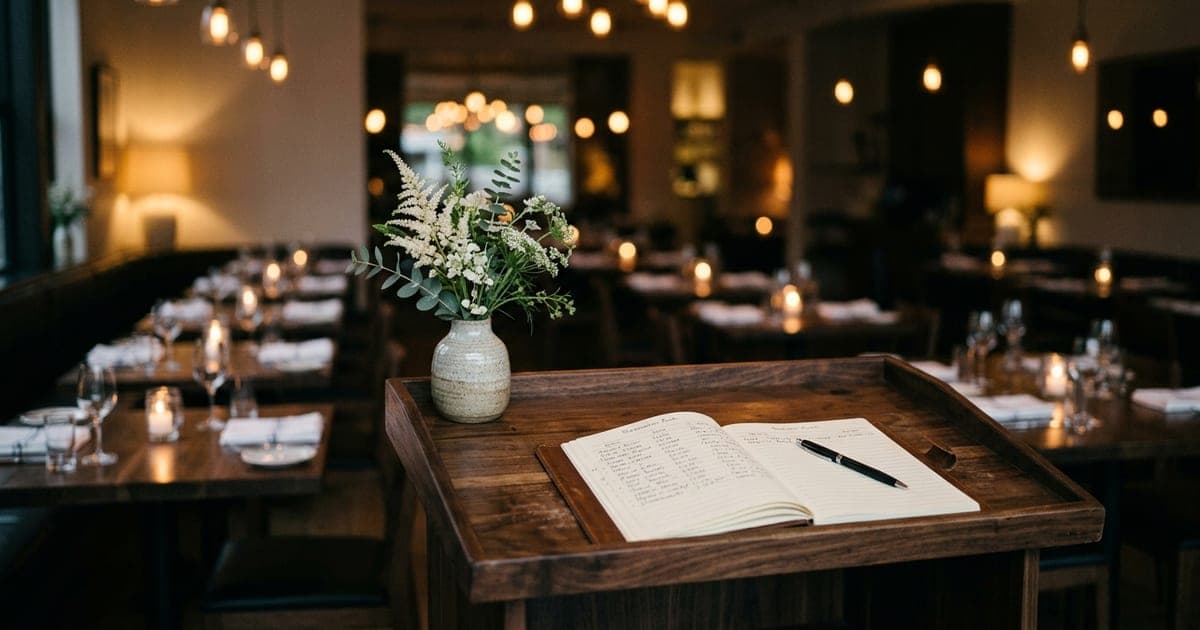
Restaurant phones get missed because call volume peaks exactly when staff are least free — the hour before service and the first hour of it. A new phone system rarely fixes that, because it is a staffing collision, not a hardware problem. The useful question is which calls can be answered without pulling someone off the floor.
Every restaurant has the same twenty minutes. Six-forty on a Friday: the first tables are seating, the pass is filling up, and the phone starts. Someone picks it up, holds it against a shoulder, and tries to find Thursday in the book while a couple waits to be seated.
Half the time nobody gets to it at all.
The problem is when, not how many
Restaurants do not take a huge number of calls. They take them in a narrow window, and the window is the worst possible one.
Pull a week of call data and the shape is almost always the same: a modest spike late morning, then a sharp peak from about an hour before service through the first hour of it, then a long quiet tail. The peak is where the missed calls live.
This matters because it changes what a solution has to do. You do not need more capacity in general. You need calls answered during a ninety-minute window when nobody has a free hand — and a new phone system, however good, does not create hands.
What the calls actually are
Broadly four kinds, and they need very different handling:
- Reservations. Booking, changing, cancelling. The highest-value calls, and the ones most likely to be lost during the peak.
- Questions. Opening hours, parking, whether you take dogs, whether the terrace is covered, is there a set menu tonight. Repetitive and easily answered from fixed information.
- Large parties and private hire. Low volume, high value, and worth a human every time.
- Allergen and dietary questions. Rare, and a safety matter — never to be answered by anything working from stale information.
Groups 1 and 2 are most of the volume. Group 2 in particular is pure interruption: the answer never changes, and it never needs judgement.
What a phone system fixes, and what it doesn't
A modern cloud phone system will give you call routing, an auto-attendant, hold music, voicemail-to-email, and call reporting. That reporting is genuinely useful — most restaurants have never actually looked at when their missed calls happen, and the data usually changes the conversation.
What it does not do is answer. An auto-attendant that offers four options to someone trying to book a table for Friday mostly teaches them to hang up and use the booking site, which — to be fair — is not the worst outcome.
That points at the honest first move for a lot of restaurants:
If most of your calls are reservations and you already run an online booking system, the cheapest fix is not a phone system at all. It is making the booking link impossible to miss on your site, your Google listing, and your Instagram bio, and having the phone greeting say "you can book instantly at…" before anything else. Deflecting the call beats answering it faster.
Covering the calls that remain
Once reservations are deflected online, what is left is questions, large parties, and the callers who will only ever use a phone. Three options:
Take a message and call back. Fine for private hire, useless for a table tonight.
A human answering service. Reliable, priced per minute or per call with a monthly minimum, and worth considering if your call volume genuinely justifies it. Most independents find the minimum hard to justify for a ninety-minute daily peak.
An AI receptionist. Answers every call during the peak, handles the repetitive questions from your own information, and passes anything needing a person — private hire, allergens, complaints — straight through. Because it is billed per minute of answered time, a slow Tuesday costs almost nothing, which suits the spiky pattern well.
The same caution applies as anywhere else: it should only claim to have made a reservation if it is writing to your actual booking system. A "reservation" that sits in an email for someone to key in later is a message, and at volume it is how double-bookings happen.
Setting it up so it doesn't embarrass you
- 1
Lead with the booking link
Whatever answers, the first thing a caller hears should be the fastest route to what they want. For most restaurants at most hours, that is booking online.
- 2
Write down the repetitive answers properly
Hours, parking, dogs, terrace, corkage, set menu nights, accessibility, whether you split bills. These are the interruptions worth eliminating, and vague answers sound like evasion.
- 3
Route allergens and private hire to a human, always
Allergen questions are a safety matter and menus change. Private hire is high-value and needs a conversation. Neither should be automated, regardless of what a demo shows.
- 4
Check it during service, not at 3pm
Test it in the peak, when the dining room is loud and the system is busy. That is the only test that reflects reality.
Where to start
Look at your missed calls by hour first. It costs nothing and it usually reframes the problem — most owners discover the losses are concentrated in a window they could describe from memory but had never quantified.
If those calls are mostly reservations, fix the deflection before you buy anything. If they are mostly questions, something that answers consistently during service will pay for itself quickly.
Dial Milo handles the second case: it answers during the rush from information you provide, captures reservation requests with the details you need, and hands private hire, allergen questions, and complaints straight to a person. The broader comparison of cover options is in after-hours answering services.
For your business
Your phone doesn't ring during dinner rush. Now it does — and Milo picks it up.
Reservations, hours, dietary questions, large-party catering. Milo handles the routine calls so your servers stay on the floor instead of stuck behind the host stand.
Get Milo answering your restaurant lineFrequently asked questions
- Why do restaurants miss so many calls?
- Because call volume peaks at exactly the moment staff are least able to answer — the hour before service and the first hour of it. The phone competes with a full dining room, and the dining room wins. It is a staffing collision, not a phone problem, which is why a new handset rarely fixes it.
- Should a restaurant use an answering service?
- It depends what the calls are. If most are reservations and you use an online booking system, pushing callers there solves more than an answering service does. If you take a lot of questions — allergens, private hire, opening hours, parking — something that answers consistently during service is worth more.
- Can an AI take restaurant reservations?
- Only reliably if it writes to your booking system. Otherwise it is taking a request that someone has to key in later, which is fine at low volume and a source of double-bookings at high volume. Ask which system it writes to.
- What about allergen questions over the phone?
- Never automate these. Allergen information is a safety matter and menus change; a wrong answer is genuinely dangerous, not just embarrassing. Any system answering your phone should hand allergen questions to a person, every time.
Keep reading
Industries
Hotel phone systems: what small properties need
A practical guide to hotel phone systems for small properties: PBX vs cloud, what PMS integration is worth, and how to cover the front desk after hours.
ReadAnswering Service
After hours answering service: what to know
What an after hours answering service costs, what happens to your 9pm callers without one, and how to choose between forwarding, a human service and AI.
ReadAI Receptionist
What is an AI receptionist?
A plain-English explanation of what AI receptionists do, how they sound on the phone, and where they fit (or don't) in a small business.
Read