Answering Service
Answering service appointment scheduling
How an answering service with appointment scheduling writes bookings to your real calendar, avoids double-booking, and beats a callback message every time.
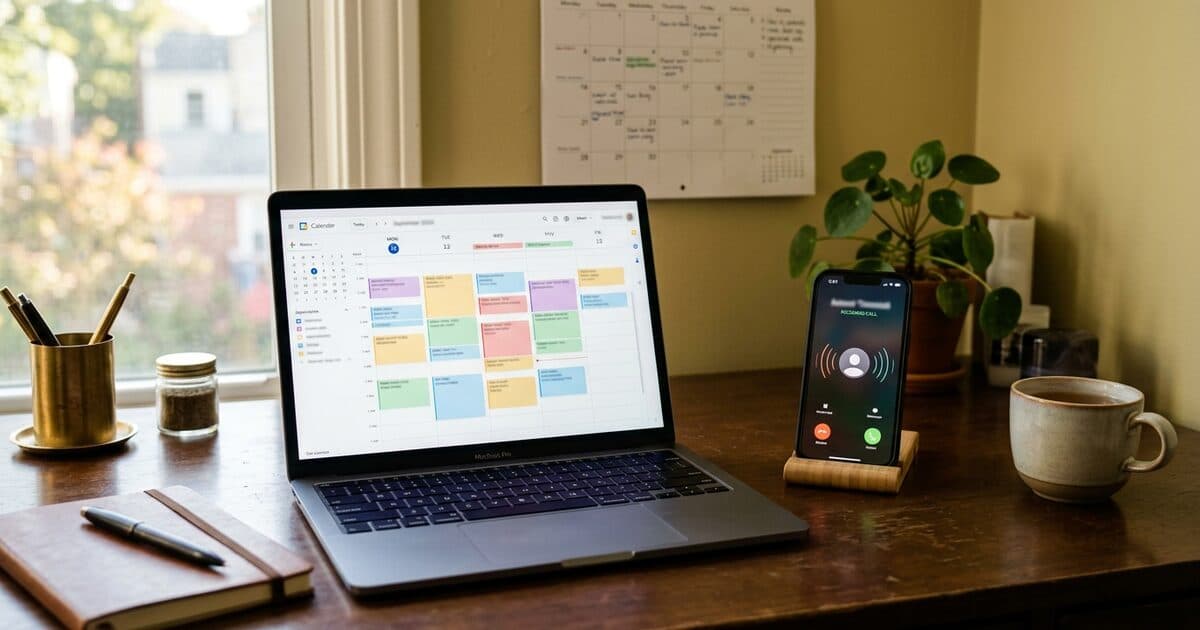
The dividing line between answering services is not price or politeness — it is whether the service takes a message about an appointment or actually books one. A real booking means reading your live calendar, offering genuine gaps, writing the event during the call, and telling the caller a confirmed time. Everything else is voicemail with better manners.
Most small businesses shopping for an answering service compare the wrong things: greeting quality, accents, whether it "sounds human." Those matter far less than one capability — what happens when a caller says "can I come in Thursday?"
A message-taking service replies "I'll pass that on and someone will call you back." A booking service replies "Thursday at 10:15 or 2:30 — which suits you?" The second one has already won the customer. The first one has started a game of phone tag that a share of callers simply abandon.
The dividing line: messages versus bookings
Ask any provider "do you book appointments?" and the answer is yes. Ask "how?" and the category splits in two.
The weaker version takes the caller's preferred day and time, writes it into a message, and emails or texts it to you. The appointment exists only when you call back and confirm — which means it competes with every other thing on your plate, and with the competitor the caller rings next.
The stronger version is connected to your calendar. It sees your availability, applies your rules, creates the event while the caller is still on the line, and reads the confirmed time back. The caller hangs up with a slot. You see it appear in your diary. Nobody has to phone anyone back.
Everything else about the service — voice quality, languages, price — is secondary to which of those two it does.
How calendar-integrated booking works
The mechanics are simpler than providers make them sound. You connect a calendar — Google Calendar is the common case — and define rules: which hours are bookable, how long each appointment type takes, how much buffer to leave between slots, and how far ahead callers can book. The Google Calendar setup guide walks through the connection step by step.
From then on, each booking call runs the same loop:
- The caller asks for an appointment, often vaguely — "sometime next week, mornings."
- The service reads your live calendar, filters by your rules, and offers two or three real gaps.
- The caller picks one. The service captures name, number, and what the appointment is for.
- It writes the event to your calendar and confirms the time back to the caller before hanging up.
Because the calendar is read live, anything you put in it yourself — a job, a school run, a day off — is automatically unavailable to callers. That is the feature that separates integration from a typed-in schedule.
What can go wrong
Calendar booking fails in predictable places, and each is testable before you sign.
Double-booking. If the service caches your availability instead of reading it live, it will offer slots you filled yourself an hour ago. The fix is a real-time read; the test is to block tomorrow morning in your calendar and then call asking for tomorrow morning.
Time zones. If you serve callers outside your own zone — or travel — a booking made against the wrong zone puts the appointment at the wrong hour for one side. Ask which zone the integration uses, and test it as a caller from another.
Buffer times. Back-to-back bookings look efficient on paper and fall apart in practice. If you need fifteen minutes between appointments to travel, prep, or write notes, that buffer has to be a rule the service enforces, not something you fix by hand afterwards.
The most expensive booking failure is not a double-booking you notice — it is a confirmed slot for a service you do not offer, at a price nobody quoted. The service should book only appointment types you have defined and refuse to invent availability or pricing for anything else.
What a booking call sounds like
Tuesday, 9:40am, while you are with a client:
Milo: Hartley Physiotherapy — this is Milo. How can I help?
Caller: Hi, my GP said I should get my knee looked at. Do you have anything this week?
Milo: We do. First appointments are forty-five minutes. I have Thursday at 9:15 or Friday at 11:30 — which works better?
Caller: Thursday morning's good.
Milo: Done. Can I take your name and a contact number?
Caller: Priya Shah, and it's this number.
Milo: Thank you, Priya. You're booked for Thursday at 9:15am at the Mill Road clinic. Please arrive ten minutes early to complete a short form, and bring any referral letter from your GP. You'll get a text confirmation in a moment.
Priya hangs up with a slot, a location, and instructions. You see a complete event — name, number, complaint — appear in your calendar. No callback, no phone tag, no risk she books the clinic down the road while waiting to hear from you.
Why a booked slot beats a callback
For the caller, a callback is a promise; a booking is a plan. The caller who gets a confirmed time stops shopping. The caller told "someone will ring you" often keeps dialling, and whoever answers with an open slot gets the business.
For you, the difference is workload. A message creates a task: listen, ring back, miss, try again, negotiate a time. A booking creates nothing — the appointment is simply there.
This is sharpest in appointment-led trades and clinics, where the call is the sale, but it holds anywhere callers want a time rather than a conversation.
What to test before signing
- 1
Block a slot yourself, then try to book into it
Put a fake event in your calendar for tomorrow at 10am, call the service, and ask for tomorrow at 10am. If it offers you that slot, it is not reading your calendar live.
- 2
Book as a caller from another time zone
Say you are in a different zone, or make the test call while travelling, and check what time the event actually lands at. Time zone bugs hide until a real caller finds them.
- 3
Check the buffer rule
Book two appointments back to back through the service and see whether your required gap appears between them. If it doesn't, you will be editing your diary by hand every day.
- 4
Ask for something you don't offer
Request an appointment type or a price you never defined. The right answer is "let me have someone confirm that and call you back." A made-up slot or an invented price is the failure that costs you customers.
What this costs in practice
Human answering services that include scheduling typically charge per minute or per call inside a plan with a monthly minimum — commonly a few hundred dollars a month, paid whether or not the phone rings, with scheduling sometimes gated behind higher tiers. An AI service bills for answered time only.
Dial Milo connects to your Google Calendar, offers real gaps against your live availability, applies your slot-length and buffer rules, and confirms the booking to the caller before hanging up — and it refuses to invent availability or prices for anything you have not defined. Billing is per second of answered call time at roughly 6¢ a minute, with no subscription, no monthly minimum, and no charge for missed, blocked or spam calls. Forward your existing number free, or take a dedicated one for $3 a month; the $1 trial credit on a new account covers about 16 minutes of real calls, enough to run every test above. At that rate, thirty two-minute booking calls a month cost about $3.65 — against a single booked appointment that would otherwise have gone to whoever answered first. The full model-by-model comparison is in answering service cost, and the broader capability checklist in virtual receptionist.
Frequently asked questions
- Can an answering service book appointments directly into my calendar?
- Some can, most cannot. The test is whether the booking is written to your live calendar during the call, with the caller told a confirmed time before they hang up. A service that emails you 'Sarah wants Tuesday afternoon' has taken a message, not made a booking — you still have to call back, and Sarah may have booked elsewhere by then.
- What stops an answering service from double-booking me?
- Reading the calendar before offering times. A properly integrated service checks your real availability at the moment of the call, applies your rules on slot length and buffer time, and only offers gaps that genuinely exist. If it works from a static list of 'usual hours' someone typed in at setup, it will book over your dentist appointment within a week.
- How do answering services handle time zones when booking?
- Badly, unless you check. The classic failure is a caller in one state booking with a service whose calendar assumption is in another, so the 2pm appointment lands at 11am or 5pm. Ask the provider which time zone the calendar integration uses, then make a test booking as a caller from a different zone and look at what actually appears in your diary.
- Is appointment booking worth paying extra for, or is message-taking enough?
- It depends on how much of your work is appointment-driven. If callers want a slot — a valuation, a consultation, a groom, a viewing — a confirmed booking closes the loop in one call, while a message starts a game of phone tag that you lose a share of. If your calls are mostly emergencies or one-line questions, booking matters less than triage.
- What does an answering service that books appointments cost?
- Human services with scheduling typically bundle it into per-minute or per-call plans with a monthly minimum, often in the low hundreds of dollars whether your phone rings or not. AI services bill per answered minute with no minimum: at Dial Milo's published ~6¢/min, a two-minute booking call costs about 12¢, and a quiet month costs almost nothing.
Keep reading
Integrations
Connect Google Calendar in 60 seconds
Connect Google Calendar so Milo books appointments directly into it during live calls. Step-by-step setup, permissions explained, done in 60 seconds.
ReadAnswering Service
Answering service cost: what you'll actually pay
What answering services really cost: a receptionist at $3,000–4,000 a month, traditional plans from $250 plus overages, or pay-as-you-go AI at cents a minute.
ReadVirtual Receptionist
Virtual receptionist: what it is and what it costs
What a virtual receptionist actually does, how live, AI and hybrid services differ, what each really costs, and how to tell which one your business needs.
Read