Answering Service
Appliance repair answering service for shops
How an appliance repair answering service captures brand, model and symptom while you're inside someone's kitchen — about 6¢ per answered minute.
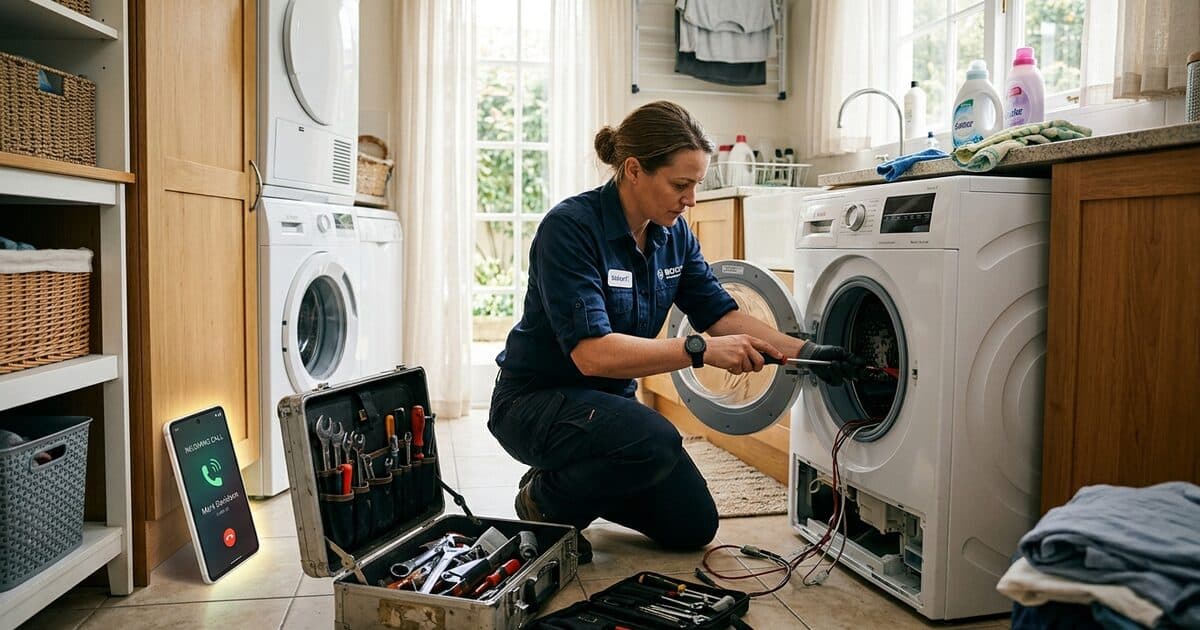
Appliance repair is a parts logistics business disguised as a repair business. The shops that grow are the ones that arrive with the right part — and that starts on the phone, with brand, model and symptom captured properly. An appliance repair answering service earns its keep by getting that intake right while you're elbows-deep in someone's dishwasher: complete job cards on your phone, for about 6¢ a minute.
The typical appliance repair shop is one or two technicians. The owner answers the phone between jobs, from inside a customer's kitchen, with a torx driver in the other hand — or doesn't answer it at all. In this trade a missed call is a job that books with the next company on the list, because a broken fridge does not wait for a callback.
What makes this trade different from plumbing or electrical is what a missed call costs beyond the job itself. A captured call with the model number taken properly is a first-visit fix. A vague message — "washing machine broken, call back" — is a diagnostic visit, a parts order, and a second trip. The quality of the phone intake decides which one you sell.
Urgent versus bookable
Appliance calls split cleanly, and the split matters:
- Water on the floor — a washing machine or dishwasher actively leaking. Damage by the minute; the caller needs shutoff guidance and the earliest slot you've got.
- Dead fridge or freezer — no water, but a few hundred dollars of food warming up. Same-day if possible, and the caller is calling everyone.
- Everything else — the squeaky dryer, the oven that runs hot, the ice maker that gave up. Annoying, not urgent. These callers happily book a slot two days out if someone actually books it.
A service that treats all three the same fails twice: it wakes you for the squeaky dryer, and it queues the flooding kitchen behind it. The right behaviour is triage from the caller's own words — the same emergency-versus-routine split covered in the emergency call answering service article — with the urgent two escalated to you immediately and the third booked into your calendar.
The model number is the job
Here is the intake detail that separates a useful message from a useless one. "My Bosch dishwasher won't drain" gets you most of the way to a diagnosis. "Dishwasher broken" gets you a phone call.
A good appliance repair answering service asks for the specifics the way a good dispatcher would:
- Appliance and brand — "what are we looking at?"
- Model number — "if you're near it, there's a sticker inside the door or on the back"
- The symptom in their words — "won't drain" and "won't start" are different parts bins
- Address and access — gate codes, parking, which floor
- Callback number, read back
That intake is what lets you arrive with the circulation pump already in the van. First-visit fixes are where the margin is in this trade, and they start on the phone.
What a dead-fridge call sounds like
Tuesday, 6:40pm, while you're finishing an install:
Milo: Harbor Appliance Repair — this is Milo. How can I help?
Caller: My fridge just stopped. The light works but it's not cold, and I literally just did a big grocery run.
Milo: Let's move fast on that — a full fridge gives you maybe four hours of safe temperature, so keep the door shut as much as you can. What brand is it?
Caller: It's a Samsung. A French door one.
Milo: If you can see the sticker inside the door frame, there's a model number starting with RF — can you read me that?
Caller: RF28R7351, something — RF28R7351SR.
Milo: Got it. Now your address and the best callback number?
Caller: 19 Claremont Avenue, and this number.
Milo: All set — Samsung RF28R7351SR, running warm with the light on, groceries at stake. I'm alerting the technician now; he'll call you back within the half hour to confirm tonight or first thing tomorrow.
You get the text: brand, model, symptom, address, urgency. The caller got a genuinely useful instruction — keep the door shut — and a timeframe. That is a saved job, and very probably a saved fridge.
Warranty, landlords and property managers
A slice of appliance calls comes with a third party attached: a home-warranty company that needs the claim number before you touch anything, a landlord who authorises the repair for a tenant's address, a property manager with thirty units who is about to become your best account if the intake goes smoothly.
These calls die on vague messages. "Warranty claim, call back" loses the job; "Reliance Home Warranty, claim 88231, authorised up to $500, tenant at 44B Walnut" is work you can schedule on the spot. Make sure whatever answers your phone knows which details your third-party calls need — that comes from the instructions and documents you give it, same as your pricing and service area.
What to test before signing
- 1
Call it with a dead fridge
Mention the groceries. The right response treats it as same-day urgent, captures brand and model, and tells the caller something useful about food safety. A message-taking service fails all three.
- 2
See if it asks for the model number
This is the single best test for this trade. If the intake doesn't naturally ask for brand and model, your first-visit fix rate stays where it is.
- 3
Call it with a tyre-kicker
"How much to fix a dryer?" The right answer captures details and books a diagnostic or offers a callback — not an invented price you never authorised.
- 4
Read the message you actually receive
Could you order the part from it? Appliance type, brand, model, symptom, address, number — if any are missing, you're paying for a callback generator.
What this costs in practice
Dial Milo runs the intake the way this article describes: urgency triage from the caller's own words, brand and model captured, your calendar booked for the routine jobs, and a text on your phone with the complete job card. It answers pricing and service-area questions from the documents you upload and refuses to quote work it can't price. Billing is per second of answered call time, about 6¢ a minute on a US number (2.6¢ carrier plus 3.5¢ AI), no subscription, no minimum, no charge for missed or spam calls.
Sixty answered calls a month at ninety seconds each: about $5.50. One first-visit fix done right instead of two trips covers that for months. The $1 trial credit buys about 16 minutes of real calls — run the dead-fridge test tonight. For how this compares to human services and subscription AI plans, see answering service cost; the HVAC answering service article covers the sister trade with the same intake problem.
For your business
Don't lose another $2,000 emergency to voicemail.
Milo picks up while you're on a roof, under a sink, or driving between jobs. She screens emergency vs scheduled, captures the address and callback number, and texts you the moment something's on fire — literally or otherwise.
Get Milo answering your trades lineFrequently asked questions
- What should an appliance repair answering service capture on every call?
- Appliance type, brand and model number, the symptom in the caller's own words, the address, and a callback number. The model number is the one most services miss — and it's the difference between arriving with the right part and scheduling a second visit. A good service asks for it naturally: 'while I book this, can you check the sticker inside the door?'
- Which appliance calls are actually urgent?
- Two kinds: anything leaking water onto a floor, and a dead fridge or freezer full of food. Both get worse by the hour and both callers book whoever answers first. A squeaky dryer or a slow dishwasher can wait for a scheduled slot — the service should book those, not wake you.
- What does an appliance repair answering service cost?
- Human services typically start around $250 a month with a minimum you pay regardless of call volume. Pay-as-you-go AI services bill per answered minute: at Dial Milo's published rate of about 6¢ a minute on a US number, sixty 90-second calls a month costs about $5.50, and the $1 trial credit covers roughly 16 minutes of real calls.
- Can it handle warranty and property-manager calls?
- Yes, if it's set up to. Warranty calls need the claim number and authorisation status captured; property-manager calls need the tenant's address plus who authorises the work. Both are intake variations the service handles from your instructions — the key is telling it which details matter for each caller type.
- Will callers be put off by an AI answering?
- Callers care about two things: did someone pick up, and did they get a booking or a useful answer. A natural voice that takes the model number and confirms a slot beats a ring-out or voicemail every time. The test that matters is what shows up on your phone afterwards — complete job details or a vague note.
Keep reading
Industries
HVAC answering service: emergency call triage
How an HVAC answering service separates a no-heat emergency from a routine call, and why one missed $400 emergency job costs more than a year of the service.
ReadAnswering Service
Emergency call answering service for 2am calls
How an emergency call answering service handles the 2am call: urgency recognised from plain speech, on-call alerted in seconds, for about 6¢ a minute.
ReadAnswering Service
Answering service cost: what you'll actually pay
What answering services really cost: a receptionist at $3,000–4,000 a month, traditional plans from $250 plus overages, or pay-as-you-go AI at cents a minute.
Read