Answering Service
Plumbing answering service for emergency calls
How a plumbing answering service handles the 11pm burst pipe: real triage, booked jobs, and cents per answered call instead of a $250 monthly minimum.
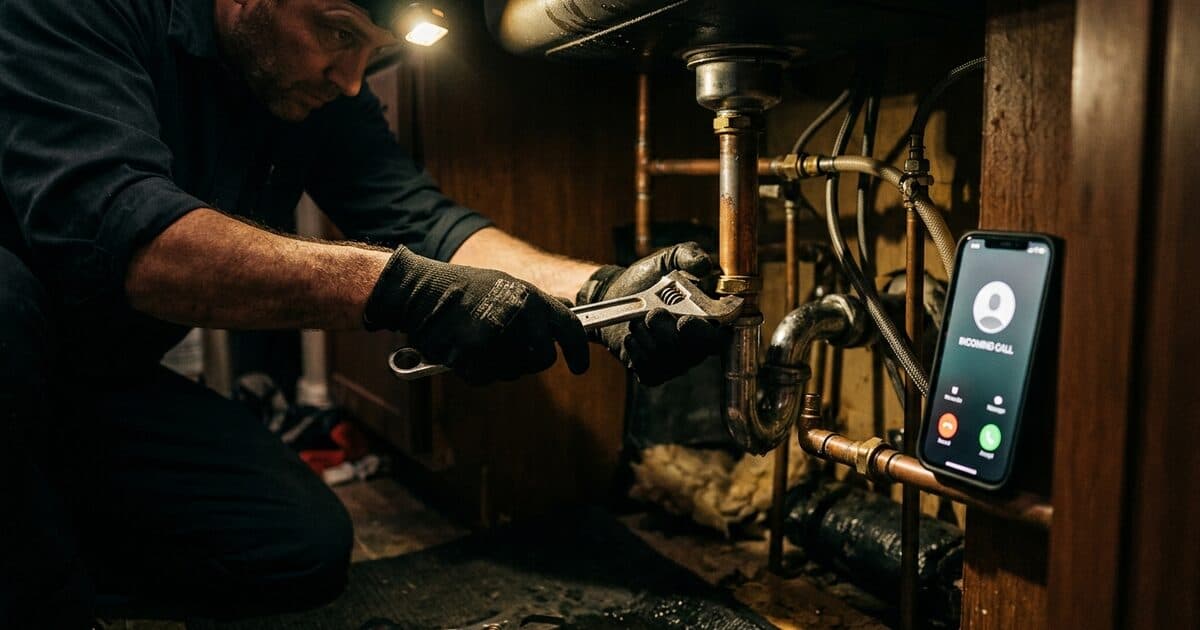
A plumbing answering service pays for itself on a single call type: the after-hours emergency. A burst pipe at 11pm books with whoever answers, at premium rates, and the call that captures it costs cents. The catch is that the service must actually triage — a burst pipe escalated to you immediately, a quote request captured for the morning — because a service that treats both the same way is just expensive voicemail.
Plumbing has the starkest version of the missed-call problem in the trades. When a pipe bursts, the homeowner does not leave a voicemail and wait. They hang up and call the next plumber on the list, and they keep calling until someone answers. That job — a $400 emergency callout, often more once the repair starts — went to whoever picked up. You never find out it existed.
Meanwhile the calls that are not emergencies still matter: water heater quotes, bathroom rough-ins, "how much to repipe a house." Those callers can wait for a callback, but only if someone takes their details properly. Two call types, two right responses, and the whole value of the service is in telling them apart.
The economics of the 11pm burst pipe
Run the numbers once and the decision makes itself. An emergency intake call lasts two to ten minutes. At pay-as-you-go rates of roughly 6¢ per answered minute, that call costs between 12¢ and 61¢. The job it captures is worth $400 and up — and emergency work at 11pm is premium-rate work, the highest-margin calls a plumber gets.
So one recovered emergency pays for months, often a year, of the service. This asymmetry is why plumbing is one of the few businesses where "never miss a call" is not marketing inflation: a handful of missed emergencies a year is a real five-figure loss, invisible because the callers never identify themselves.
The comparison that matters is not the monthly cost against zero. It is the monthly cost against one job.
Emergency versus quote: the triage that matters
The customer never says "this is an emergency." They say:
- "There's water pouring through my kitchen ceiling"
- "The toilet's overflowing and it won't stop"
- "We've got no water at all"
- "There's sewage coming up in the shower"
- "How much roughly to replace a water heater?"
Four of those need you alerted immediately, address and callback number captured first. The fifth needs details taken and a booked estimate or a morning callback. A plumbing answering service has to recognise the difference from ordinary speech, in either direction — waking you for a dripping tap is almost as bad as letting a burst pipe wait until Tuesday.
There is also a third behaviour that separates a real service from a message-taker: telling the caller something useful while they wait. "Turn off the water at the main shutoff valve — it's usually where the pipe enters the house, or by the water meter" is the difference between a contained leak and a ruined ceiling. This comes from your own uploaded information, so it reflects what you actually want callers told.
Gas smell on a water heater or boiler call is not an emergency booking — it is a safety call. Any service answering your phone must be instructed to tell the caller to leave the property and ring the emergency gas line, not to schedule a visit. Ask to see that instruction before you sign. The same triage logic, applied to heating, is covered in the HVAC answering service article.
What an emergency intake sounds like
A call at 11:20pm, while you are asleep:
Milo: Apex Plumbing — this is Milo. How can I help?
Caller: My water heater's leaking everywhere — there's water all over the garage floor.
Milo: That sounds urgent — let's get someone to you fast. While we do this: if the leak is heavy, turn off the cold-water valve on top of the heater, or the main shutoff for the house. Now — what's your name and the address?
Caller: Mike Carter, 412 Pine Street.
Milo: Best callback number, Mike?
Caller: This one.
Milo: Got it — 412 Pine Street, water heater leaking, water contained if the valve's off. I'm alerting the on-call plumber now and he'll call you right back.
You wake to a text with the name, address, number, and a summary — not a voicemail to transcribe at 6am. The customer got told what to do in the meantime, which is worth remembering when you price against a human service: an agent reading a script rarely improvises the shutoff instruction.
After-hours calls are your most valuable calls
Daytime calls, you mostly answer yourself or return within the hour. The after-hours block is where the value concentrates: evenings and weekends are when homeowners discover problems, when they are home to let you in, and when your competitors' phones go to voicemail too.
This is also where traditional answering-service pricing bites hardest. Human services commonly load nights and weekends — the exact hours you are buying cover for — on top of a $250-plus monthly minimum. An after-hours answering service that bills per answered minute costs the same at 2am as at 2pm, and costs nothing at all on the nights nobody calls.
What to capture on every call
Plumbing intake has a longer required list than most businesses, and a message missing any of it means a callback before you can even quote:
- Address, including access notes — gate codes, which entrance, parking
- Callback number, read back to confirm
- The problem in the customer's own words — "water heater leaking" quotes differently from "no hot water"
- How urgent, and whether property is actively being damaged right now
- Who authorises the work — owner, tenant, landlord — because a tenant calling about a rental changes what you can agree to
A service that reliably captures all five turns a missed evening into a job you can price on the way to the van. One that texts you "Mike, wants a plumber" has saved you nothing.
What to test before signing
- 1
Call it with a real emergency, in real words
“Water's coming through my ceiling.” Time how long until your phone buzzes, and read what the alert contains. That latency is the product.
- 2
Call it with a tyre-kicker
“Ballpark, what's a water heater replacement cost?” The right answer captures details and offers a callback or estimate slot. The wrong answer invents a price you never authorised.
- 3
Listen for the shutoff instruction
A genuine emergency response should tell the caller how to limit the damage. If it just takes a message, it does not understand plumbing calls.
- 4
Check the message you'd actually receive
Complete address? Correct number? Could you ring back and sound informed? Most services pass the voice test and fail this one.
What this costs in practice
Dial Milo is built around the emergency-versus-scheduled split: it recognises urgency from natural phrasing, captures address and callback number, texts you the moment something is urgent, and answers routine questions from the documents you upload — while refusing to quote work it cannot price. Billing is per second of answered call time, roughly 6¢ a minute on a US number, with no subscription, no minimum, and no charge for missed, blocked or spam calls. Forward your existing number free, or take a dedicated one for $3 a month, and the $1 trial credit on a new account buys about 16 minutes of real answered calls to test against.
Sixty answered calls a month at ninety seconds each: about $5.50. One 11pm burst pipe covers that for a year. The full pricing-model comparison, including where human services genuinely win, is in answering service cost.
For your business
Don't lose another $2,000 emergency to voicemail.
Milo picks up while you're on a roof, under a sink, or driving between jobs. She screens emergency vs scheduled, captures the address and callback number, and texts you the moment something's on fire — literally or otherwise.
Get Milo answering your trades lineFrequently asked questions
- What should a plumbing answering service do with an emergency call?
- Recognise it from the words customers actually use — burst pipe, water everywhere, sewage backing up, no water at all — capture the address and callback number, and alert you immediately rather than adding it to a message queue. It should also tell the caller something genuinely useful, like how to shut off the main, while they wait for your call.
- Is an after-hours plumbing answering service worth it?
- The after-hours calls are usually the most valuable ones a plumber gets, because emergency work carries premium rates and the caller books whoever answers. A single $400+ emergency callout pays for months of an AI answering service at cents per answered call — so the question is less whether it is worth it and more whether the service actually triages emergencies properly.
- What does a plumbing answering service cost?
- Human services typically start around $250 a month with a minimum you pay whether calls arrive or not, and some load nights and weekends — exactly when your emergency calls come. Pay-as-you-go AI services bill per answered minute with no minimum: at Dial Milo's published ~6¢/min, sixty 90-second calls a month costs about $5.50, and even a ten-minute emergency intake is about 61¢.
- Can an answering service tell a real emergency from a quote request?
- A good one can, because it triages from natural language rather than a menu. 'Water coming through the ceiling' triggers immediate escalation; 'how much to replace a water heater' gets details captured and a callback or a booked estimate. Test this before signing — call it with both, in real words, and watch what it does.
- Should emergency calls be dispatched to me at night or just messaged?
- That is a business decision, not a product feature, and you should decide it before you shop. Many plumbers want genuine emergencies escalated personally because the callout rates justify it, with quote requests held for morning. Others want everything captured and triaged at 7am. A proper service supports either and knows which it is doing.
Keep reading
Industries
HVAC answering service: emergency call triage
How an HVAC answering service separates a no-heat emergency from a routine call, and why one missed $400 emergency job costs more than a year of the service.
ReadAnswering Service
After hours answering service: what to know
What an after hours answering service costs, what happens to your 9pm callers without one, and how to choose between forwarding, a human service and AI.
ReadAnswering Service
Answering service cost: what you'll actually pay
What answering services really cost: a receptionist at $3,000–4,000 a month, traditional plans from $250 plus overages, or pay-as-you-go AI at cents a minute.
Read