Answering Service
Salon answering service for booked-out chairs
How a salon answering service books appointments while your hands are in a client's hair: real calendar slots, no phone tag — about 6¢ a minute.
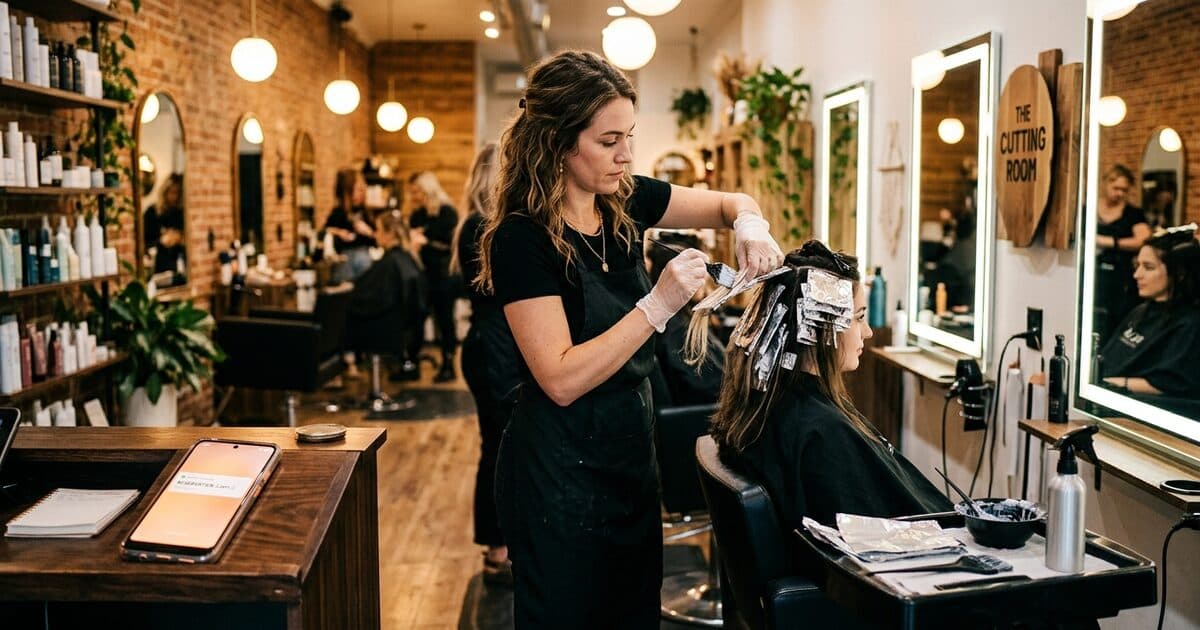
A salon is a business where everyone with clean hands is busy making someone else's hands dirty. The phone rings mid-foil, mid-fade, mid-massage — and the new client on the other end books the next salon on the list. A salon answering service turns those rings into booked slots in your real calendar for about 6¢ a minute, which makes it one of the cheapest chairs you'll ever fill.
Salon economics are simple: revenue is chairs times hours, and empty chair-hours are gone forever. The maths that hurts is the invisible kind — the new colour client who called during your 2pm full head, got no answer, and booked elsewhere. Colour work is the highest-value appointment most salons sell, typically $120 to $300 for a full service, and the client who books it once tends to rebook for years.
You can't answer mid-service, and clients know better than to leave voicemail. Hiring a front desk is the classic answer and the classic overkill: a whole salary to cover a phone that rings in bursts. The gap between those two — answer everything, hire nobody — is exactly what an answering service is for.
The booking call is the whole game
Almost every salon call is one of four things: a new booking, a reschedule or cancellation, a price or hours question, or a "do you do X?" question (extensions, keratin, bridal parties). Three of the four can be resolved completely on the spot if the service knows your services, your prices, and your calendar.
The one that matters most is the booking. A message-taking service converts "can I get a balayage next week?" into a note you answer at 9pm — by which time the client has booked somewhere else. A booking service converts it into a confirmed slot before the caller hangs up. The mechanics of what real booking looks like, and how to test it, are covered in answering service appointment scheduling.
What a booking call sounds like
Saturday, 11:15am, both stylists mid-appointment:
Milo: Lumen Hair Studio — this is Milo. How can I help?
Caller: Hi, do you do balayage? And what would that cost?
Milo: We do — a full balayage with toner starts at $180 and takes around three hours. Would you like to book a slot?
Caller: Yeah, maybe Thursday or Friday afternoon?
Milo: I have Thursday at 2pm with Sofia or Friday at 3:30pm with Dana. Which works?
Caller: Friday with Dana.
Milo: Booked — Friday at 3:30 with Dana for a full balayage. Since it's your first colour with us, we'll need a quick patch test at least 48 hours before; you can pop in any time Wednesday or Thursday. Can I take your name and number?
Caller: Jess Marlowe, this number.
Milo: All set, Jess. You'll get a text confirmation shortly — see you Friday.
Dana's Friday gap is filled, the price came from the salon's own rate card, the patch-test policy was mentioned unprompted, and nobody put down a brush. That call is what $0.12 buys.
Patch tests, cancellation windows, deposits for long appointments — every salon has policies that clients "never knew about." Upload them. A service that states your policy at booking time saves the awkward conversation at the chair, and it only knows your policies if you give them to it.
Cancellations are found money
The 7am "I can't make tomorrow" call feels like a loss until you realise what it's worth: a day of notice to refill a Saturday slot. An answering service that takes the cancellation properly — calendar updated instantly, you texted immediately, waitlist client offered the gap — turns a no-show into a rebooked hour. One that leaves the slot looking busy until you check messages at 6pm turns it into nothing.
The same logic covers the awkward calls: the regular moving her standing appointment, the bride pricing a party of six, the walk-in asking if anyone's free now. Each gets a complete, correct answer from your own information — the thing a distracted "sorry, we're with clients, can you call back" never delivers.
What to test before signing
- 1
Book yourself as a new client
Ask for a service, hear your real price quoted from your rate card, pick a real gap, hang up with a confirmed slot. If any step involves "someone will call you back," it fails.
- 2
Cancel as an existing client
The slot should free up in your calendar within seconds, with a text to you. That refill speed is the feature.
- 3
Ask a policy question
"Do I need a patch test?" or "What's your cancellation policy?" The answer should be yours, verbatim in spirit. An invented policy is worse than none.
- 4
Test a Saturday surge
Three calls in ten minutes is a normal Saturday. Ask how concurrent calls are handled — a booking bottleneck during your busiest hour is a step backwards.
What this costs in practice
Dial Milo answers on the second ring, quotes your services and prices from documents you upload, books into your connected calendar, handles reschedules and cancellations against your real availability, and texts you when something needs a human. Billing is per second of answered call time, about 6¢ a minute on a US number (2.6¢ carrier plus 3.5¢ AI), with no subscription, no monthly minimum, and no charge for missed, blocked or spam calls.
Forty two-minute booking calls in a month: under $5. One balayage that would have rung out pays for a year. The $1 trial credit buys about 16 minutes of real calls — enough to book yourself a Friday slot and see what lands in the diary. For the numbers against human services and subscriptions, see answering service cost and the budget-buyer breakdown in affordable answering service.
For your business
Cut hair, not phone calls.
Milo answers while your hands are in someone's hair. She books appointments directly into your Google Calendar, knows your pricing, and reschedules without a hold queue. Sounds warm, never mechanical.
Get Milo answering your salon lineFrequently asked questions
- Why do salons miss so many booking calls?
- Because everyone who could answer is mid-service: hands in hair, gloves on, colour processing. A solo stylist or small salon has no front desk at all, and the call that rings out during a balayage is usually a new client who books the next salon instead. You find out weeks later, as a gap in the diary you can't explain.
- What should a salon answering service capture on a booking call?
- The service they want, which stylist if it matters, their preferred times, whether they're a new or existing client, and a callback number — then a real slot booked into your calendar. New clients should also get the practical details: patch-test policy for colour, how long the appointment takes, what it costs, from your published prices.
- What does a salon answering service cost?
- Human services typically start around $250 a month — more than most solo stylists can justify. Pay-as-you-go AI services bill per answered minute: at Dial Milo's published rate of about 6¢ a minute on a US number, a two-minute booking call costs roughly 12¢, and a month of forty such calls is under $5.
- Can it handle cancellations and reschedules?
- Yes — a cancellation taken at 7am means the slot can be refilled by 9am, which is found money on a fully-booked Saturday. The service should update your calendar directly and tell you immediately, not leave the slot looking taken until you check a message inbox.
- Will clients mind that an AI answered?
- Clients mind ringing out and playing phone tag; they don't mind a voice that books them in on the spot. What they remember is that your salon answered, knew the services and prices, and gave them a confirmed time — which is more than most salon phones manage during a busy Saturday.
Keep reading
Answering Service
Answering service appointment scheduling
How an answering service with appointment scheduling writes bookings to your real calendar, avoids double-booking, and beats a callback message every time.
ReadAnswering Service
Affordable answering service: the honest math
What an affordable answering service really costs: a receptionist at $3,000+ a month, plans from $250 with minimums, or ~6¢ a minute with a $1 trial.
ReadAnswering Service
Answering service cost: what you'll actually pay
What answering services really cost: a receptionist at $3,000–4,000 a month, traditional plans from $250 plus overages, or pay-as-you-go AI at cents a minute.
Read