Answering Service
Towing answering service for roadside calls
How a towing answering service dispatches the 1am highway breakdown: mile-marker location, vehicle details, driver alerted — for about 6¢ a minute.
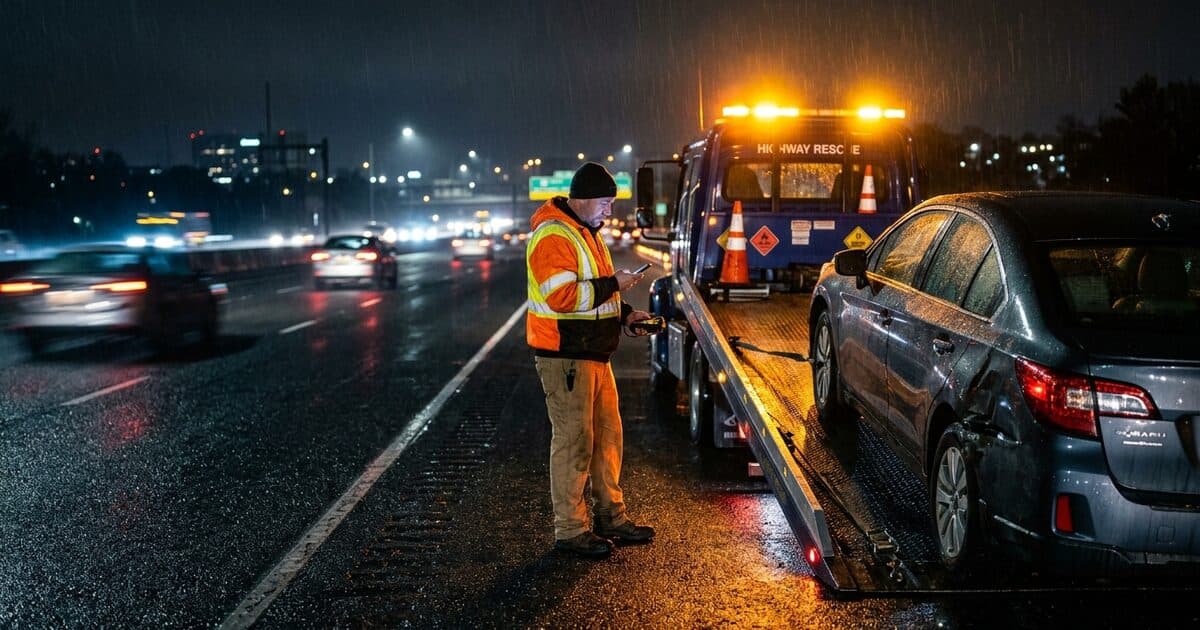
Towing is the purest answering-service business that exists. Every call is urgent, the caller books whoever answers first, and the person who would answer the phone is under a car or behind the wheel. A towing answering service pays for itself if it does one thing: turn "no answer, next company" into a captured location, a vehicle description, and a text on the driver's phone within seconds — for cents a call.
Nobody calls a tow truck to browse. The caller is on a hard shoulder with traffic going past, or in a car park at midnight with a dead battery and a kid in the back seat. They found your number in a search result, and if you don't answer they are already tapping the next one. There is no callback window, no "they'll leave a message." In towing, the answer rate and the booking rate are the same number.
Meanwhile the economics of a one-or-two-truck operation make answering impossible exactly when it matters. The driver is winching, strapping, driving. Hiring a dispatcher for the night shift costs more than the night shift brings in for most small operators. That gap — between a business that must answer 24/7 and a crew that physically can't — is the entire case for a towing answering service.
The call that decides your night
A retail tow — the motorist who found you directly — typically runs $75 to $150 for a local hook-up, more for distance or a flatbed. It is also the highest-intent call any small business gets: the person is stranded now and pays now.
The calls do not spread evenly across the day. They cluster: rush hour, Friday and Saturday nights, the first cold snap that kills every weak battery in town at once. A service that charges a flat monthly minimum makes you pay for the quiet weeks; one that bills per answered minute costs nothing on a slow Tuesday and about 18¢ for a three-minute dispatch call on the Saturday rush.
Location is the whole job
Towing intake has a problem no other trade has: the caller often doesn't know where they are. "I'm on the highway" is not a location. A message that says "Dave, broken down, call back" means ringing a stressed stranger and starting from zero.
A real towing answering service works the location out with the caller:
- Nearest exit or junction — "what did the last sign say?"
- Mile marker — "can you see a small green sign?"
- Direction of travel — "which way were you heading?"
- Landmark fallback — a petrol station, a bridge, anything the driver can find on a map
Then the rest of the dispatch card: vehicle make and model, what happened, where the car is going, and a callback number read back for confirmation. That is the difference between rolling the truck straight to the pin and playing phone tag while your caller books someone else.
What a 1:40am breakdown call sounds like
Milo: Redline Towing — this is Milo. How can I help?
Caller: My car just died on the interstate. I can hear it clicking but it won't turn over.
Milo: Okay — if you're on the shoulder, stay in the car with your seatbelt on and hazards going. Let's get a truck to you. Do you know roughly where you are — the last exit or a mile marker?
Caller: Uh — I passed exit 214 a few minutes ago. Heading north.
Milo: North of exit 214, northbound side — good. What's the vehicle?
Caller: A 2016 Honda CR-V. Blue.
Milo: And where is it going — home, a garage?
Caller: There's a tyre place near my house, I'll give the driver the address.
Milo: Perfect. Best callback number — this one? Got it. Blue 2016 CR-V, northbound just past exit 214, clicking but won't start. I'm alerting the driver now and he'll call you with an ETA in the next few minutes.
You get a text with everything you need to roll: location worked out to a findable pin, vehicle, problem, destination, number. The caller got a safety instruction and a promise with a name behind it.
The safety instruction is not decoration. A caller standing outside a car on a live highway is in real danger, and what your phone answerer tells them in the first ten seconds matters. Whatever service you use, make sure its first move on a roadside call is "stay in the car, hazards on" — and check the instruction yourself with a test call before you trust it.
Retail versus rotation
One honest boundary: police-rotation and motor-club work comes through its own dispatch channels, with its own scripts and clock rules, and no answering service replaces that pipe. What an answering service changes is the retail side — the direct calls that small operators lose to voicemail at night. For most one-to-three-truck companies, retail is the margin, and it is precisely the work that evaporates when nobody picks up.
It is also the side where the emergency call answering service rules apply in full: urgency recognised from plain speech, location and number captured first, the driver alerted in seconds, and something useful said to the caller while they wait.
What to test before signing
- 1
Call in a breakdown with a vague location
"I'm broken down on the highway somewhere past the mall." Watch whether the service works the caller to a real location — exit, marker, direction — or just writes "on the highway."
- 2
Check the dispatch text, not the demo
After the test call, read what actually arrived on your phone. Location, vehicle, problem, destination, callback number — all five, in seconds? Or a vague note you'd have to call back to decode?
- 3
Listen to the first ten seconds
A roadside call should open with a safety instruction, not a questionnaire. If it starts with "can I take a message," it does not understand towing calls.
- 4
Test the surge
Breakdowns cluster in cold snaps and Friday nights. Ask what happens when five calls arrive in ten minutes, and whether a monthly minute block can run out mid-surge — that is exactly when you cannot afford it to.
What this costs in practice
Dial Milo answers the calls you physically can't: it works a vague roadside description into a usable location, captures the vehicle and destination, texts you the dispatch card within seconds, and answers routine questions — hours, coverage area, prices you have published — from the documents you upload. Billing is per second of answered call time, about 6¢ a minute on a US number (2.6¢ carrier plus 3.5¢ AI), with no subscription, no monthly minimum, and no charge for missed, blocked or spam calls.
A three-minute breakdown call costs roughly 18¢. A $110 tow pays for a month of ordinary volume by itself, and the nights nobody breaks down cost you nothing. The $1 trial credit buys about 16 minutes of real calls — enough to stage tonight's test breakdown from a friend's phone. For the cost comparison against human dispatch services, see answering service cost; the after-hours answering service article covers the evening and weekend pattern in general.
For your business
Don't lose another $2,000 emergency to voicemail.
Milo picks up while you're on a roof, under a sink, or driving between jobs. She screens emergency vs scheduled, captures the address and callback number, and texts you the moment something's on fire — literally or otherwise.
Get Milo answering your trades lineFrequently asked questions
- Why do towing companies miss so many calls?
- Because the person who would answer is the person doing the work. The driver is winching a car onto the bed, strapping it down, or driving the last tow — one-person operations especially. Every unanswered call is a stranded motorist who dials the next company within seconds, so the missed-call rate is the lost-job rate.
- What should a towing answering service capture on a breakdown call?
- Location first — and for highway calls that means working it out with the caller: nearest exit, mile marker, direction of travel. Then vehicle make and model, the problem, where the car is going, and a callback number. A message missing the location or the destination is a callback before you can even roll the truck.
- What does a towing answering service cost?
- Human dispatch services typically start around $250 a month with minimums you pay in quiet weeks. Pay-as-you-go AI services bill per answered minute: at Dial Milo's published rate of about 6¢ a minute on a US number, a three-minute dispatch call costs roughly 18¢, and a slow Tuesday costs nothing.
- Can an answering service handle police-rotation or motor-club calls?
- Rotation and club calls follow strict scripts and ETAs, and the reliable ones arrive through their own dispatch channels rather than your public line. What an answering service handles well is the retail side — the stranded motorist calling your number directly — capturing the job cleanly and alerting you immediately.
- How fast does the driver get alerted?
- With a proper service, seconds after the caller hangs up — a text with the location, vehicle, problem, destination, and callback number. Test this before signing: call in a fake breakdown at night and watch what arrives on your phone and when.
Keep reading
Answering Service
Emergency call answering service for 2am calls
How an emergency call answering service handles the 2am call: urgency recognised from plain speech, on-call alerted in seconds, for about 6¢ a minute.
ReadAnswering Service
Locksmith answering service for lockouts
Lockouts are speed-to-answer races. How a locksmith answering service picks up first, captures lock type and car make, filters spam, and bills per minute.
ReadAnswering Service
After hours answering service: what to know
What an after hours answering service costs, what happens to your 9pm callers without one, and how to choose between forwarding, a human service and AI.
Read