Answering Service
Pest control answering service for panic calls
How a pest control answering service turns wasp-nest panic calls into booked jobs while you're driving between sites, for cents per answered call.
A pest control answering service exists for one reason: the wasp-nest and bedbug panic calls book with whoever answers first, and that is usually not you — you are driving between jobs with gloves on. The right service answers in seconds, books the job into your real calendar, absorbs the seasonal surge without a monthly minimum, and costs a few cents per answered call.
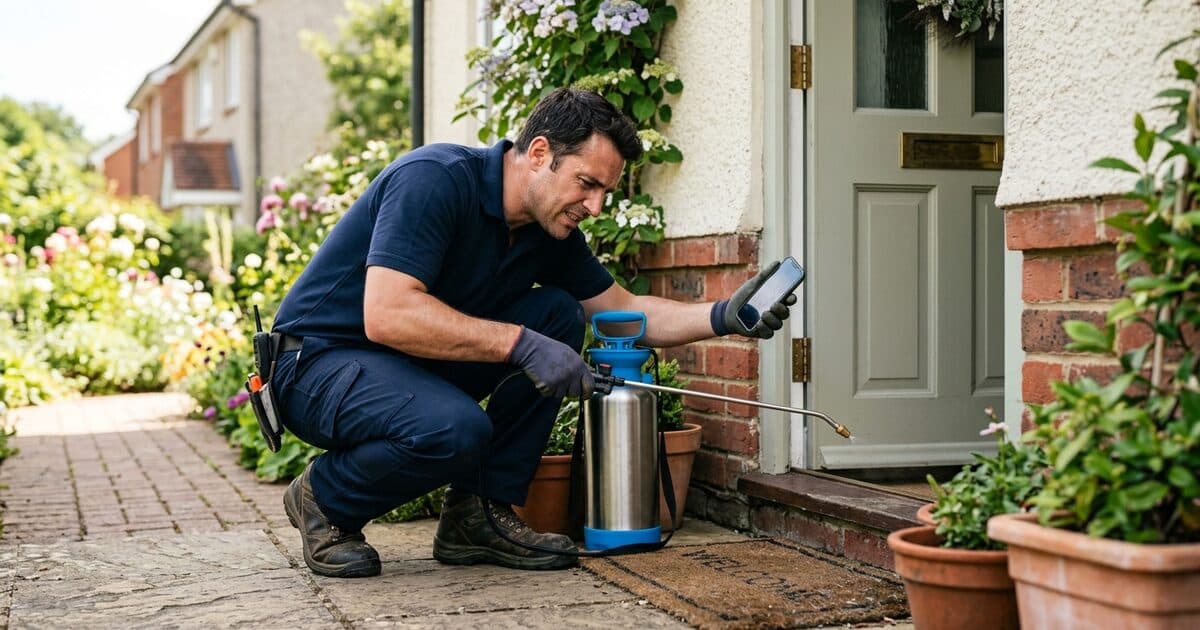
Pest control's phone problem is a vehicle problem. Your day is a route: treat a flat, drive twenty minutes, treat a restaurant, drive again. The phone rings constantly and you are never in a position to answer it properly — gloves on, sprayer in hand, or on a customer's driveway. Meanwhile the calls coming in are not patient ones. Nobody discovers a wasp nest over the back door or bedbugs in the spare room and thinks "I'll leave a voicemail and see who calls back." They call the next name on the list.
So the question is not whether to miss fewer calls in the abstract. It is who answers the panic calls while you are on the road.
Panic calls book with whoever answers
The high-value call in pest control is short, emotional and immediate: wasps swarming the kids' bedroom window, a rat seen in the kitchen, bedbug bites discovered at midnight. The caller's behaviour is consistent — search, call down the list, book the first business that answers and confirms a slot. A wasp treatment might bill $150–300, a bedbug programme $500–1,500, a rodent proofing job more. The call that decides it lasts two minutes.
A service that answers that call and books it costs about 12¢ at pay-as-you-go rates. A service that takes a message you return in an hour has mostly watched the job drive away — the caller has already been booked by the competitor who picked up.
What a wasp-nest call sounds like
A call at 6:15pm, while you are between jobs:
Milo: Clearline Pest Control — this is Milo. How can I help?
Caller: We've got a wasp nest right above our back door and there are wasps everywhere. Can someone come out?
Milo: Yes — and until we get there, keep the door closed and keep kids and pets away from that side of the house; don't try to knock the nest down yourself. I can book a visit for you now. Would tomorrow morning or tomorrow afternoon work?
Caller: Morning, please — as early as possible.
Milo: You're booked for tomorrow between 8 and 10am. Can I confirm your name, the address, and the best number to reach you?
Caller: Priya Shah, 14 Alder Grove, this number.
Milo: Booked — 14 Alder Grove, wasp nest above the back door, visit tomorrow 8–10am. You'll get a confirmation text shortly.
You get a text with the name, address, number, and job summary. The caller hangs up booked and reassured instead of dialing your competitor. And when you arrive, you already know it is an accessible exterior nest over a door — you are not walking in blind.
Exterminator answering service: same phone, same problem
Callers do not distinguish. The person ringing about mice says "exterminator," the one ringing about wasps says "pest control," and both are describing the same need to the same phone line. An exterminator answering service and a pest control answering service are one product with two names — what matters is that it recognises both vocabularies, plus the panicked versions: "something is scratching inside the wall," "I found bites in rows," "there's a nest and I don't know what it is."
That recognition has to come from natural speech, not a phone menu. A caller mid-panic will not press 2 for rodents. They describe what they saw, and the service either understands it or loses them.
Seasonal surges are the pricing trap
Pest control demand arrives with the weather, twice a year. The first warm fortnight of summer triples wasp calls, exactly when you are booked solid and least able to answer. Autumn brings the rodent migration indoors. Then January is nearly silent.
This shape is why the monthly-minimum model fits pest control so badly. A human answering service sized for your July surge charges the same $250-plus through your dead months — dead money for a seasonal business. Per-minute billing with no minimum scales with the season instead: surge weeks cost more, winter costs almost nothing, and the annual total lands far lower. The same seasonal trap hits exterior painters — the painter answering service article runs the same math — and the full pricing-model comparison is in answering service cost.
Pest control after hours answering
Bedbugs are discovered at midnight. Rats appear when the kitchen lights go on at 10pm. Restaurant and Airbnb hosts call after close, because that is when they see the problem and when they can talk. Pest control after hours answering is not a premium extra — it is when a large share of the most motivated callers ring.
An after-hours answering service that bills per answered minute costs the same at 11pm as at 11am, and nothing on quiet nights. That matters in a trade where the after-hours caller is often the most desperate to book — and where human services typically load nights and weekends on top of their minimum, charging you most for the hours you most need covered.
The renewal calls are quiet money
Panic calls get the attention, but a pest control business on recurring plans lives on renewals. Quarterly-plan customers call to reschedule a visit, ask whether a treatment covers ants as well as spiders, or say they are thinking of cancelling. Each of those is answerable or bookable without you: coverage questions from your own uploaded documents, reschedules written into your calendar, cancellation risks flagged to you with the customer's details so you can call back personally.
A $400-a-year plan lost to an unanswered phone costs more than the answering service does all year. The renewal calls are where "answered by software" quietly beats "rang out to voicemail."
Where an AI receptionist is not the answer
Worth stating plainly. A customer mid-dispute about a failed treatment should reach you, not software — that call is retention work and needs your judgment. And a large commercial contract enquiry, a restaurant chain wanting a service agreement, deserves a personal callback with the details captured properly, not a scripted booking. The right configuration answers everything and hands off the calls that need you, and anything you evaluate should make that handoff obvious when it happens.
What to test before signing
- 1
Call it in a panic
“There's a wasp nest by my door, can someone come today?” Does it book a real slot in your real calendar, or take a note? The difference is the whole product.
- 2
Ask a coverage question from your own materials
Something your service list answers — what a quarterly plan covers, whether you handle moles. It should answer from your documents, not invent one, and offer a callback when it genuinely does not know.
- 3
Try to reschedule a plan visit
Confirm it writes the new slot to your calendar rather than logging a request for someone to key in later.
- 4
Check the written message
Name spelled right, address complete, number read back and correct? Could you arrive at the job already knowing the problem? Most services pass the voice test and fail this one.
What this costs in practice
Dial Milo answers in seconds, books jobs into your Google Calendar, answers coverage and preparation questions from the documents you upload, and texts you the caller's details the moment they hang up. It bills per second of answered call time — roughly 6¢ a minute on a US number — with no subscription, no minimum, and no charge for missed, blocked or spam calls. Forward your existing number free, or take a dedicated one for $3 a month. New accounts start with a $1 trial credit, about 16 minutes of answered calls, so testing it against real callers costs nothing.
Sixty answered calls a month at ninety seconds each comes to about $5.50. One bedbug programme pays for a year of that several times over. For a trade where emergencies dominate more than they do here, the HVAC answering service article covers the triage side in more depth.
For your business
Don't lose another $2,000 emergency to voicemail.
Milo picks up while you're on a roof, under a sink, or driving between jobs. She screens emergency vs scheduled, captures the address and callback number, and texts you the moment something's on fire — literally or otherwise.
Get Milo answering your trades lineFrequently asked questions
- How do pest control companies handle calls while driving between jobs?
- Mostly badly, because the honest options are limited: let it ring to voicemail and lose the panic callers, pull over for every call and lose an hour a day, or have someone answer for you. A pest control answering service is the version that scales — and at cents per answered call, an AI receptionist is usually the only version whose economics make sense for a one-to-five-person operation.
- Should a pest control answering service book jobs directly or take messages?
- Book directly, if it can write to your real calendar. A wasp nest over a child's bedroom or a bedbug discovery is a book-now call — the caller phones down the list and books whoever confirms a slot first. A message you return in an hour is often a job already given to a competitor.
- What does a pest control answering service cost?
- Human services typically start around $250 a month with a minimum you pay whether calls arrive or not — hard to justify through the quiet winter. Pay-as-you-go AI services bill per answered minute with no minimum: at Dial Milo's published ~6¢/min, sixty 90-second calls a month costs about $5.50, and a dead February costs almost nothing.
- Can it handle seasonal surges like summer wasps or autumn rodents?
- Seasonality is where per-minute billing wins over a monthly minimum. The first warm fortnight can triple wasp call volume exactly when you are fully booked and least able to answer; a minimum-based human service charges the same through your dead months. Per-minute billing scales with the season — surge weeks cost more, winter costs almost nothing, and the annual total lands far lower.
- What should it do with recurring-plan renewal and rescheduling calls?
- Existing customers on quarterly plans call to reschedule visits, ask what a treatment covers, or renew. A good service answers coverage questions from documents you upload, books the rescheduled visit into your calendar, and captures renewal intent so you can close it — instead of losing a $400-a-year plan to an unanswered phone.
Keep reading
Industries
HVAC answering service: emergency call triage
How an HVAC answering service separates a no-heat emergency from a routine call, and why one missed $400 emergency job costs more than a year of the service.
ReadAnswering Service
After hours answering service: what to know
What an after hours answering service costs, what happens to your 9pm callers without one, and how to choose between forwarding, a human service and AI.
ReadAnswering Service
Answering service cost: what you'll actually pay
What answering services really cost: a receptionist at $3,000–4,000 a month, traditional plans from $250 plus overages, or pay-as-you-go AI at cents a minute.
Read