Answering Service
Restaurant answering service for the Friday rush
How a restaurant answering service takes reservations during service: tables booked, large parties captured, hours and menu questions answered — ~6¢ a minute.
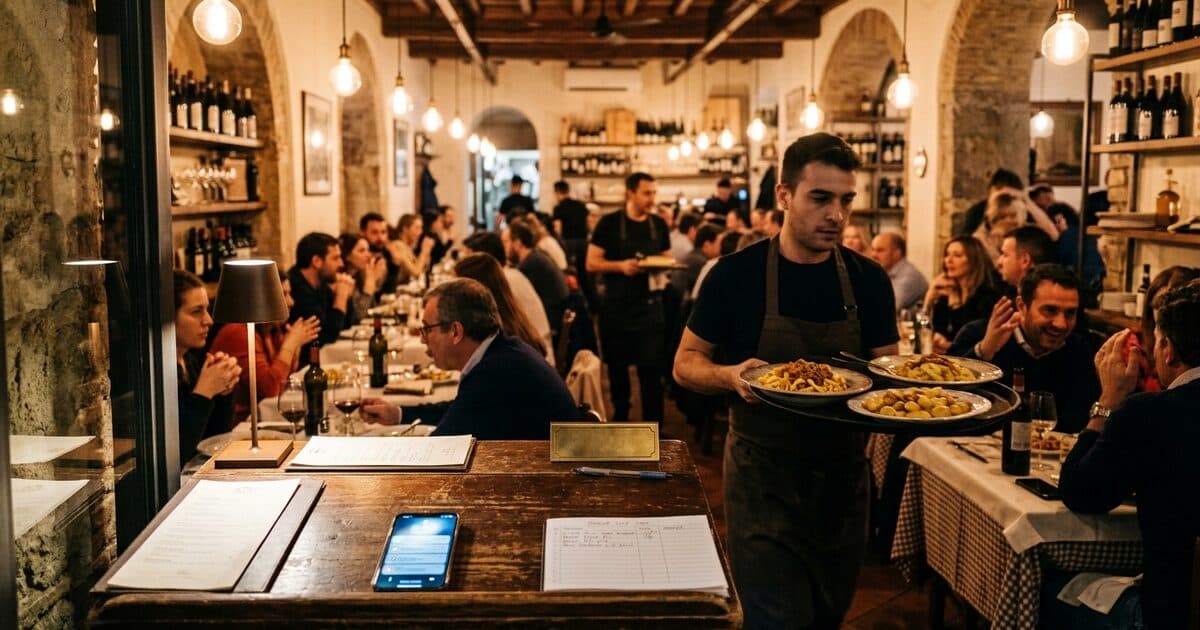
Restaurants lose bookings to a phone that rings during service, when every hand is carrying plates. The fix isn't hiring someone to stand by the phone — it's a service that answers on the second ring, books the table into your real availability, and answers the hours-and-menu questions from your own information. At about 6¢ per answered minute, a fully-booked Friday's worth of calls costs less than a coffee.
Friday, 6:45pm. The walk-in queue is four deep, table 12 wants the bill, the kitchen just called 86 on the sea bass — and the phone rings. Whoever that is, they're about to learn your restaurant doesn't answer, and they'll book the place two doors down while still standing in their kitchen deciding. Covers lost this way never show up anywhere; you just run a slightly softer Friday than you should have.
This is the oldest unsolved problem in small restaurants. The phone matters most exactly when the team can least afford to touch it. The classic fixes all have a catch: a dedicated host for the phone is a salary against thin margins, online-only booking loses the callers — and there are plenty, especially for larger parties and older regulars — and ignoring it is the status quo that quietly costs you a table or two a night.
The calls, in order of value
Reservations. The core call: party of two, tonight, 7:30 if you have it. An answering service that checks your real availability and confirms on the spot converts intent into a booking before the caller's finger finds the next number. Note this article is about the answering layer; if you're weighing the phones themselves, see restaurant phone systems.
Large parties and events. "Table for twelve next month, it's my mum's 70th." High value, high detail, and the worst possible call to take as a scribbled note. The right handling is full capture — size, date, occasion, dietary needs, budget hints — flagged to you for a personal callback, with nothing promised you haven't priced.
The questions. Hours, parking, gluten-free options, "do you take walk-ins," "are you open bank holiday Monday." Each one is thirty seconds of a staff member's dinner service, multiplied by twenty calls a week. Answered from your own published information, they cost seconds and interrupt nobody.
What a Friday-rush call sounds like
Milo: Trattoria Belvedere — this is Milo. How can I help?
Caller: Hi, do you have a table for four tonight, around 7:30?
Milo: Let me check — I can do 7:15 or 8:45 for four tonight. Would either work?
Caller: 7:15 is perfect.
Milo: Booked — four guests at 7:15 this evening. Can I take a name and a contact number?
Caller: The Delaney family, and this is the best number.
Milo: Lovely. Anything I should note — high chair, dietary requirements, an occasion?
Caller: Actually yes, one gluten-free.
Milo: Noted — one gluten-free guest, and the kitchen has solid options. You're all set, the Delaneys at 7:15. See you tonight.
Thirty seconds, no interruption to the floor, a booking in the system with the dietary note attached, and a family that walks in expecting to be looked after — because they will be.
Where the line is
An answering service is the front-of-house phone, not the till. It should not be punching collection orders into your POS or improvising tonight's specials. Set the boundary explicitly: bookings, information, and captured enquiries flow through it; anything involving money or tonight's 86 board routes to a human or your online ordering. The services that disappoint are the ones set up without that line drawn.
The same logic applies to promises. "Do you do a set menu for groups?" is answerable from your documents. "Can you seat twelve on the terrace at sunset?" is a judgement call for the manager — the right response is a captured enquiry and a fast callback, not a yes you'll regret. More on how calendar-integrated booking behaves under test in answering service appointment scheduling.
What to test before signing
- 1
Book a table as a test caller
Ask for tonight at a busy time. The service should offer only real gaps, confirm a specific time, take name and number, and have the booking in your system before you hang up.
- 2
Ask your three most common questions
Hours, parking, dietary. Every answer should match your published information exactly. An AI that improvises your allergen policy is a problem, not a feature.
- 3
Leave a large-party enquiry
Twelve people, an occasion, a date. You want a complete captured enquiry flagged to you in seconds — size, date, occasion, contact — not a booking made beyond your rules.
- 4
Call during a simulated rush
The point of the thing is the rush. If the demo only works when you're quiet, it solves the wrong problem. Test it at 6:45pm on a Friday, for real.
What this costs in practice
Dial Milo answers on the second ring, books tables against your real availability, answers hours and menu questions from your uploaded information, captures large-party enquiries in full, and texts you when a call needs a human. Billing is per second of answered call time, about 6¢ a minute on a US number (2.6¢ carrier plus 3.5¢ AI), with no subscription, no monthly minimum, and no charge for missed, blocked or spam calls.
Twenty reservation calls on a busy Friday at ninety seconds each: about $1.85, against tables that average far more than that per cover. The $1 trial credit buys about 16 minutes of real calls — run tonight's service as the test. For the comparison against human services and flat subscriptions, see answering service cost.
For your business
Your phone doesn't ring during dinner rush. Now it does — and Milo picks it up.
Reservations, hours, dietary questions, large-party catering. Milo handles the routine calls so your servers stay on the floor instead of stuck behind the host stand.
Get Milo answering your restaurant lineFrequently asked questions
- Why do restaurants miss so many calls?
- Because calls cluster exactly when nobody can answer: the lunch and dinner rush. The host is seating a queue of walk-ins, the manager is in the kitchen, and the phone rings out. Studies of restaurant behaviour aside, anyone who has run a Friday service knows the phone is the first thing sacrificed — and every unanswered ring is a cover that ate somewhere else.
- What should a restaurant answering service handle?
- Reservations first: party size, date, time, name, number, any occasion or dietary note, booked into your actual availability. Then the high-volume questions — opening hours, parking, dietary options, whether you take walk-ins — answered from your published information. Large-party and private-event enquiries should be captured in full and flagged to you, not quoted.
- What does a restaurant answering service cost?
- Human services typically start around $250 a month, which is a hard sell against food-cost margins. Pay-as-you-go AI services bill per answered minute: at Dial Milo's published rate of about 6¢ a minute on a US number, a ninety-second reservation costs roughly 9¢, and a quiet Monday costs nothing.
- Can it take orders for collection or delivery?
- A phone answering service is not a POS system — it shouldn't be punching in orders. What it can do is tell callers how to order (your own number of covers permitting), take a name and number for a callback, or direct them to your online ordering. Keep order-taking in your till; let the service handle bookings and questions.
- Will regulars be put off by an AI answering?
- Regulars are put off by ringing out three Fridays in a row. A voice that answers on the second ring, knows your hours and your menu basics, and confirms their table on the spot is a better experience than the phone screaming behind a busy host stand — and they still get a human the moment they walk in.
Keep reading
Industries
Restaurant phone systems and the dinner rush
Why restaurant phones get missed at exactly the wrong moment, what a phone system can and can't fix, and how to stop losing reservations during service.
ReadAnswering Service
Answering service appointment scheduling
How an answering service with appointment scheduling writes bookings to your real calendar, avoids double-booking, and beats a callback message every time.
ReadAnswering Service
Answering service cost: what you'll actually pay
What answering services really cost: a receptionist at $3,000–4,000 a month, traditional plans from $250 plus overages, or pay-as-you-go AI at cents a minute.
Read