An AI voice agent is software that holds a spoken phone conversation, understands what the caller says, and takes a business action such as answering a question, booking an appointment or logging a message.
Your phone rings while you're finishing a job, helping a patient or checking in a guest. Meanwhile, yesterday's enquiries still need callbacks, and customers who haven't returned need thoughtful follow-up. The useful question isn't whether software can sound friendly. It's which conversations you can safely delegate, what permission you need and whether the completed work earns more than it costs.
What an AI Voice Agent Is
Say a customer calls a salon to move an appointment. They don't know the booking reference, change their preferred day halfway through and ask whether the same stylist is available. A useful agent keeps track of that conversation, checks the diary and confirms the change rather than restarting after every answer.
Think of it as a receptionist who never goes to lunch, follows an approved script and can check the diary while still on the line. The analogy has limits: software doesn't have a receptionist's judgement. You must define what it may answer, what it may change and when someone should take over.
How it differs from older phone tools
Older systems can help route or inform callers, but they don't necessarily complete the caller's task.
| Tool | What it does | What's different about a voice agent |
|---|---|---|
| Button-based phone menu | Routes callers through fixed choices | Accepts a spoken explanation |
| Prerecorded message | Plays information | Can handle follow-up questions |
| Text chatbot | Exchanges written messages | Conducts the interaction aloud |
Earlier voice assistants mainly responded to isolated commands. Current business agents can carry information across several conversational turns, collect missing details and use connected tools to complete an approved action. That's the difference between announcing opening hours and arranging a visit.
Grand View Research's market report describes rapid projected growth and identifies inbound voice agents as the largest reported revenue category. Published market estimates differ widely because analysts include different combinations of assistants, contact-centre software and autonomous agents. Treat the direction as useful context, not a reason to trust a particular market valuation.
Practical rule: Judge an agent by the business action it completes correctly, not by how convincing its greeting sounds.
There are two directions to consider. Inbound calls arrive at your business, usually because someone wants help now. Outbound calls originate from your business and reach your own customers, leads or contacts, only with their consent. The underlying conversation technology may be similar, but permission, scheduling and measurement require different operating decisions.
How an AI Voice Agent Handles a Call
Consider a customer calling an auto repair shop to book a service. A successful conversation requires more than recognising the word booking. The agent must identify the requested service, gather the right details, find a suitable opening and avoid confirming anything the calendar hasn't accepted.
This diagram shows the overall path from spoken request to completed action.
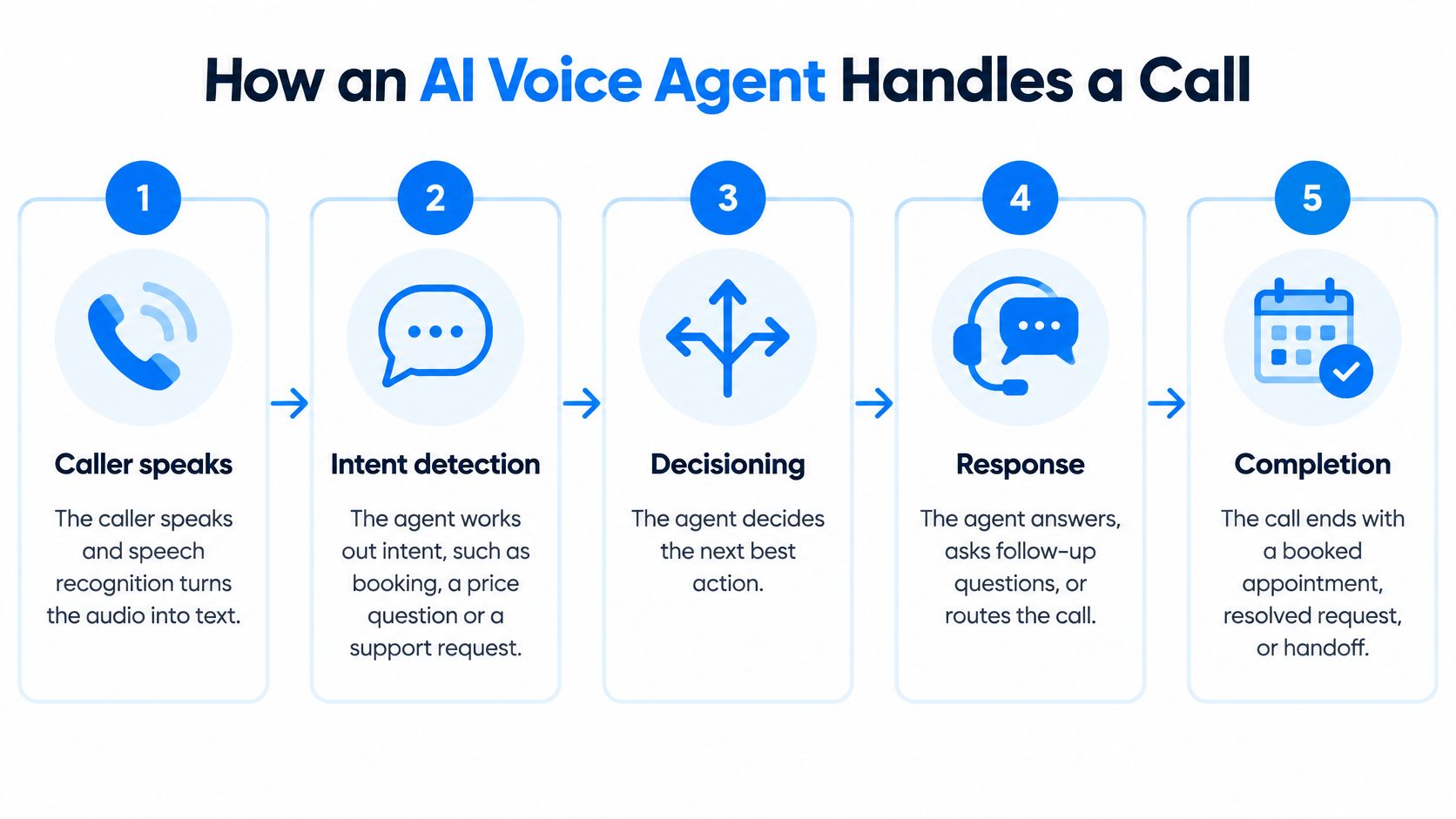
From speech to a confirmed booking
- The caller speaks. Speech recognition turns incoming audio into text that the system can process. Road noise, a weak connection or an unfamiliar surname can cause mistakes, so important details need confirmation rather than silent assumptions.
- The agent identifies the intent: booking a service, asking about a price or requesting a person. A caller may express several needs together, so the agent should clarify the immediate task instead of forcing the whole conversation into the first category it detects.
- It retrieves approved information. The knowledge base supplies relevant website pages, FAQs and uploaded PDFs alongside the business's script. We index uploaded knowledge content for retrieval during calls, but missing or outdated information still requires a clear fallback, not an invented answer.
- Connected tools perform the action. The system checks calendar availability, confirms the customer's details and requests the booking. A disconnected calendar or failed booking request must produce a callback or handoff, never a claim that the appointment is confirmed.
- The language model prepares a reply, and text-to-speech turns it into the chosen voice. We use the greeting script and voice the business selected; replies should remain brief, clear and within the approved information rather than adding unsupported promises.
- The system records the result. A configured workflow saves the transcript and outcome, then sends a confirmation text. A wrong mobile number or failed message delivery needs its own status so staff don't confuse a booking with a successfully delivered confirmation.
Why the pauses matter
Each stage can add delay. In a production voice-agent pipeline study published by Springer, median response latency across 30 real API sessions fell from 3,277 ms to 1,909 ms when intent detection and speech synthesis ran concurrently rather than waiting for the full reasoning path to finish.
That finding concerns system design, not a promise about every commercial service. Streaming audio and preparing likely tool requests in parallel can shorten waiting, but the agent must still wait for a successful transaction before announcing completion.
A spoken demonstration can help you listen for the transitions between these stages.
Before enabling a booking flow, test knowledge coverage, the calendar connection and transfer rules. Ask an uncovered question, disconnect the calendar during a test and request a person. Those tests reveal more than a perfectly rehearsed booking.
Timing and Turn-Taking Decide Whether Callers Stay
A caller starts giving a phone number, pauses to remember the ending and hears the agent jump in. They stop, the agent stops, and both begin again. Even if the final transcript is accurate, the interaction feels difficult.
People usually sense when someone has finished speaking without counting silence. AI voice agents need explicit mechanisms for that judgement. A quiet moment might mean the caller is finished, thinking, reading an appointment card or waiting for someone nearby.
Accuracy isn't the whole test
The voice-agent timing and multiparty evaluations described in the benchmark evidence report an 86% aggregate timing score for the strongest tested system, with appropriate waiting through 23 of 30 pauses and passes on 29 of 30 turn-taking items; they also report that several real-time agents exceeded 90% accuracy in discussion scenarios while nearly all performed at or below chance in a turn-based game.
These are task-specific findings, not a universal ranking for business phone calls. Their practical lesson is that conversational context matters. A system that handles flowing discussion well may still struggle when it must wait for a precise signal before speaking.
The design needs several cooperating controls:
- Voice-activity detection separates speech from background sound.
- Interruption handling stops outgoing speech when the caller corrects or redirects the agent.
- Adaptive end-of-turn thresholds account for short answers, hesitations and unfinished details.
- Explicit conversation state distinguishes a proposed appointment from a date the caller has accepted and the calendar has confirmed.
Match the pace to the job
For appointments, favour careful collection of names, dates and contact details. If someone says they can attend Friday, then pauses before adding only after work, a premature booking creates avoidable recovery work.
Outbound reactivation needs a different rhythm. Recipients may answer briefly because they weren't expecting a conversation. The agent should recognise a short refusal or request for information without leaving an awkward gap, while allowing someone to finish explaining their circumstances.
A fast response is useful only when it's the right moment to respond.
During testing, request interruption rate, missed-response rate, pause acceptance and time-to-first-audio. Listen to the failures behind those measures. Averages won't tell you whether callers struggle specifically with spelling surnames or correcting dates.
Where Businesses Use Inbound and Outbound Agents
Start with the call your team misses most often or repeats most often, not the most ambitious automation idea. A narrow task gives you a clear script, a manageable exception path and an outcome you can verify.
Inbound work is about receiving the caller's request and getting it to the right destination. Outbound work is about contacting an eligible person for a defined purpose and recording what happened, including refusal, no answer or a need for human follow-up.
Inbound and outbound call jobs by business type
| Business type | Inbound calls | Outbound calls | First metric to track |
|---|---|---|---|
| Dental practices and clinics | Booking, rescheduling and address questions | Appointment reminders and no-show follow-up | Booked-to-attended rate |
| Salons and professional services | Bookings and after-hours enquiries | Rebooking and lapsed-client win-backs | Repeat-booking rate |
| Trades and auto repair shops | Job enquiries and callbacks while staff are working | Quote follow-up and service reminders | Quotes converted to jobs |
| Restaurants and hotels | Table and room enquiries and changes | Booking confirmations and feedback calls | No-show rate |
| Real estate agencies | Property enquiries and viewing bookings | Lead follow-up within minutes | Viewings booked per lead |
| E-commerce and subscriptions | Order status and returns questions | Renewal reminders and win-back calls | Renewal rate |
| Insurance and research teams | Policy or claims questions outside hours | Renewal reminders and survey calls | Completed surveys per consented contact |
| Casinos and sportsbooks | Account questions answered within local rules | Lapsed-player reactivation within local rules | Reactivated accounts, with complaints and opt-outs tracked |
Say a trade shop receives a Saturday enquiry while everyone is working on a roof. The useful inbound outcome is a captured address, job description and agreed next step. The agent shouldn't promise an emergency arrival unless the business has explicitly authorised that commitment.
For a clinic, an outbound reminder the day before an appointment can ask whether the patient intends to attend and route a rescheduling request. Measure attendance rather than assuming that a completed reminder prevented a missed visit. Avoid speaking sensitive details before establishing that the appropriate person is on the line.
Give outbound campaigns a defined stopping point
A real estate team might contact a consenting web lead within minutes to arrange a viewing. An insurer might contact consenting policyholders about renewals or feedback. Each flow needs a different script and a different successful outcome, rather than a generic instruction to keep talking until someone agrees.
For uploaded lists, define what happens after every result: accepted, declined, unreachable, opted out or needs staff attention. Our outbound AI calling guide provides a starting point for mapping those campaign decisions.
Language coverage also needs operational thought. We answer calls in 20 languages, but you should still check the wording of service descriptions and ensure staff can handle the resulting handoff.
Keep complaints, refund decisions, medical or legal advice and other judgement-heavy conversations with people. For casinos and sportsbooks, eligibility and responsible-gambling safeguards must govern outreach before commercial objectives do. An account on an old list isn't automatically an appropriate reactivation target.
Compliance Rules for Outbound AI Calls
Only call people who agreed to hear from your business. The FCC's AI-generated voice ruling confirms that artificial-voice restrictions apply and that covered calls require prior express consent unless an exception applies.
Outbound AI call requirements by call type
| Call type | Before dialing | Disclosure at call start | If the contact opts out |
|---|---|---|---|
| Appointment reminder | Number from the booking, purpose recorded, permission checked | Says it is an AI assistant and names the business | Suppress reminders for that number and record the opt-out |
| Lead follow-up | Lead asked to be contacted, consent record stored | Says it is an AI assistant and names the business | Remove from all future lead calls |
| Win-back or reactivation | Documented consent for this purpose, suppression checked | Says it is an AI assistant and names the business | Suppress across every campaign |
| Survey or feedback call | Consent covers research, no sales pitch without separate consent | Says it is an AI assistant and names the business | Stop the survey and record the refusal |
| Renewal reminder | Purpose documented, permission checked, local time confirmed | Says it is an AI assistant and names the business | Suppress renewal calls and keep the record |
A booking or policy record alone isn't a substitute for checking the required permission. Retain how consent was obtained and what it covers.
Use these controls before launching a campaign.
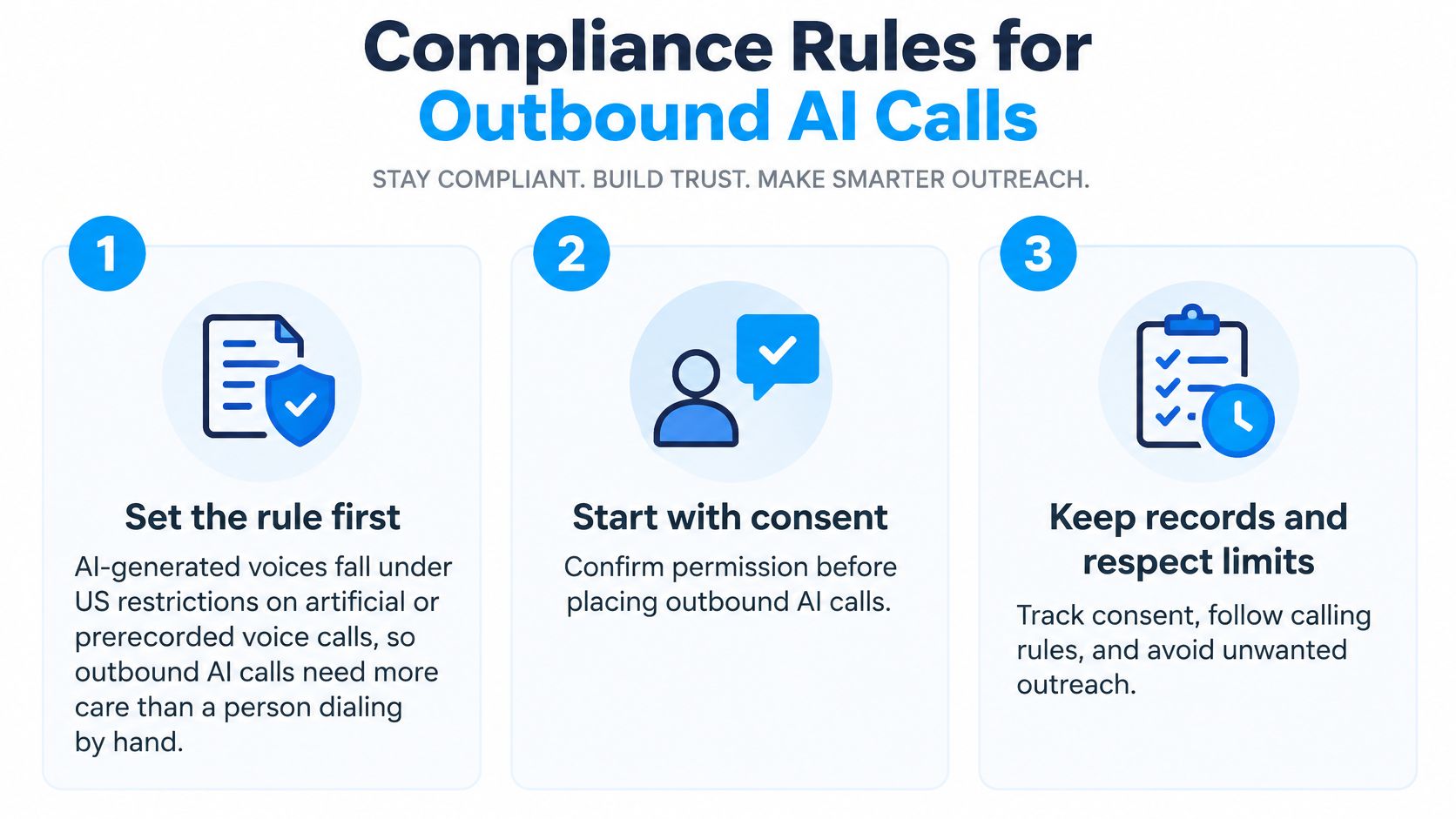
Every call we place opens with “I'm an AI assistant.” Name the business too, and record the outcome. The FCC's AI disclosure proposal is a proposal, not a universal final disclosure rule. For inbound reception, identify the AI before collecting personal information; after handoff, the person should clearly identify themselves.
The FTC's telemarketing guidance sets consumer calling hours at 8:00 a.m. to 9:00 p.m. local time, unless prior consent allows otherwise, and describes stricter written-agreement requirements for prerecorded telemarketing.
Apply revocations promptly across campaigns and follow-up channels. Suppress contacts before every dial, including applicable Do Not Call restrictions under the Telemarketing Sales Rule. Review our AI phone call laws guide, then have counsel check each jurisdiction and campaign type.
Measuring Whether Automated Calls Pay Off
Answered calls aren't the same as incremental profit. A booking that never happens, a caller who was already returning and a lead that needs extensive staff recovery can all make an automation dashboard look better without improving the business.
A US report discussed by Novobrief analysed 677,562 calls for 2,967 businesses between January 2025 and August 2026, reported that 91% missed at least one potential-customer call in a typical week, and found that 78% of surveyed consumers had hired or purchased from a competitor after an unanswered or unreturned call. Its opt-in survey panels and answering-service customer sample mean those findings don't establish economy-wide missed-call rates.
Separate activity from value
Build your review around outcomes that staff can verify:
- Appointments: Track booked appointments separately from completed visits.
- Lead quality: Separate qualified enquiries from spam and unsuitable requests.
- Recovered customers: Distinguish campaign-driven returns from customers who would have returned anyway.
- Contribution: Deduct discounts, staff follow-up and delivery costs from campaign revenue.
- Recovery work: Track failed transfers and whether people resolved the escalated request.
- Customer impact: Review opt-outs and complaints alongside conversion, segmented by business activity.
Use an answering-service cost calculator to organise assumptions, but use actual completed outcomes to judge the result. A low handling cost doesn't rescue a flow that creates more corrective work.
Run a fair comparison
For a discretionary win-back campaign, randomly keep a share of eligible contacts uncalled during the same period. Compare their return rate with the called group, using similar customer histories and the same observation window. Don't withhold essential service or safety communications to create a test.
Count the additional profitable outcomes, not every sale that happened after a call.
Review results monthly. We record transcripts and capture messages, giving the business material to inspect alongside recorded outcomes. Read a sample, check results against the holdout and stop or revise flows that don't improve net outcomes.
The business remains responsible for reviewing the AI's behaviour and adjusting its script, knowledge base and compliance settings. Automation doesn't remove that operating responsibility.
Pick One Call Flow to Automate First
Choose a repetitive, high-volume flow with a clear endpoint, such as a consented reminder or an after-hours booking request. Keep the first deployment narrow enough that one person can inspect every result.
Map the normal route and the human fallback before going live. For an inbound flow, decide which calls the agent answers fully, when it transfers to a person and when it takes a message instead. For an outbound flow, decide what the agent does with a yes, a no and a request to stop calling.
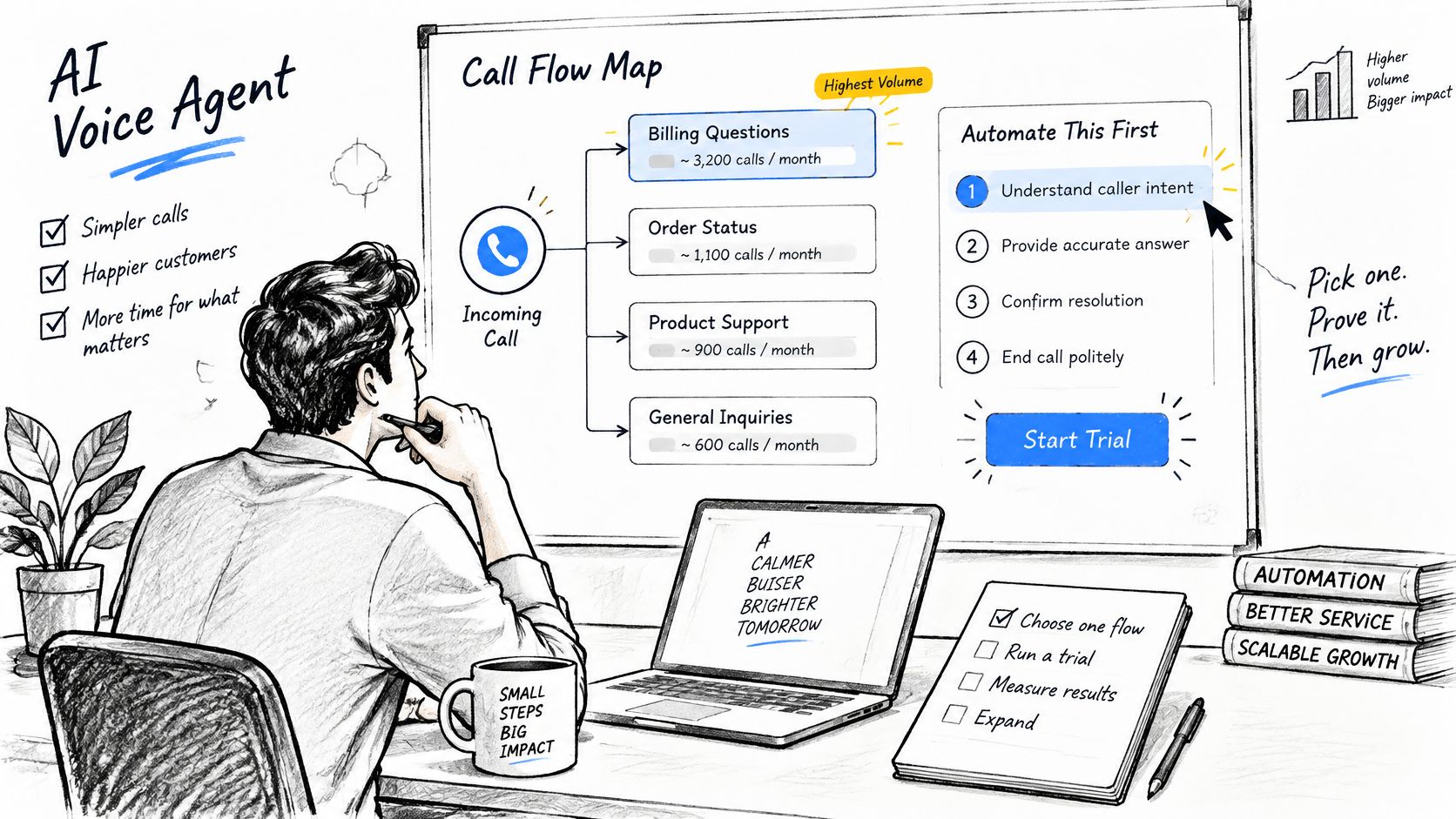
Set up a controlled trial
- Create an account and run the free 60-second browser demo, which lets you hear the receptionist before going live.
- Let setup read your website. It drafts a receptionist script from your services, opening hours and prices, which you then verify line by line. Connect your business calendar for bookings and check that confirmation texts and human transfers behave as expected.
- Choose your number arrangement, a new number or forwarding your existing line, and set a daily spend limit. For outbound tests, the campaign states it is an AI at the start of each call and records how each call ended.
- Run the flow briefly, read the transcripts and compare completed outcomes with your holdout group before expanding the list.
Dial Milo uses prepaid, usage-based billing rather than subscription tiers, and charges AI processing separately from telephone costs, with each call's charge visible in the dashboard. The optional premium voice engine (OpenAI Realtime) costs about 30.3¢ per minute on a US number, unanswered outbound calls are not charged, and prepaid balances do not expire. Phone numbers carry a monthly rental charge.
Example monthly costs at the premium-engine rate
| Scenario | Calculation |
|---|---|
| One 3-minute answered inbound call | 3 × 30.3¢ = about 91¢ |
| 100 answered 3-minute calls in a month | 300 minutes × 30.3¢ = about $90.90 |
| 100 outbound calls, 40 unanswered | 40 unanswered calls not charged; 60 answered calls charged for actual talk time |
| New US number, first month | Monthly rental charge, plus call charges |
| Forwarding an existing business line | Your existing number stays in place; call charges still apply |
Check current pricing before scaling, and create your trial account when your script, consent records and success measure are ready.
Dial Milo answers inbound calls around the clock and runs outbound customer campaigns for reminders, follow-ups, offers and win-backs. Start with one approved call flow, test its handoffs and review completed outcomes before putting a larger list into motion.
Keep reading
AI Answering Service Explained: How Calls Are Handled
Learn what an AI answering service does on every call, how bookings, handovers and outbound campaigns work, and what it costs.
Read
AI Appointment Setter for Inbound and Outbound
See what an AI appointment setter does on inbound and outbound calls, how booking works, and what to check before you trust it.
Read
No One Answer the Phone? How to Catch Every Call
When no one answer the phone, every missed call can become a lost enquiry. Learn how to capture callers, call back fast and stay compliant.
Read