
Your phone rings while you're serving a customer. By the time you can check it, the caller's gone, there's no message, and you don't know whether you missed a booking or a wrong number. Later, you return the call from your mobile and nobody picks up.
When customers ask, “Why does no one answer the phone?”, the answer often involves both staff availability and caller trust. You need a reliable way to receive enquiries, but you also need customers to recognise your callbacks. For businesses calling customer, lead or player lists at scale, both sides need a defined process.
Map Where Your Missed Calls Actually Go
A plumber up a ladder can't safely answer. A salon with three chairs full can't interrupt every appointment. A clinic receptionist at lunch leaves a predictable gap unless someone else takes over. Each business has missed calls, but buying the same solution for all of them would miss the cause.
Even large operations lose callers before a conversation starts. Ofcom's 2025 customer-service comparison found that, in 2024, 6% of calls to mobile providers and 7% of calls to broadband and landline providers were abandoned before customers spoke with an adviser.
Match the pattern to the fault
Pull two weeks of call logs from your phone system or carrier. Sort missed calls by hour, day, destination and outcome, then check whether repeat attempts came from the same caller.
Common causes of missed calls and first fixes
| Cause | Typical sign in call logs | First fix |
|---|---|---|
| Staff busy with customers | Missed calls cluster in peak hours | Add a voicemail greeting and a callback promise for peak times |
| Calls outside opening hours | Missed calls in evenings, weekends and holidays | Set an after-hours greeting and route calls to voicemail or a fallback |
| Forwarding or number faults | Calls never ring the phone, or ring a dead line, and all callers are affected at once | Test from a mobile and check forwarding settings and number status with the provider |
| Long waits with no voicemail | Calls end after a few seconds or ring out | Turn on voicemail and set a clear response time |
| Unknown-number screening | Calls to customers go unanswered on first ring | Show the business name and give the reason in the first sentence of outbound calls |
Call logs reveal patterns, not motives. A short outbound attempt doesn't prove somebody screened the call, and a short inbound call could be spam rather than a lost enquiry. Keep those distinctions in your notes.
Count unique callers as well as missed attempts. Otherwise, a customer who repeatedly tries to change an appointment can look like several separate opportunities.
First fix: Count missed calls by cause and tackle the largest group before changing the whole phone setup.
Assign an owner to that fix. A forwarding fault belongs with whoever manages the line; a lunchtime gap needs a rota or fallback. Don't ask reception staff to solve a routing problem by working faster.
Choose the Right Fallback for Calls You Cannot Take
Start with the call type. A new enquiry needs a quick reply and a booking route. An appointment change needs a confirmation the caller can see. A reminder needs a useful message and a number the recipient can call back.
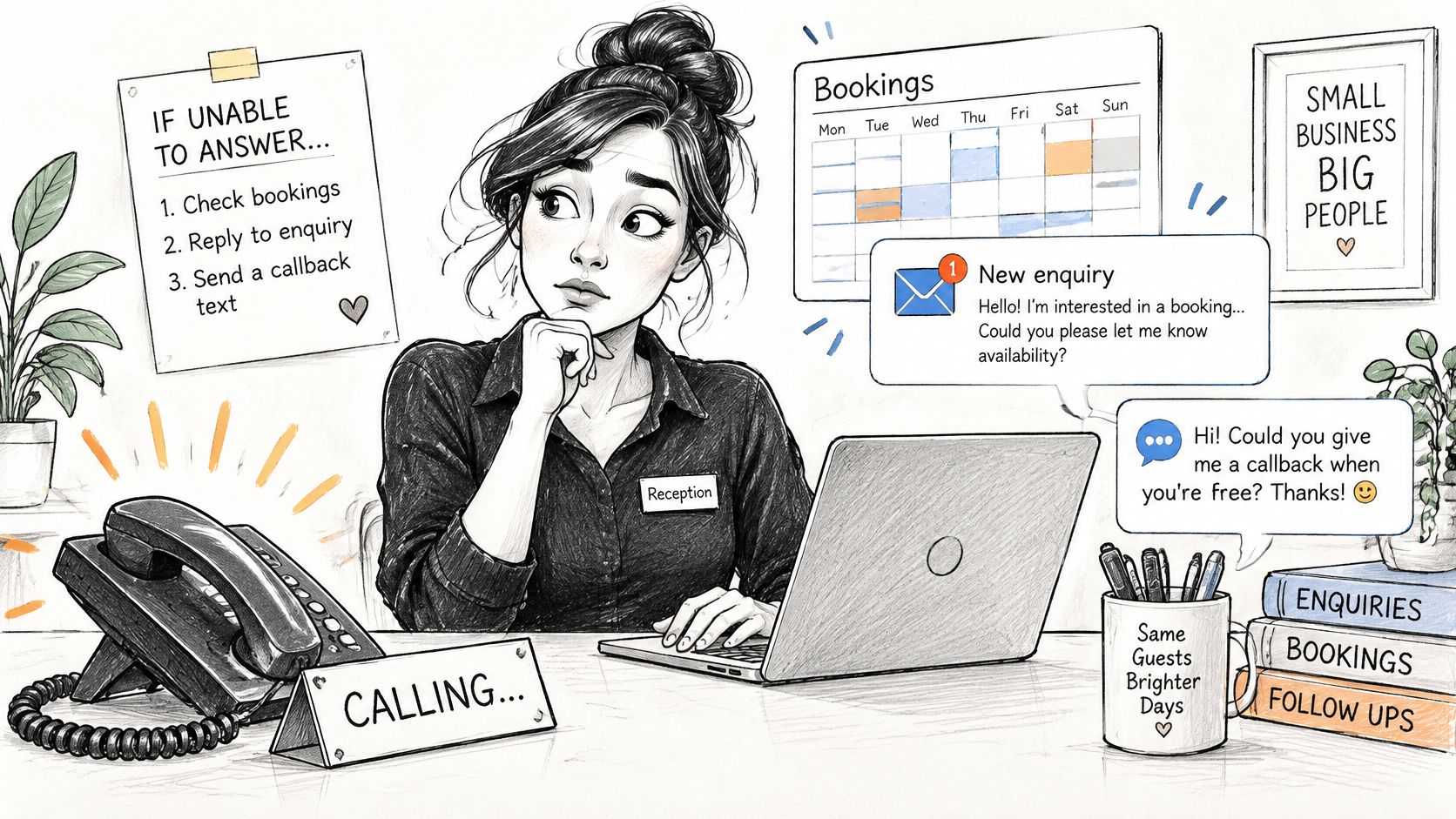
The reception workload includes more than picking up the handset.
Fallback options for calls nobody can take
| Option | Response speed | Covers after hours | Human handover |
|---|---|---|---|
| Voicemail only | When someone listens and responds | Yes | Only if someone checks and calls back |
| Text-back after a missed call | Within minutes if sent automatically | Yes | Only if staff reply |
| Scheduled callback | Within the window you promise | Only if staff are on duty | Yes |
| Answering service | Immediate when staffed | Yes, with after-hours coverage arranged | Usually after a message is taken |
| AI receptionist | Immediate | Yes, 24/7 | Yes, transfers to a person when needed |
Choose a route staff can maintain
Voicemail works only if somebody listens. Text-back creates another unattended inbox unless someone owns replies. A scheduled callback helps only when staff keep the promised window, so reserve callback time rather than squeezing it between customers.
An AI receptionist can capture details, book into a calendar, send confirmations and transfer callers. The practical distinction is whether it can complete the caller's task or merely collect another message. Our AI answering service guide explains that workflow.
When email is the sensible follow-up, RealEstateCRM's missed call email guide offers a useful starting point. Keep the message specific to the missed conversation and give the recipient one clear next action.
Keep human access and emergencies separate
Don't configure silence as failure. In a 2025 STAMMA survey of 356 people who stammer, 65% experienced barriers on their most recent business call, including interruptions, hang-ups or voice-recognition loops.
Allow longer pauses and offer keypad, text or human alternatives. Test whether callers can reach a person without successfully completing speech recognition first.
Dial Milo isn't a replacement for traditional phone service and must not be relied on for emergency calls. Our AI receptionist isn't trained to dispatch emergency responders, so keep emergencies on a separate route.
Every fallback should give callers a way to reach a human within the same day. If you can't staff that promise, arrange cover rather than implying it exists.
Make Customers Trust the Call Before They Answer
In 2024, 74% of U.S. consumers said they didn't answer calls from unknown numbers because they feared scams, according to TransUnion's survey of 1,556 mobile-phone users. Returning calls faster won't help much if customers can't tell who's calling.
A U.S. survey cited in a 2025 FCC filing on unidentified calls found that 90% were uncomfortable answering unidentified calls and 92% assumed they were fraudulent; respondents said they would answer when the name appeared (73%), the name and logo appeared (76%), or the reason for calling also appeared (78%). Those are stated intentions, not measured campaign results, but they give operators a clear direction.
Make the number recognisable
Use a consistent business number rather than switching between staff mobiles. Publish it on your website, booking confirmations and receipts so customers can check it independently.
- Set a recognisable caller name. Use the trading name customers know, not an unfamiliar legal entity.
- Check the display. Review branded caller ID and test how your identity appears on recipients' phones.
- Set expectations. Where the customer has agreed to texts, send a short business-named message before a reminder call.
- Provide a safe alternative. Let customers call your published number instead of asking them to trust an unexpected incoming call.
Open with identity and purpose
A legitimate call should explain itself immediately. Say that you're the business's AI assistant, name the business and state the specific purpose, such as confirming an appointment or following up on a requested quote.
Avoid a long introduction followed by a vague offer. Don't begin by demanding sensitive details, and don't use urgency to pressure someone into staying on the line.
Ask three customers whether they'd answer a call from your number. Show them the actual incoming-call display rather than describing what you intended to configure. If they hesitate, fix the identity and expectation-setting before increasing campaign volume.
Keep Outbound Calls Legal and Respectful
A customer may give you a phone number for delivery updates without agreeing to sales calls. Before adding that number to a campaign, record what the person agreed to receive and confirm that the permission covers the campaign's purpose.
The FCC's guidance on AI-generated voices says the Telephone Consumer Protection Act's restrictions on artificial or prerecorded voices apply to modern AI voice technology. These calls generally require prior express consent. The required standard depends on the call's purpose and destination, including prior written consent for prerecorded telemarketing calls to residential or wireless numbers.
Build checks into the campaign
Keep consent evidence with each contact. Record the source, date, wording and scope of permission, rather than relying on a checkbox marked “contactable.”
- Match permission to purpose. Confirm that consent covers the specific campaign.
- Apply opt-outs immediately. Treat every stop request as final and suppress the number from future calls.
- Check timing and opt-out controls. Under the FTC's Telemarketing Sales Rule guidance, U.S. telemarketing calls to consumers' homes generally must take place between 8:00 a.m. and 9:00 p.m. in the recipient's local time, unless the recipient has consented to different hours. Qualifying prerecorded telemarketing calls must explain the interactive opt-out at the start, keep it available throughout the call, automatically suppress the number and disconnect after an opt-out.
Before each campaign, check national and company-specific suppression records. The FTC's Telemarketing Sales Rule restricts calls to numbers on the National Do Not Call Registry, subject to exceptions, and prohibits calls to consumers who have asked that company not to call.
A fresh list upload must never reactivate somebody who already opted out.
Set disclosure, opt-outs, local-time scheduling and spend caps as launch gates for automated outbound calls. Hold the campaign if any required control is missing. For caller-ID and AI-disclosure practices, follow the guidance in the trust section above.
Have a lawyer review requirements for the countries, industries and campaign types involved. Permission for a service reminder does not automatically cover insurance marketing, subscription win-backs or iGaming player reactivation.
Run a Five-Minute Recovery Routine and Measure It
A caller misses you during an appointment, then sees an unknown number call back. A fast response helps only if the caller recognises the business and has a reason to answer. Give every missed call an owner, a next action and a clear identity in the follow-up.
Use this recovery sequence as the operational checklist.
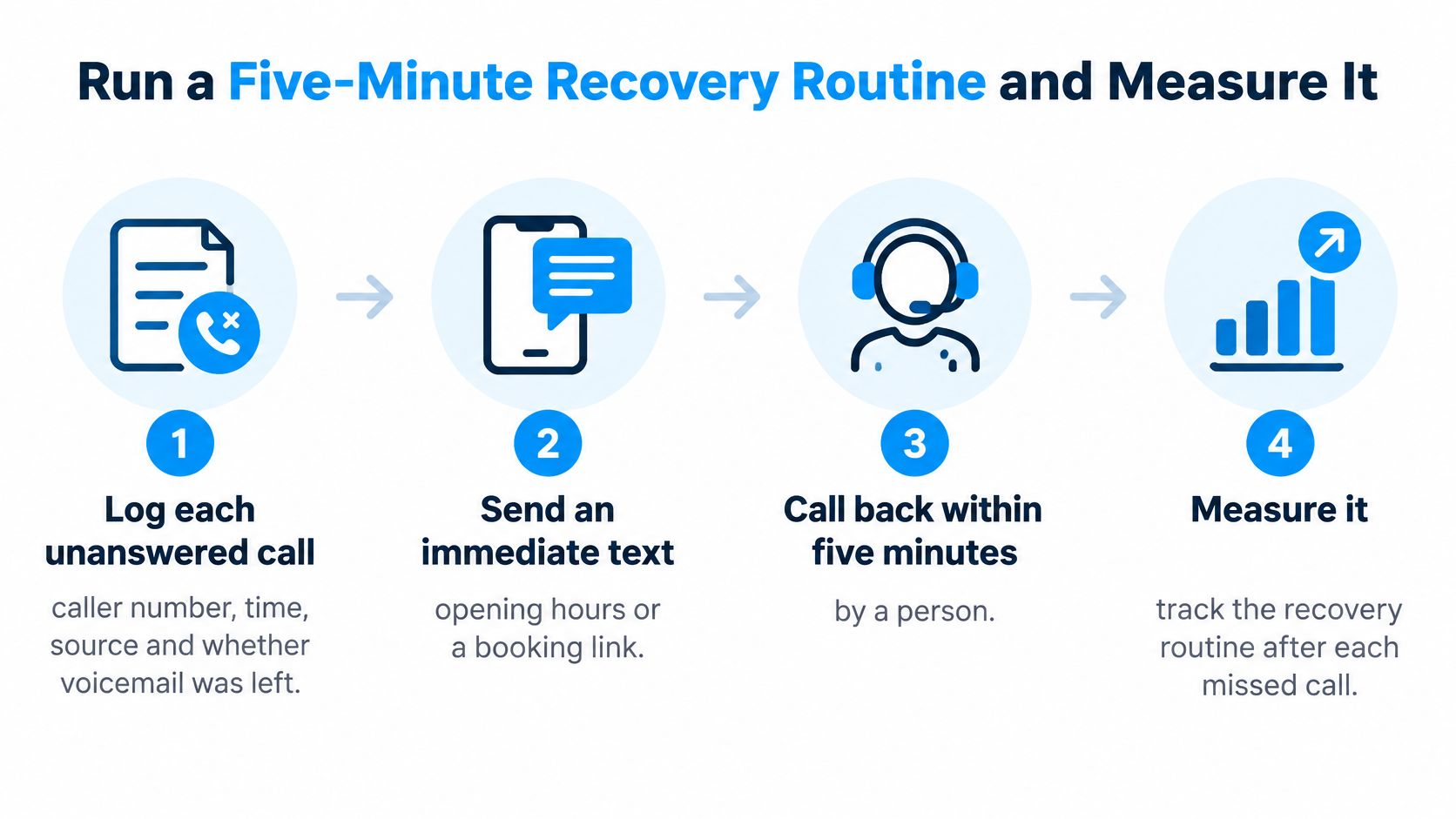
Give every missed call a next action
- Log each unanswered call. Save the caller number, timestamp, campaign or source, and whether voicemail was left. Link repeat attempts to the same contact so staff can review the history before responding.
- Send an immediate acknowledgment. Where permitted, text your opening hours or a booking link. Identify the business, say whether the message is monitored, and avoid requesting medical, legal or financial details in an unsecured reply. Keep the callback task open until the enquiry is resolved.
- Set a prompt callback target. Aim to call back within five minutes during staffed, permitted calling hours. The MIT and InsideSales lead-response study, discussed in this lead-response guide, found that contacting a lead within five minutes was associated with much higher odds of qualification than waiting 30 minutes. Use that finding to set a response target, not as a promise about results from missed calls. Make the business identity clear when calling back, and use a person or a consent-appropriate automated callback.
- Retry on a defined cadence. For example, try again later the same day and on the next business day, within permitted hours. Stop when the contact declines or opts out. Assign one owner so several staff members do not chase the same person independently.
- Record the outcome. Use booked, qualified follow-up, wrong number, declined, unreachable or opt-out. Add a short note when the next action is unclear, such as a requested callback after the customer's shift.
Total callbacks alone hide delays. Missing dispositions create a separate problem: an unreachable customer can appear to have heard and rejected the offer. Track attempts, conversations and outcomes separately.
The useful next action depends on the call type. A clinic may need to route urgent enquiries for review; a real estate team may need to qualify a viewing request; a feedback campaign may need to record a response without turning it into a sales pitch.
Put the routine into service this week
Start with the top two causes in your call log. For each affected call type, set a fallback and name the person responsible for follow-up. Set the five-minute target for calls that arrive during staffed, permitted hours, and keep a separate queue for calls that arrive outside them.
If you use Dial Milo for reception, choose Answer my calls on the first onboarding screen. In setup step 3, get a new number or forward your business line; Milo then starts answering. The AI receptionist answers 24/7 in the business's voice, captures caller details and texts the business about each call. It can warm-transfer a call when a person is needed. Set when Milo answers, when calls go to voicemail, and what after-hours callers hear.
Review the generated business information and correct opening hours, booking instructions, escalation contacts and campaign permissions before calls go live. If the answer is not in the knowledge base, the receptionist says so and can take a message, save the caller as a lead or transfer the call rather than inventing an answer.
Use the walkthrough to check the setup flow before your live test.
Review outcomes every week
Keep the dashboard focused on decisions staff can act on:
- Median time to callback. Measure elapsed time from the missed call, not from when someone opened the task.
- Contact rate by attempt. Check whether later attempts produce useful conversations or repeat contact without progress.
- Live-answer rate by call type. Separate enquiries, appointment changes, support and outbound campaigns.
- Booking rate. Count completed appointments against eligible enquiries.
- Opt-out rate. Review whether the script, audience or campaign purpose needs changing.
For broader service quality, use tracking AHT, FCR, and CSAT alongside callback speed and outcomes. Short calls are not a useful goal if customers still need to contact you again.
Review failed transfers and incorrect bookings alongside the metrics. Keep the fallback that produces useful resolutions, and revise the one that raises answered-call counts without resolving callers' needs.
Dial Milo handles inbound reception and outbound calls, with call records and outcomes available through a dashboard. Test the greeting, booking route and human handover before relying on the service for live enquiries.
Keep reading
AI Answering Service Explained: How Calls Are Handled
Learn what an AI answering service does on every call, how bookings, handovers and outbound campaigns work, and what it costs.
Read
AI Voice Agents Explained: How They Work for Business
AI voice agents answer calls, book appointments and place outbound calls. Learn how they work, where businesses use them and the rules to follow.
Read
What Does It Mean to Screen a Call
What does it mean to screen a call? It means judging who deserves a live conversation, not the same thing as blocking, silencing or answering.
Read