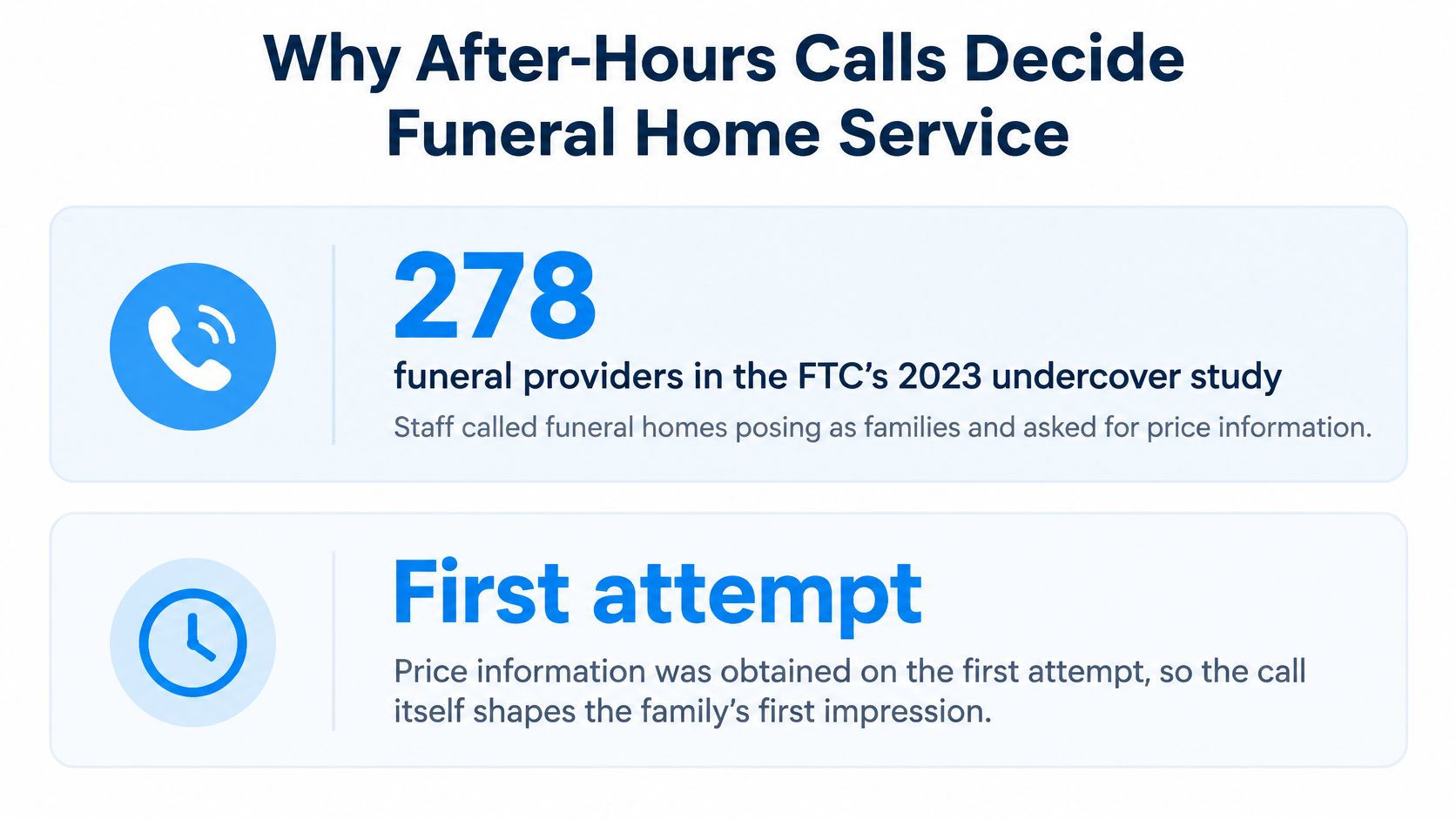
Staff posing as families got funeral price information on the first attempt from 67.3% of providers during business hours, and from only 37.1% after hours, in a 2023 Federal Trade Commission undercover phone sweep. That is a 30.2 percentage point drop, from 187 of 278 providers in the daytime to 103 after hours. Answering services for funeral homes exist because that first ring is an intake and compliance record, not a slip of paper someone reads in the morning.
A price answer, a removal request, and a pre-planning question don't belong in the same pile. The cost of coverage only makes sense once you add escalation, quote accuracy, and consent risk. A cheap message pad that can't quote a current price list, or that dials a family who never asked to be called, is not a bargain.
What Answering Services Cost Each Month
An answering bill has two parts: the monthly charge and the cost of a call handled badly. The second part is bigger. A service that takes a message but cannot quote your current general price list, or that parks a removal request in an inbox until morning, hands the expensive work back to you. Since the first call is an intake record, accuracy and escalation belong inside the cost model, not after it.
Three billing structures cover the market, and they price risk differently.
| Option | How it bills | Monthly cost | Notes |
|---|---|---|---|
| In-house receptionist | Salary plus benefits | Regional wage plus benefits | Covers office hours; nights and weekends need a second arrangement |
| Live answering service | Monthly plan built on a bundle of talk minutes | Set by bundle size and features | Overage applies past the bundle; unused minutes do not come back as cash |
| Dial Milo AI receptionist | Prepaid, usage-based charge per call | Scales with the minutes actually answered | AI processing and telephone time billed separately; a number carries a monthly rental |
How the pay-as-you-go line is built
Dial Milo bills prepaid and usage-based rather than in subscription tiers. The charge separates AI processing from telephone time, and each call's cost is visible in the dashboard, so you can see what a single intake ran. You can take a new number or forward your existing business line, and forwarding removes the monthly number rental. Outbound calls that nobody answers are not charged, prepaid balances do not expire, and every account gets the full feature set, including unlimited concurrent calls, so a second family ringing during a long first call still reaches an answer. If a charge looks wrong, billing questions go to hello@dialmilo.com, with 48 hours requested to investigate and respond.
Practical rule: Price the minutes you will actually speak, then add the cost of a wrong quote or a missed transfer. A bundle of minutes that cannot read your general price list costs more than metered talk time that can.
A bundle plan bills the same in a quiet month and adds overage in a busy one. Prepaid charging tracks the conversations you had. Because the AI answers from a knowledge base built on your website, FAQs, and uploaded documents such as price lists and policies, a price question at 2 a.m. gets the figure you published. When a caller needs a person, it warm-transfers to whoever is on call and texts you about the call.
The free answering service cost calculator puts an in-house receptionist, a live answering service, and an AI receptionist side by side per month, per year, and per call. Load your wage bill, a bundle quote, and your expected minutes into the same view before signing anything. The in-house row has no national figure because wages differ by market and benefits sit on top of the salary.
How to turn calls into minutes
Count the calls that arrive after the office closes, not the ones the front desk already answers. Multiply that count by a realistic average length. A two-minute price question and an eight-minute removal intake are not the same minute. At 40 after-hours calls averaging five minutes, you need roughly 200 minutes of coverage a month. A plan sized far above that count wastes money in quiet months. A plan sized far below it bills overage or stops taking detail on the worst weekend.
I would size coverage to the after-hours count with a little room, then review after 30 days. The transcripts and recordings show the split: mostly short price calls argues for less volume, repeated long intakes argues for more. The product is a complete record of every call and a person on the line when the call is urgent. The minute count is only how you pay for it.
Why After-Hours Calls Decide Funeral Home Service
In the FTC's 2023 phone sweep, staff still could not get after-hours price information from 73 providers, 26.3% of the sample, even after the full calling process. The same sweep found nearly 70% of providers needed several calls or a return call before price information came through after hours, compared with about 30% during business hours. FTC researchers called between February and December 2023, up to three times in business hours and up to three times after hours, across large, medium, and small U.S. metropolitan and micropolitan areas. The sweep does not count every missed call or put a dollar figure on lost work; it shows families hitting unanswered lines, delayed callbacks, and incomplete answers when staff are not there.
What the family hears at 9:40 p.m.
A daughter calls at 9:40 p.m. because a hospital needs a funeral home named. If nobody answers, she hears voicemail, and a callback that lands after she has phoned a second home changes nothing. Families in that moment often try one provider and stop, so the first answer largely decides the enquiry.
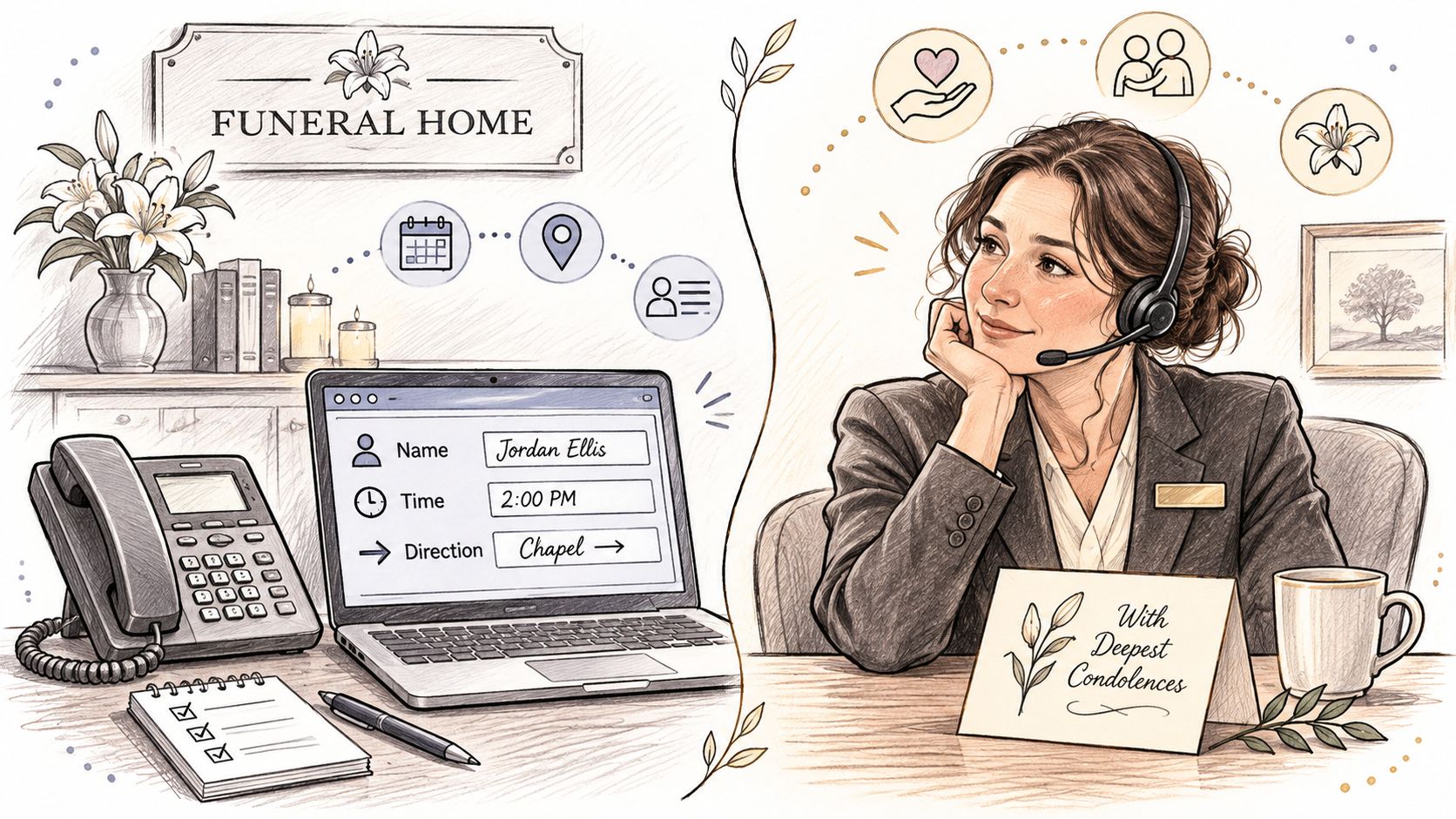
The voicemail also fails a second job. That first call is the intake record the case will run on. A garbled message, or no message, leaves the director reconstructing names, locations, and family contacts during the arrangement instead of working from a captured record.
The scale is the whole trade, not a handful of large firms. The National Funeral Directors Association reports more than 15,401 funeral homes in the United States and about 105,300 employees. Most run on small staffs. A home that size cannot keep a receptionist on the night desk and still have a director free for the prep room.
Published estimates of after-hours work describe different things, so the percentages do not merge into one figure. Some count only death notifications; others count every first-contact call, including price questions and pre-need enquiries. Read any quoted share as applying to one pile or the other. Either way, a large share of the work shows up when the office is dark.
Three requirements the gap supports
- Continuous coverage: Someone or something must answer the ring at 2 a.m., on Sunday, and on a holiday. A machine that only promises a morning callback fails the family who needs a removal tonight.
- Accurate capture: The record needs the caller's details and the question in the caller's own words, with a time stamp. Treat the call as the first page of the case file. A garbled voicemail forces the director to rebuild it later.
- A dependable path onward: Urgent matters need a named person. Routine matters need a complete intake and a callback time you can keep.
Answer rate, time to a human, complete intake, and callbacks kept on time tell you whether the setup works. Raw call volume does not. A busy line that loses the hospital name is worse than a quiet line that keeps it.
Which Calls AI Can Take and Which Need a Person
The decision that matters is which words in the first ten seconds send the call to a person. Write that split down before the line goes live: logistics the receptionist completes from approved information on one side, anything a director must hear firsthand on the other. Automate low-risk logistics and make a person easy to reach during grief.
Families already handle more of the arrangement online, so callers increasingly expect answers without a human on the line. That doesn't remove the need for a person when someone is reporting a death. The open question is narrower than most guides frame it: which calls can be automated, and which phrases force a handoff.
| Call type | AI handles it? | Handoff rule | Example request |
|---|---|---|---|
| Death notification or first call after a death | No, route at once | Transfer to the on-call director | A relative says a person has just died at home |
| Removal or transfer request | Takes details only | Transfer or text staff immediately | Family asks for a body to be collected from a hospital |
| General prices and price lists | Yes, from the approved list | Escalate disputed or unusual quotes | Caller asks the cost of a basic cremation package |
| Pre-planning enquiries | Yes | Book a callback with staff | Caller asks about arranging a service in advance |
| Service times, obituary and visitation | Yes, from current details | Escalate if the details are unclear | Caller asks the viewing hours for Saturday |
| Distressed or angry caller | Takes a message | Warm transfer to a person | Caller is crying and asks to speak with someone now |
| Question not in the knowledge base | Says it does not know, takes a message | Transfer or callback | Caller asks about a religious practice the home has not documented |
Death notification is the critical first row. The receptionist doesn't counsel, doesn't estimate a timeline, and doesn't park the caller in a queue. It identifies the situation and transfers to the on-call director. A removal request is next. The line may collect location and a callback number, then it transfers or texts staff immediately. Leaving that as a morning email is how hospitals call the next home.
Prices, pre-planning, service times, obituaries, and visitation hours can be answered from approved, current information. If the caller disputes a package or the Saturday hours aren't in the file, the call goes to a person. A distressed or angry caller gets a message and a warm transfer, not a script that talks over them.
If the answer isn't in the knowledge base, the receptionist says so, takes a message, saves the caller as a lead, or transfers the call. It doesn't invent an answer. That rule matters more in a funeral home than in a shop, because a made-up religious custom or a made-up fee is something the family will repeat to relatives.
What to capture, and the words that force a person
On a funeral line, the receptionist qualifies the call by the type of request, the location, the urgency, and the callback number, and it separates emergencies from scheduled work. Ask for identity only when the caller offers it. Note the relationship to the deceased, where the person is, and how urgent the request is. Don't demand a name before you'll speak. Some callers are a nurse at a desk. Some are a son who can barely talk.
Write the trigger list down and review it with the team before you turn the line on.
- Death language: "Died," "passed," "gone," "just now," or a hospital calling to report a death. Transfer at once.
- Movement language: "Removal," "pick up," "transfer," "release," or a named hospital, hospice, or nursing home. Take the location, then reach a person.
- Distress: Crying, anger, "I need someone now," or a caller who can't finish a sentence. Warm-transfer. Don't keep asking intake questions.
If families in your area call in more than one language, write the trigger phrases in each of them and test each one. The handoff rules apply whatever language the caller uses. A calm price question is a price question. A death notification in Spanish still goes to the director.
Firms that want a wider view of where software fits, and where it doesn't, can explore AI funeral service options and then come back to the phone rules above. The phone is still the moment a family decides whether you heard them. Our guide to an AI answering service walks through knowledge bases and handoffs in more operational detail if you are setting the script this week.
Run the night test
Call the line after the office is closed. Use every row in the table, including a caller who only cries and says someone has died. Read the transcript the next morning. Check that the death call transferred, that the price call quoted only the approved figure, and that the unknown religious question produced "I don't have that" plus a message. If the transcript shows a guessed answer, fix the rule before any family uses the line.
How to Build the Urgent-Call Escalation Route
A voicemail forces the director to replay a garbled message and guess which detail mattered. Structured intake hands over a prioritised record: who called, where the person is, and how fast someone must move. Build that route in order, and don't skip the night test because the daytime transfer "usually works."
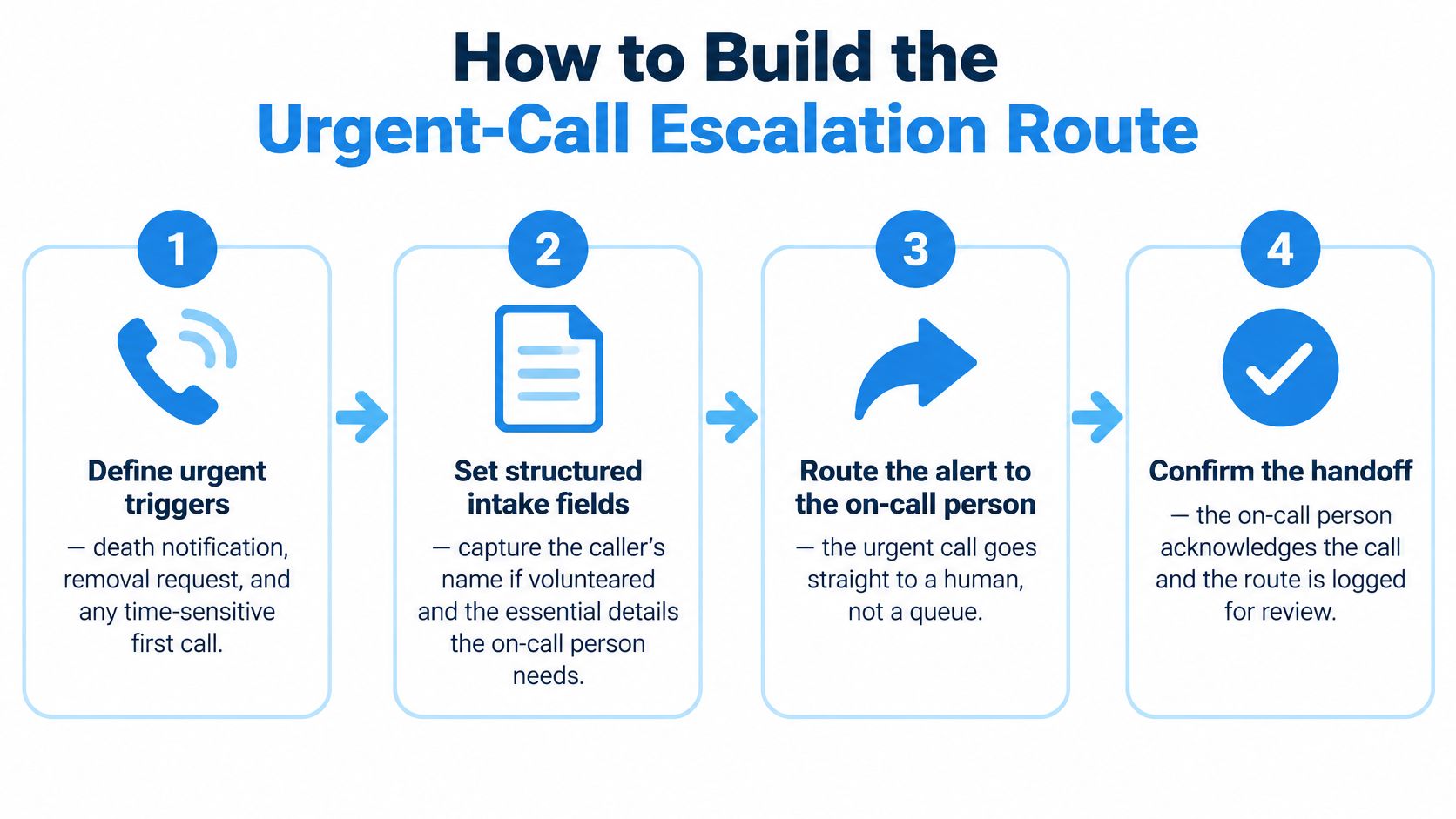
- Name the urgent triggers. Death notification, a removal or transfer request, and any first call that can't wait until morning. Write them as phrases staff hear, not as internal codes. If it isn't on the list, it shouldn't wake anyone. If it is on the list, it shouldn't sit in a queue.
- Set the intake fields before the phone rings. Caller name if they volunteer it, decedent location, time of death or discovery, and whether the place is a hospital, a hospice, or a residence. Add the requested service and callback urgency. These fields are why the director can leave the house with the right address instead of calling the family back to ask where to go.
- Route urgent calls by warm transfer, and text the staff member about each call. The on-call director should hear the caller, not a summary an hour later. The text is the backup record if the transfer audio is noisy. We send that text on every call so a missed pickup still leaves a written trail.
- Name a second person. If nobody answers after the number of rings you set, repeat the transfer and send an urgent text to the backup. A single on-call phone in a pocket on silent is not a route. Two names, with an order, is a route.
- Say the emergency-channel line out loud in the script. The AI receptionist isn't trained to dispatch emergency responders. Anyone in immediate danger should dial emergency services directly. You are responsible for configuring that message clearly and for transferring potential emergency calls to a human promptly. A funeral home line is not a substitute for emergency services, and the caller needs to hear that without a lecture.
- Limit confirmation texts. Send texts for booked appointments and for follow-up you have already approved. Don't text a family a cheerful confirmation because a death call ended. The director's acknowledgement belongs in the call record, not in a marketing-style SMS.
- Test every route at night with a scripted call, then read the transcript for blank fields. A transfer that works at 10 a.m. can fail at 1 a.m. because the on-call phone is forwarded somewhere else. Fix the blank field the same night. A missing hospice name is the defect, not the software brand.
Track four numbers, not how many times the phone rang. Answer rate shows whether the line was up. Time to human transfer shows whether urgent calls reached a person. Complete-intake rate shows whether the fields were filled. Callback time shows whether the non-urgent pile was worked. A high answer rate with empty location fields is a failed route.
Our notes on an emergency call answering service spell out the same split: the business configures the human transfer and tells callers the other emergency channel. Set both before you forward the live number.
Price Quotes and Records the Service Must Keep
A service that only takes a message is not enough when the caller asked what a cremation costs. Under the FTC Funeral Rule, callers who ask about prices or offerings must receive accurate information from the General Price List, the Casket Price List, and the Outer Burial Container Price List. Staff or an answering service can't require a name, address, or phone number before answering. An answering machine or service may record the call, but the provider has to respond to questions individually. FTC undercover call reviews of funeral homes treat the telephone as a compliance channel, so a price question parked until morning leaves the home exposed.
What the line is allowed to say
Keep a version-controlled knowledge base. Put the current price lists in it with a date, plus approved service descriptions and location-specific limits such as service area. The receptionist answers from that base, built from the website, FAQs, and uploaded documents such as price lists and policies, without manual scripting. It quotes only what those files contain. If a caller asks for a package you haven't documented, the honest line is that the figure isn't available on this call, followed by a message or a transfer. Guessing a "basic" price because the caller sounds rushed is how a wrong number gets repeated to three siblings.
Cremation is the question many of those after-hours callers are asking. An NFDA projections release projects cremation at 63.4% of U.S. dispositions in 2025, against 31.6% for burial. Most families have already looked up funeral options online before they dial, and many reach the phone still unsure what their choices should cost. They call to check basic-service fees, transportation, permits, urns, visitation, and timing. They are often comparing homes in the same evening.
A wrong quote at that moment doesn't just annoy someone. It is the number the family uses to judge you, and an inaccurate or incomplete answer can create regulatory exposure.
Do three things instead of a callback-only script. Send or read from the current general price list. Name the limits, including where you will and won't travel. Escalate unusual or disputed requests to staff. Then keep the transcript, the recording, and the outcome against the account. Calls the AI answers are recorded and transcribed, and those files stay on the account so a director can hear exactly what was promised.
Once a month, pull five price answers at random and read them against the price list that was in force that day. Fix any mismatch the same day, and replace the file if someone has been quoting last quarter's urn price. That half hour is cheaper than explaining a bad figure to a family who already told their relatives the number.
Outbound Calls to Families and the Consent Rules
A pre-planning client who asked for a follow-up call is a reasonable outbound contact. A win-back blast to everyone who ever phoned the front desk is not. Keep outbound dialling rare and limit it to people who asked to hear from the home, because a grieving family is the least forgiving audience a dialler can reach. When a campaign does run, the AI makes the offer, answers questions, and records how each call ended, so the contact's history shows the outcome rather than a guess.
The FCC's 2024 ruling on AI-generated voices confirms that the Telephone Consumer Protection Act covers AI-generated human voices because they fall within the law's "artificial or prerecorded voice" category. Under that rule, a call using such a voice generally needs the called party's prior express consent, whether the number is a residential line or a wireless one, and telemarketing calls to wireless numbers need prior express written consent unless an exception applies. You need a consent record for each contact, and a way to exclude anyone who hasn't authorised that kind of call, before reminders, surveys, or any promotional dialling starts.
What the message itself must do
If the message advertises or amounts to telemarketing, FCC rules on artificial and prerecorded voice require specified ways for the person to ask that calls to that number stop. The message must identify the business at the beginning and give a telephone number or address during or after the message. Record the opt-out immediately, suppress that number from later lists, and keep the call record.
The FTC's Telemarketing Sales Rule prohibits calls that use prerecorded messages regardless of whether the consumer is on the National Do Not Call Registry, and the agency has affirmed that those prohibitions cover voice-cloning robocalls. Separate ordinary staff follow-up, a director calling a family who just asked for a meeting, from regulated automated or AI voice outreach. Apply an internal suppression list and Do Not Call checks before any automated dialling. That distinction matters for any operator with a large list, not only funeral homes.
- Say it is an AI at the start. Compliance toggles for AI disclosure, recording disclosure, and opt-out handling are configurable. Turn them on before the first campaign call, not after a complaint.
- Honour the opt-out in the moment and keep that number off the next list.
- Call in the contact's local time. A reminder at a reasonable hour reads as a courtesy, and the same call at the wrong hour reads as harassment.
- Send every call result back to the record. When the outcome feeds the contact list, the next campaign starts from what happened, and a family who said stop stays off it.
Check the consent basis with legal counsel before you launch. A toggle in software doesn't replace the rule, and an exception you hope applies is not a record you can show later. If the home cannot produce a consent record for a number, my advice is simple: that number does not go on the list.
Confirm the Setup Before You Sign Up
Treat the decision as an intake audit. The line has to answer first calls after hours, reach a named person for urgent transfers, then reach a second name when the first does not pick up. The knowledge base needs your dated price list, policies and FAQs, so the receptionist quotes what you approved and says when an answer is not there. Call recordings and transcripts should sit against the account for review, with message capture clear enough that staff can reconstruct who called, what they were told and where the call went. Any outbound list needs a consent record and a suppression step before it is loaded.
Setup can start from the website, which drafts the greeting and script from services, hours and prices, or from a couple of sentences if the home has no site. Upload the price list and policies directly; there is no manual scripting or prompt work to maintain. Choose a local or toll-free number, or forward the existing line, then keep the old path live until the new one proves itself. Put hello@dialmilo.com in the file for billing questions; Dial Milo asks for 48 hours to investigate and respond.
Run the night test before forwarding family calls. Call as a first-call family, a price shopper and an urgent removal; confirm each warm transfer and each text, including the backup person. Potential emergency calls must transfer promptly to a human and tell callers the alternative emergency channel, since the AI does not dispatch responders. Read five transcripts the next morning. Only then point the office number at the new path; current plan details are on the Dial Milo pricing page, and setup starts at signup.
A route you have not heard with your own ears is still a promise. I would not rely on it until the night test matches the route you approved.
Dial Milo answers funeral-home calls around the clock, quotes only the price lists you upload, and transfers death notifications and removals to your on-call director. Outbound campaigns stay limited to people who agreed to hear from you, with AI disclosure and opt-outs built in. Visit Dial Milo to set up the line and run the night test before you forward a single family call.
Keep reading
Automotive Answering Service: How It Works for Repair Shops
Learn how an automotive answering service handles repair enquiries, bookings and after-hours calls, what it costs, and how to set one up in your shop.
Read
No One Answer the Phone? How to Catch Every Call
When no one answer the phone, every missed call can become a lost enquiry. Learn how to capture callers, call back fast and stay compliant.
Read
AI Answering Service Explained: How Calls Are Handled
Learn what an AI answering service does on every call, how bookings, handovers and outbound campaigns work, and what it costs.
Read