A repair call often arrives while the counter is handling an estimate or a technician is finishing a job. The caller may need a routine service slot, help identifying a part, or a person to discuss a complicated repair. A useful answering workflow sorts calls by need, then books a slot or transfers the caller instead of leaving them to try another shop.
Why Missed Calls Cost Repair Shops Money
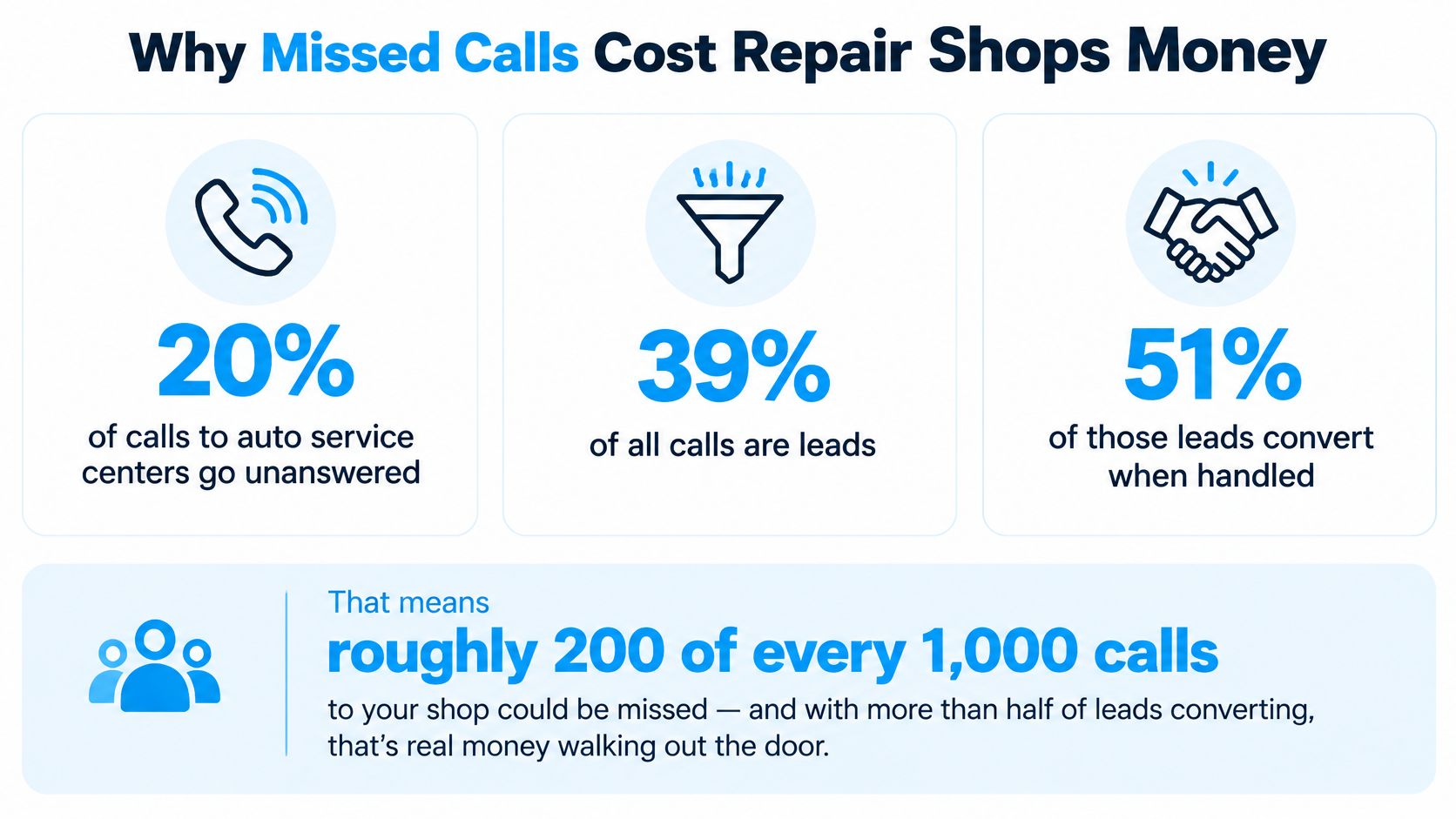
An Invoca analysis of inbound calls reported that approximately 20% of calls to auto service centers go unanswered, 39% of all calls are leads, and 51% of those leads convert when handled. Treat those figures as an industry benchmark; your own unanswered-call rate is the number that matters. Across 1,000 inbound calls, that benchmark would mean about 200 go unanswered.
At 9:15 on a Tuesday, an advisor is writing an estimate while a technician is finishing a brake job. The phone rings, but neither can stop. A caller with a grinding noise and another whose car won't start may try the next shop instead. Numa's 2024 Industry Trends report, covering nearly 600 service departments, found franchise dealership service departments missed about 158 appointment calls per month on average.
The problem also shows up in dealer call handling. Car Wars tracking cited by Kimoby, across nearly 3,000 dealerships, found that dealerships connected with only about 65% of inbound service callers. Among unconnected calls, 31.8% ended with the customer hanging up while on hold. Average hold time was 3 minutes and 5 seconds.
Every missed call is a repair order that may already be lost.
Track your call answer rate, then check whether answered calls result in appointments or a clear handoff. Capturing the vehicle and the concern on the first contact can help improve first call resolution.
What the Service Handles and When a Human Takes Over
An automotive answering service handles routine calls when the counter is busy or the shop is closed. Its job is to turn each call into a booking, a useful message, or a handoff to someone who can make a decision.
The call-type map
Set the call path by what the caller needs. The AI can answer using the shop's script and knowledge base, book appointments into the calendar, take messages, send follow-up texts, and transfer calls to a person. If it does not have the answer, it should say so and take a message, save the caller as a lead, or transfer the call.
| Call type | What the service does | Human needed |
|---|---|---|
| Book a service or repair appointment | Captures the vehicle's year, make, model, and concern, then books a service slot in the shop's calendar | For exceptions or a request that needs staff judgment |
| Repair estimate enquiry | Captures the vehicle and symptoms, answers from the shop's knowledge base, or offers a diagnostic appointment | If the requested estimate is not covered by the shop's information |
| Parts price or availability | Uses an uploaded parts cross-reference or inventory feed to answer common lookups | For complex questions or decisions the feed cannot answer |
| Repair status update | Takes the caller's details and message, then texts the shop or transfers the call | When a staff member needs to check the repair |
| Tow, no-start, or stranded driver | Sends the shop owner an immediate text when the caller uses terms such as “tow,” “won't start,” or “stranded” | Yes, for dispatch |
| Warranty, accident, or billing dispute | Captures the details and transfers the call to an advisor | Yes |
| After-hours general enquiry | Answers from the shop's knowledge base or takes a message for follow-up | If the caller needs a person |
A parts lookup is appropriate when the shop has provided the relevant cross-reference or inventory information. Complex fitment questions and pricing decisions belong with staff. For repair-status calls, the service can capture a message or transfer the caller; it should not imply that it can read a shop's repair-order system.
What must leave the AI
Transfer calls that require judgment, safety guidance, or a person's authority. Pass along the caller's details and stated concern so staff can pick up the conversation with context.
- Safety complaints: For brake, steering, or airbag symptoms, the AI can capture the concern and arrange a diagnostic appointment. It should not tell the caller the vehicle is safe to drive.
- Accidents, warranty disputes, and disputed estimates: Capture the facts and transfer the call to an advisor.
- Angry callers: Transfer billing arguments or other escalating complaints to a person.
- Authorization and complex pricing: Staff should handle requests to approve work or quote a job that is not covered by the shop's provided information.
Tow, no-start, and stranded calls need prompt human attention. The immediate owner text is an alert, not a dispatch service. The shop is responsible for configuring emergency calls to transfer promptly to a person and telling callers to contact emergency services directly when appropriate.
Judge the call by its next step
Pied Piper's 2025 Service Telephone Effectiveness Study evaluated 2,105 dealerships and 200 independent service centers. It found that customers were placed on hold for over two minutes 2% of the time, down from 13% in 2024, while callers disconnecting before an appointment was offered fell from 13% to 9%.
A fast answer matters only if the call moves somewhere useful. Check that the system offers a suitable appointment, captures a message when it cannot answer, and gets calls requiring judgment to a person. Configure AI and recording disclosures before calls begin, and make sure staff know how to handle the alerts and transferred calls.
How an AI Answering Service Handles a Repair Call
Telephone is still the main booking channel. An independent Pied Piper study reported by WardsAuto found that approximately two-thirds of automotive service appointments were still made by phone, and that dealerships set appointments for phone customers 91% of the time at the leading-performing brand. Build the voice path for that channel, not as a backup to a web form.
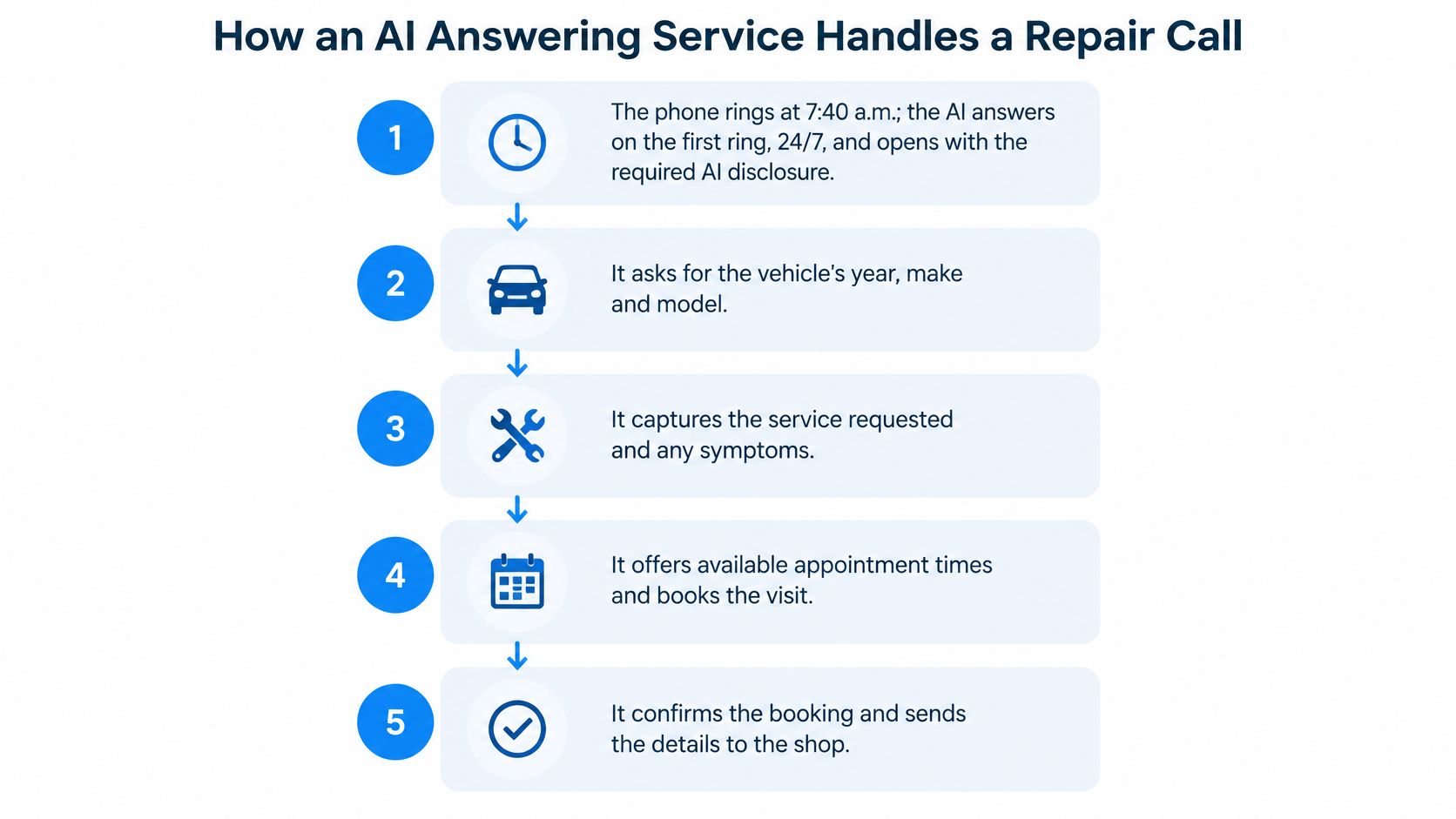
- The phone rings at 7:40 a.m. The AI answers on the first ring, 24/7, and opens with "I'm an AI assistant." Callers shouldn't have to guess who they reached.
- It asks for the vehicle's year, make, and model first. Fitment, service interval, and parts all depend on that, and the shop has it before the customer arrives.
- It captures the concern in the caller's words, such as brakes grinding, AC not cold, or a warning light, plus mileage or symptom detail, whether the car is safe to drive, preferred timing, and a callback number.
- It checks hours, appointment duration, technician capacity, and blackout dates, then offers a real opening and writes the visit to the calendar with the vehicle and issue attached. J.D. Power's 2024 U.S. Customer Service Index found mass-market vehicle owners waited an average of 5.2 days for a dealer service appointment, up from 4.8 days in 2023. Offer a slot you can keep, not a promise to call back.
- It asks whether later updates should be SMS, voice, or another channel, then texts a confirmation that repeats the vehicle, service, date, time, address, and callback number.
- For hours, parking, and menu prices it uses the shop's knowledge base. If the answer isn't there, it says so and takes a message.
- Diagnosis, warranty interpretation, an unavailable part, or a pricing judgment becomes a warm transfer with the context attached.
- Words like "tow", "won't start", or "stranded" trigger an immediate text to the owner.
J.D. Power's 2025 U.S. Aftermarket Service Index, covering 10,348 owners surveyed from February through April 2025, found that 56% of tire-replacement and quick-oil-change customers preferred text-message work updates, yet some received phone calls instead. Use the stated preference for confirmations, repair-status notes, and declined-work follow-up. A voice-only trail feels unresponsive to people who asked for text.
The short walkthrough below shows the same path from ring to booked visit.
After the call, the shop sees a transcript, a recording, and an outcome on every conversation. Structured fields, not only a paragraph of speech, are what make the appointment usable in the morning.
What an Automotive Answering Service Costs
Cost depends on who covers the phone, when they answer, and what happens after a call. Compare the full workflow, not just the cost of picking up: a useful call should end with a booked appointment, a message for the team, or a transfer when a person needs to take over.
| Option | Main cost factors | After-hours cover | Call spikes |
|---|---|---|---|
| In-house receptionist | Salary, benefits, and training | Requires scheduled coverage | Limited by staff availability |
| Live answering service | Plan structure, call volume, and any overage charges | Depends on the service arrangement | Depends on available capacity |
| AI answering service | Usage, telephone costs, and any number rental | Can answer around the clock | Can handle concurrent calls |
An in-house receptionist gives the shop a person who can use judgment, but coverage depends on staffing. A live answering service can extend coverage, though the exact plan and whether calls are booked or passed on vary. An AI receptionist can follow the shop's script, book into its calendar, and transfer calls to a person. Diagnosis and judgment stay with the advisor.
Dial Milo uses prepaid, usage-based billing. AI processing and telephone costs are charged separately, and individual call charges appear in the dashboard. Phone numbers have a monthly rental charge, while prepaid balances do not expire. Compare the costs of each option with the answering service cost calculator, which estimates monthly, annual, and per-call expenses.
A no-start call can lead to a mobile repair visit rather than a workshop booking. For context on that separate service cost, see the typical call-out fee for Irish motorists.
Practical rule: Match the cost to the work. Routine booking and call capture suit a scripted workflow; diagnosis and decisions about repair work need a human. Measure whether calls produce appointments, useful messages, or timely transfers, not just whether they were answered.
Outbound Reminders and Win-Backs That Stay Compliant
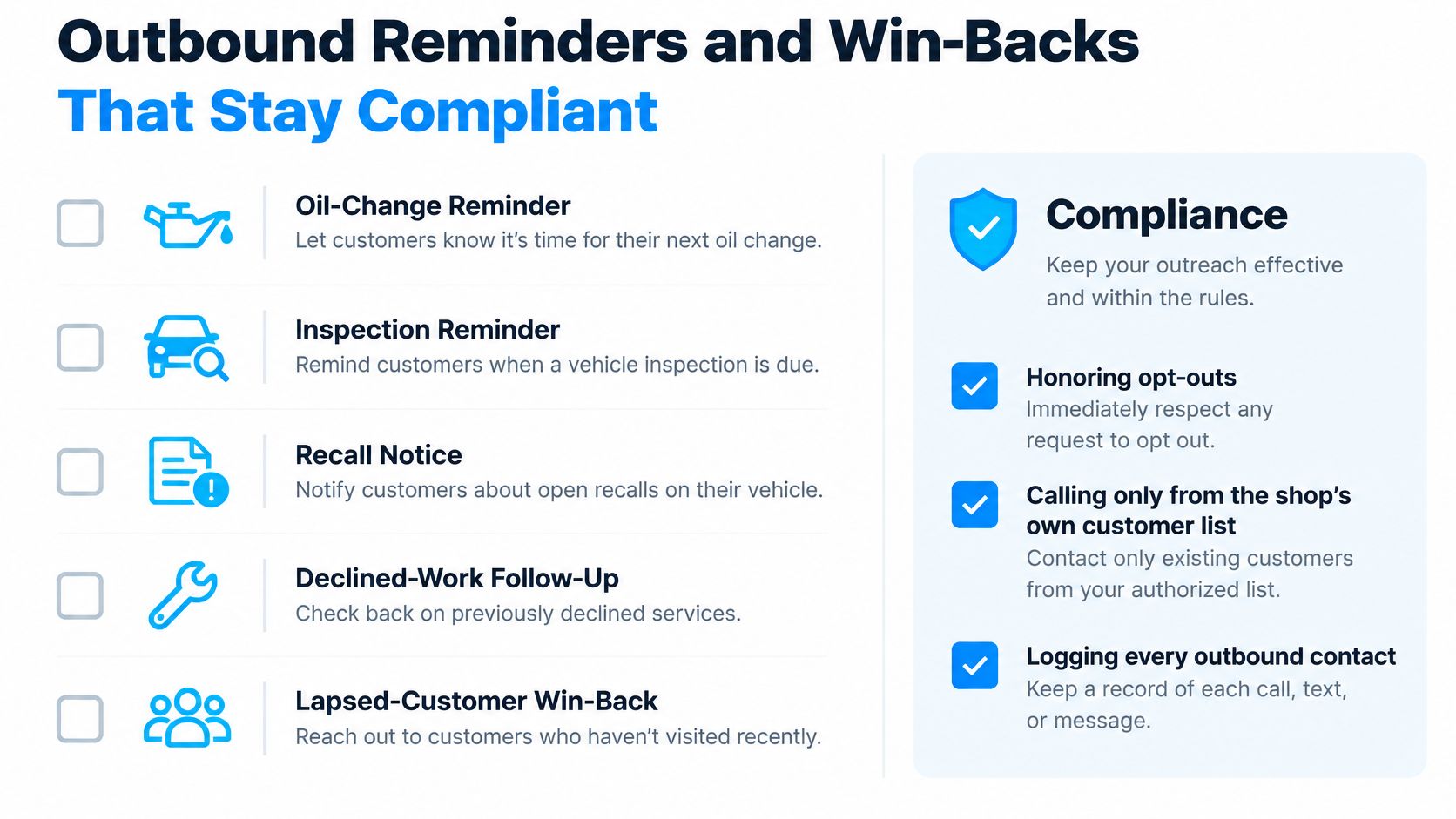
A reminder call only helps if it produces a useful next step. Shops can use outbound calls for oil-change and inspection reminders, recall notices, declined-work follow-ups, and lapsed-customer win-backs. Post-job surveys belong in a separate follow-up. These post-job survey message templates offer examples of questions to ask after the vehicle is returned.
How a campaign runs
Start with a clean list and a clear purpose for each call. Milo tells each person at the start that it is an AI, calls in the contact's local time, answers questions using the business's script, and records how the call ended. Track each call as confirmed, rescheduled, declined, unreachable, wrong number, or needs a human. Those outcomes show whether the campaign is filling appointment slots or only placing calls. The guide to automated outbound calls explains how call results can feed a follow-up journey. Configure AI disclosure, recording disclosure, and opt-out handling before the campaign begins.
The rules in plain language
Call only people who have agreed to hear from the business. Under the FCC's guide to unwanted robocalls and texts, non-emergency autodialed or prerecorded calls to mobile phones generally require prior express consent. Written consent is required for calls that include advertising. The FCC treats AI-generated voices as artificial voices under the Telephone Consumer Protection Act, so using an AI voice does not remove those requirements.
The FTC's Telemarketing Sales Rule guidance prohibits outbound telemarketing calls to a person's home before 8:00 a.m. or after 9:00 p.m. local time, unless the person consented to different hours. For lists spanning time zones, keep each contact's local time available and schedule calls and retries within the permitted window.
Give callers a clear way to opt out, and honor requests such as “stop calling,” “remove me,” or “do not contact me.” Record the request and apply it to future attempts. A request for a human should trigger a transfer; an opt-out should suppress future calls.
Keep service reminders separate from promotional offers. A past repair visit alone does not establish permission to market. Maintain consent records and identify whether each number is mobile or residential.
Set Up a Service and Measure the First Month
Set the call workflow around the calls your shop misses. Review missed-call records and identify when they occur and what callers need. That gives you a practical starting point for choosing daytime overflow, closed-hour coverage, or answering every ring.
- Choose coverage. Match service hours to the gaps in your missed-call data. If calls go unanswered mainly during repairs or busy counter periods, begin with those windows.
- Point the number. You can get a new number or forward your existing business line.
- Draft the script from the website. The service can use your website to draft a script, which you can edit for greeting, voice, tone, business hours, and after-hours behavior. Add a parts cross-reference or inventory feed, and connect the business calendar for bookings. Milo answers from the script and knowledge base you provide, including common questions about hours and parking, and can route complex parts questions to a person.
- Set the call path. Decide which questions the AI can answer, when it should take a message, and which calls should transfer to a person. Configure emergency calls to reach a human promptly, and tell callers how to contact emergency services when needed. The business remains responsible for calls answered and actions taken on its behalf.
- Test four paths. Try a booking, a parts lookup, a tow call, and an after-hours message. Check that the calendar entry includes the vehicle and concern, and that the shop receives the appropriate text.
- Measure the first month against a staff baseline. Use the same call categories and booking definitions for both.
A Dealer.com analysis of 2,464 dealership service calls evaluated 21 call-handler behaviors and reported call-to-appointment conversion rates ranging from 11% to 90%. The gap makes the outcome worth tracking, not just whether a call was answered.
Track three measures: calls that became booked appointments, appointments that were completed, and the staff time spent handling calls and follow-up. Review recordings and transcripts regularly for incorrect information, unsafe repair advice, privacy issues, and bookings that do not fit the shop's actual capacity. For outbound reminders and win-backs, record each result consistently: confirmed, rescheduled, declined, unreachable, wrong number, or human follow-up.
Dial Milo answers inbound calls, books appointments into the shop's calendar, and can text the business about calls. It also supports outbound reminders and win-back campaigns. Judge the setup by whether it produces completed appointments and useful follow-up, not by answer rate alone. If routine calls are crowding out service work, put those calls on an automotive answering service and keep judgment calls with your advisors. Visit Dial Milo to set up the line and place a test booking before the next rush.
Keep reading
No One Answer the Phone? How to Catch Every Call
When no one answer the phone, every missed call can become a lost enquiry. Learn how to capture callers, call back fast and stay compliant.
Read
AI Answering Service Explained: How Calls Are Handled
Learn what an AI answering service does on every call, how bookings, handovers and outbound campaigns work, and what it costs.
Read
AI Voice Agents Explained: How They Work for Business
AI voice agents answer calls, book appointments and place outbound calls. Learn how they work, where businesses use them and the rules to follow.
Read