
Two hundred and eighty numbers dialled on Tuesday. A hundred and ninety people picked up. The average score came back at 4.6 out of five, and the dashboard printed it in green.
On Thursday a one-star review appears from a customer who says nobody ever asked how the job went. An email follows from someone who was called twice in one evening and wants it stopped.
Both reports describe the same week. A finished call isn't the same thing as trustworthy feedback, and the gap between those two things is where most feedback programmes fail. The phone still surfaces what a one-tap survey never names: a 25-minute wait, a price that surprised someone at the counter, a job left half finished. Getting that detail depends less on the questions than on who you ring, when you ring them, and what you write down when the call ends.
What a Feedback Call Is For
A salon owner dials the morning after a colour appointment. The customer has already left a three-star review overnight. The colour was fine, she waited 25 minutes past her slot, and nobody told her why. A two-minute call the evening before would have found that out privately, while an apology and a booking fix still counted for something.
That is the job. The phone earns its place because it's where messy problems get explained out loud. More than 50% of customers across age groups typically use the phone to contact a service team, and 81% of service professionals name phone support as a preferred channel for complex issues, according to customer-service research compiled by Influx. The same compilation reports satisfaction of 91% for phone support against 85% for live chat. People don't just rate problems on a call, they describe causes, expectations and what they were told at the desk.
Three jobs sit behind every useful feedback call, and they run in this order:
- Decide who is worth calling and why. A post-visit list, a no-show list and a lapsed-customer list need different questions. Mixing them produces calls that wander.
- Ask for a reason, not only a number. A rating without a sentence attached tells you nothing you can hand to a person.
- Log an ending that names the next action. Completed, declined, no answer, callback, complaint, opt-out, booked. If the ending is vague, the follow-up is guesswork.
The rule that shapes everything downstream: an unanswered call is not a neutral opinion, and a feedback conversation is not a sales pitch squeezed into the same two minutes.
The same three jobs apply whether you're a two-chair salon, a dental clinic, an auto shop with cars on the ramps, a hotel front desk or a team dialling 20,000 consented numbers for a subscription or a reactivation list. Volume changes how you audit the calls. It doesn't change what makes one worth making.
Sample Questions for a Two-Minute Feedback Call
Keep the call to roughly two minutes and four beats: permission, a rating, one open reason, and a check that nothing is still hanging. Longer calls drop completion on a list of 5,000. Shorter ones hand you a number with no story attached.
Read the table as the script itself. Each row is one beat.
| Beat | Ask this | A usable answer | Do not |
|---|---|---|---|
| Permission | "Is now a good two minutes, or should I call back?" | Yes, a later time, or a clear stop | Keep talking after a no |
| Which visit | "I'm calling about Tuesday's colour appointment. Is that the right one?" | Yes, or they name a different visit | Talk about "your recent experience" with no date |
| Rating | "On a scale of 1 to 5, how did that visit go?" | A number | Follow the number with a discount |
| One change | "What is one thing we should do differently next time?" | A wait, a price, a person, or a step | Accept "fine" with no probe |
| Still open | "Is anything from that visit still unresolved?" | Yes or no, plus the open item | Turn the answer into a sales pitch |
| Almost cancelled | "What almost stopped you booking or coming in?" | A concrete barrier | Argue with the reason |
| Would return | "Would you come back, and what would make that easy?" | A conditional yes with the condition | Treat a yes as a new booking |
The last two rows are optional. Add them on win-back and reminder lists, where the barrier matters more than the score.
What separates feedback from a rating
A usable answer has a number or a clear yes or no plus a concrete reason you could hand to a manager. A bare "five" with no sentence is a score, not feedback, and it can't be acted on by anyone.
"Was everything okay?" invites "fine", because it's the polite answer and it ends the call fastest. Ask "What is one thing we should do differently next time?" instead. If the reply is "nothing, it was fine", probe once: "Was there a moment that took longer than you expected?" Then stop. A second probe turns a feedback call into an interrogation.
Name the specific thing you're calling about. "The brake job on the blue Golf, picked up Wednesday" gets a real answer. "Your recent experience with us" gets a shrug.
Keep the offer off the call
Don't attach a discount, a renewal or a win-back offer to the score. The moment a customer hears a pitch, the rating stops describing the visit and starts describing the offer. If the business needs to make an offer, do it on a later call or in a text once the feedback is logged.
Use the same wording on every call in a list, so the numbers mean the same thing across the batch. If you test a variant, change one line only. Teams building this out for larger lists can borrow the structure in these AI call script templates, which keep the opener, questions and close in a fixed order while you test one element at a time.
For your next ten calls, pick one rating and one open question, write them down, and don't improvise a third.
How to Conduct a Customer Feedback Call
Order beats wording. A beautifully written script delivered without consent screening, at the wrong hour, to someone who never agreed to hear from you, is a complaint generator with a log file.
The first decision is who places the call: a person, or an AI working from a fixed script. Everything after that is sequence.
Here is the sequence to follow.
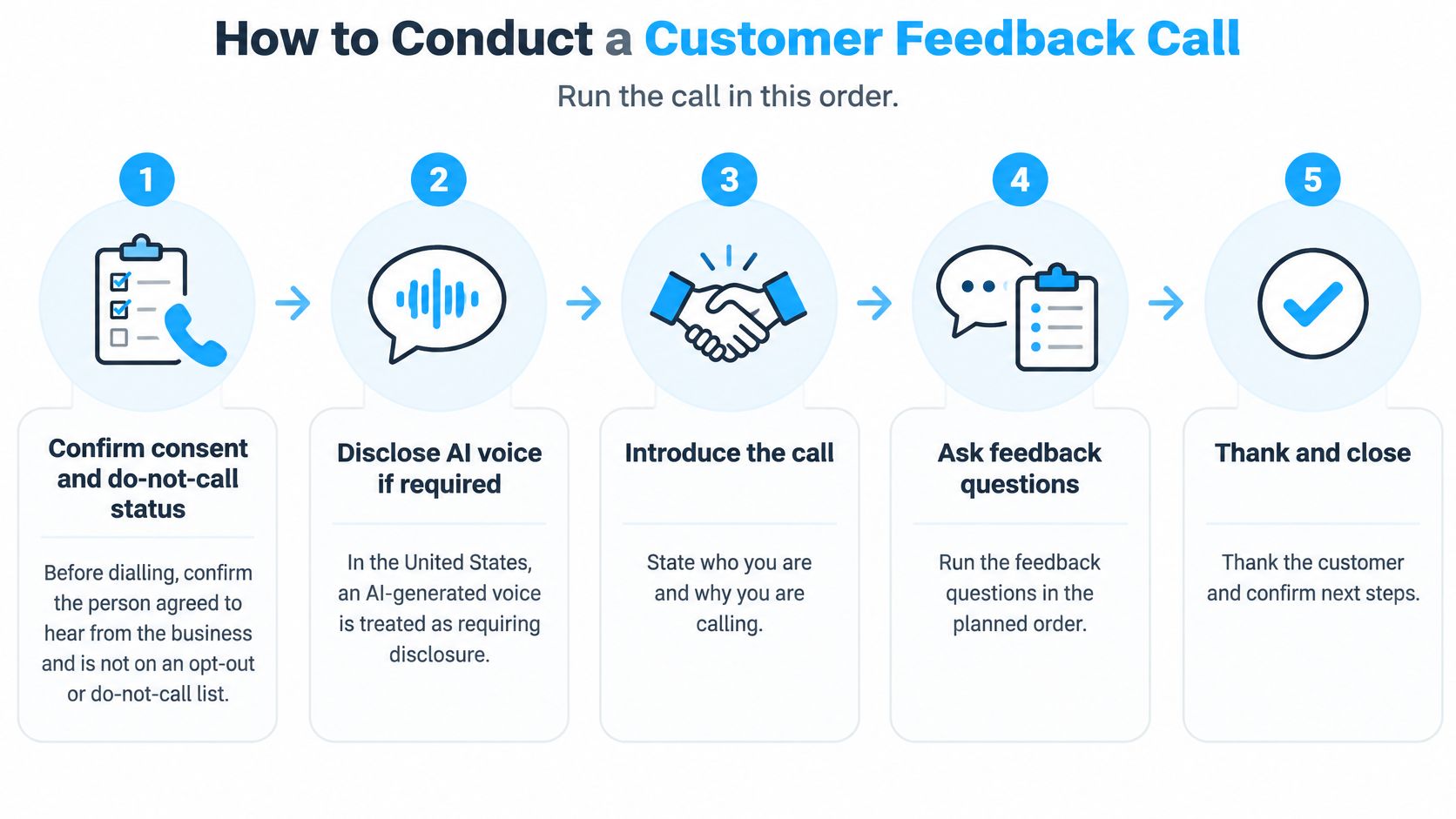
- Confirm consent and do-not-call status before dialling. In the United States, AI-generated voice calls are treated as calls using an artificial or prerecorded voice under the Telephone Consumer Protection Act, and the FCC's declaratory ruling on AI-generated voices states that callers generally need the called party's prior express consent, unless an emergency or another recognised exemption applies. An existing customer relationship on its own isn't enough.
- Call in that person's local daytime hours. Say the business name. If an AI is speaking, say so at the start. Ask whether two minutes is all right.
- Name the visit, job or order. The Tuesday colour, the brake job, Friday's viewing, order 4471.
- Ask the rating, then the open question, then whether anything is still unresolved. Use plain words, offer to repeat any question, and confirm the language if the person isn't comfortable in the opening language.
- Stop the survey if it turns serious. Safety, discrimination, a billing dispute, distress, or a request for a person means a handoff. An automated caller can take a rating. It should not finish that conversation.
- Honour a stop immediately. End the call and remove the contact before the next attempt, not at the end of the week.
- Read back any callback or new time, then text a confirmation. A booked time with no written confirmation is a booking you'll make twice.
- Log the ending before the next dial. Completed, declined, no answer, callback, complaint, opt-out. A no-answer isn't a two out of five.
Screening outbound contacts against do-not-call registers, and honouring opt-outs the moment they're given, sits with the business running the campaign. That responsibility doesn't transfer to the dialler, the AI or the agency.
The closing questions do as much work as the opening ones. If you're refining how the ask is phrased so it doesn't sound like a survey, review² on guest feedback scripts is a useful reference for wording that gets a sentence back instead of a grunt.
Why Customers Ignore Unknown Feedback Calls
The hard part usually isn't the question. It's getting a real customer on the line in the first place.
Telephone survey response has collapsed. Pew's US telephone-survey response rate fell from 36% in 1997 to below 6% in 2018, and the organisation stopped outbound telephone polling in 2022, as Médiamétrie's analysis of survey collection sets out. The reason isn't that people stopped having opinions. It's that they stopped answering numbers they don't recognise.
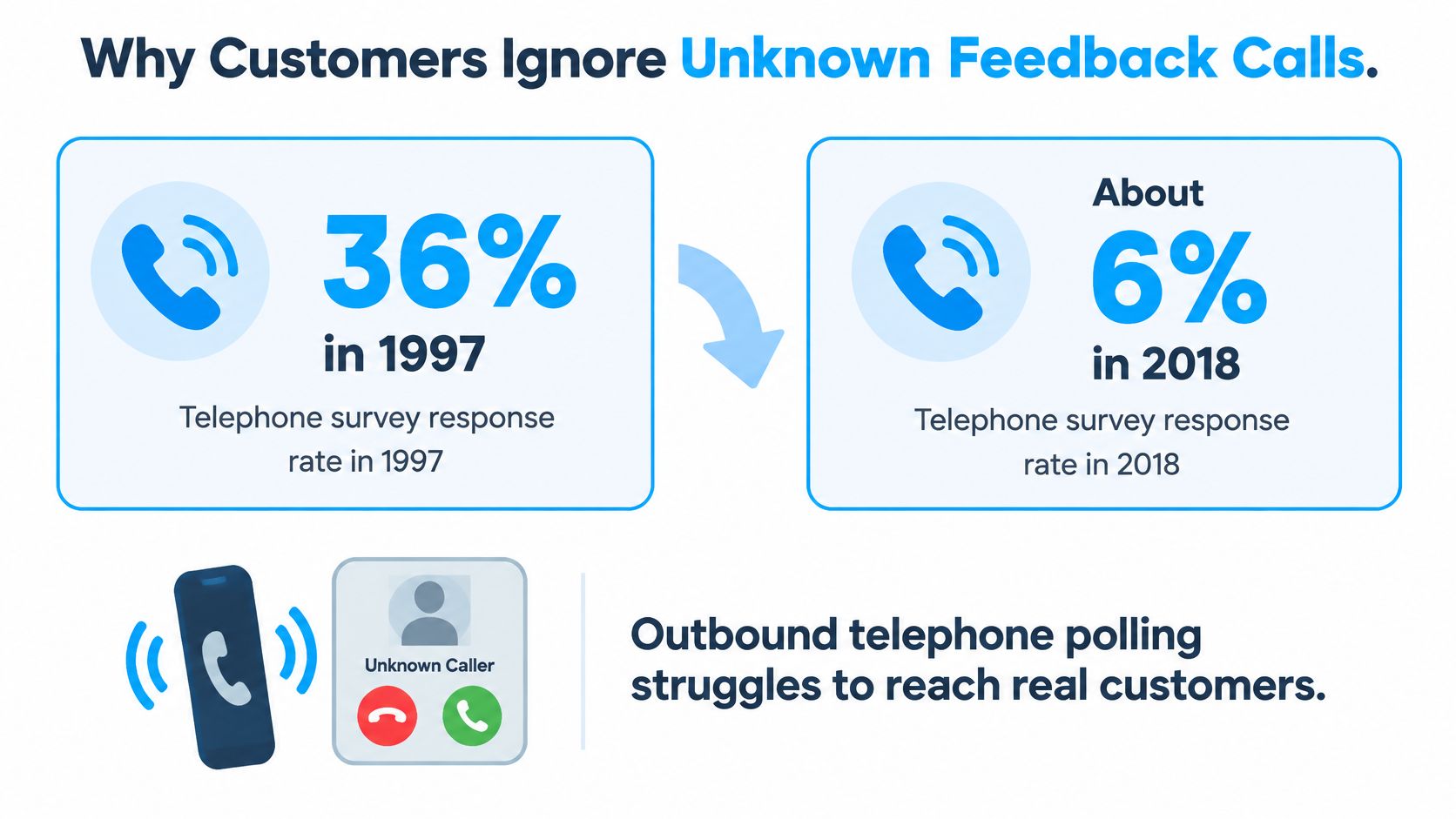
The same source puts numbers on the screening problem. Recent French data cited by Médiamétrie indicates that more than 70% of mobile users encounter fraud or unwanted calls weekly, while first-call pickup was reported at only 5.7% for non-geographic numbers against 21.7% for standard landlines. A 2025 US Kantar/TNS survey found that 75% of adults had missed an unknown-number call they would have answered if they had known who was calling, and 81% would answer when the call followed a recent action with that brand.
| Figure | Value | Context |
|---|---|---|
| US telephone survey response rate | 36% in 1997 | Fell to about 6% by 2018 (Pew data) |
| First-call pickup, non-geographic numbers | 5.7% | Recent French data cited by Médiamétrie |
| First-call pickup, standard landlines | 21.7% | Same French data, for comparison |
| Mobile users meeting fraud or unwanted calls weekly | More than 70% | Recent French data |
| Adults who missed an unknown-number call they would have answered | 75% | 2025 US Kantar/TNS survey |
| Adults who would answer after a recent action with the brand | 81% | 2025 US Kantar/TNS survey |
Four things that raise pickup
- Be recognisable. Show the business name on caller ID where the carrier allows it, or dial from the number the customer already has in their phone. A random area code reads as spam.
- Warn them first. A short text or email that names the visit and says a two-minute call is coming, with a way to opt out, converts a cold pickup into an expected one.
- Call close to the event. Soon after the appointment, job or order. Weeks later, the customer has to reconstruct the visit and often doesn't bother.
- Leave one voicemail and offer a callback. Say who you are and why, and let them pick a time. Don't run the survey on the recording.
Timing deserves more attention than it usually gets. If your list spans time zones, calling customers at the right hour is the difference between a pickup and a third failed attempt.
Here's a short walkthrough of how outbound calling and follow-up fit together in practice.
Then report in four piles, kept apart: reached and completed with a reason, refused, unreachable, and actionable issue raised. One controlled retry is enough for the unreachable pile. A high completion rate can mean you only heard from the people who answer unknown numbers, and the youngest, most privacy-sensitive or already-annoyed customers are exactly the ones missing from your average.
When a High Score Is Not the Real Story
A friendly voice makes bad news harder to deliver. That's not a theory about your customers, it's a measurable effect on the channel.
A meta-analysis of 18 experimental comparisons found that telephone respondents were significantly more likely than respondents in other modes to select extremely positive answers, while not becoming more likely to give extremely negative ones, according to a Public Opinion Quarterly meta-analysis of mode effects. The proposed explanation is social desirability: people are reluctant to hand bad news to a person on the line.
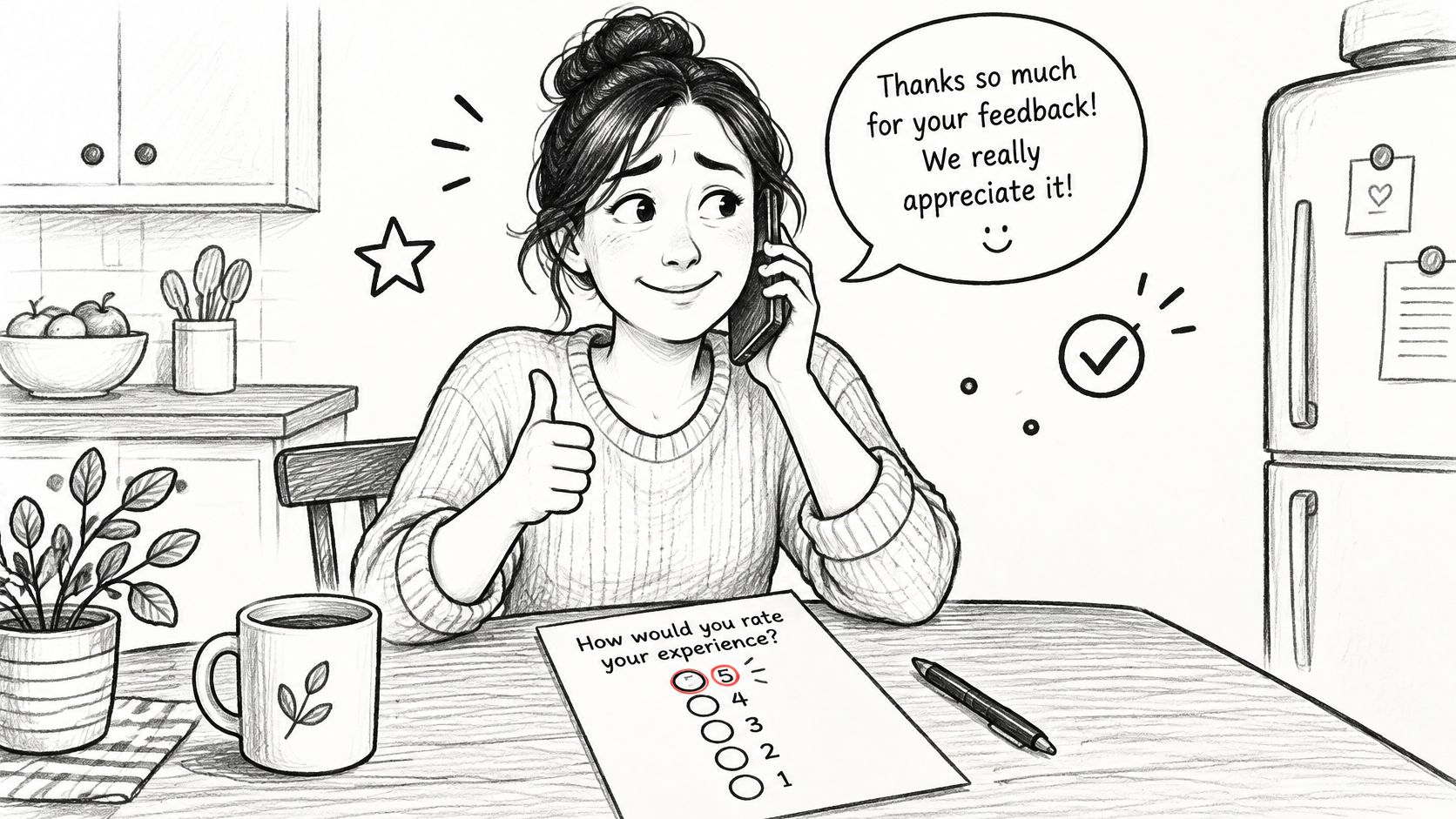
Picture a visit that went badly. The customer waited, the finish was rushed, and the price came as a surprise. Now a staff member who did the work asks, twenty minutes later, how it went. Plenty of people will say four. Some will say five to be kind. The average drifts upward, and the manager reading it concludes the week was fine.
Four checks that keep the number honest
- One neutral script, no exceptions. If each caller improvises a warmer or chattier version, you can't compare batches.
- Keep the open question beside the rating. A 4 with "the wait was long" is a diagnosable result. A 4 alone is decoration.
- Never pair the score with a tip request, a review link or a renewal. The ask changes the answer.
- Compare phone ratings with a short SMS later the same day. Track the gap by service type and by whether a person or an AI asked the questions. A large, consistent positive gap between the call and the text is a measurement artifact, not proof of excellence.
If the written comments say "wait" and the scores say "excellent", believe the comments.
A 4.6 average after a haircut or a service visit overstates how the visit felt more often than operators expect. Treat that figure as an illustration of the risk, not a benchmark, and check your own phone scores against your own later text or web replies. More callbacks can lift completion, but a higher response rate doesn't remove the politeness pull or the bias from the people who never answer at all.
How to Turn Each Call Into a Follow-Up
A transcript nobody codes is a recording, not feedback. The difference is whether someone reads the reasons and changes something.
Speech analytics shows what coverage buys you. In a contact-centre deployment that combined transcription, semantic tagging and rule-based classification, assessed process quality improved by 15% against manual call sampling, analysis time fell by approximately 17%, and detection of calls that needed cancellation because of serious agent errors improved by more than 300%, as reported in the speech-analytics study on transcript classification. The mechanism is plain: coverage plus structured coding. Every conversation becomes a comparable field instead of an anecdote.
The one metric to watch
Not average score. Watch the percentage of calls with a completed disposition and a named next step, split by campaign, script, issue type, and whether a person took over the call. That number tells you whether the programme produces decisions or just reports.
Tag every transcript for sentiment, unresolved issues, booking friction and escalation triggers. Then audit a sample against the recording, because transcription errors and missing context mislabel calls. A wrong tag sends a customer to the wrong queue.
| Ending | What it means | Next action |
|---|---|---|
| Completed with a reason | A score plus something specific | Tag the theme and name an owner if a fix was stated |
| Praise only | A high score and no detail | Hold it out of the all-clear pile until a later text or comment |
| Declined | They refused the questions | Do not enter a middle score; note the refusal |
| No answer | Never reached | One local-hours retry or a text, then stop |
| Callback requested | Willing but busy | Book the time they named and text the confirmation |
| Unresolved issue | Something from the visit is still open | Assign a person the same day, not another survey |
| Safety, billing, or distress | Too sensitive for a script | Stop the survey and transfer or call back with a person |
| Opt-out | They asked you to stop | Remove them before the next attempt |
| Booked or rescheduled | They took an action on the call | Send the written confirmation and close the feedback task |
The routing is where the value lands. A salon that hears "I waited 40 minutes" three times in one week has a front-desk scheduling problem, not a satisfaction problem, so the fix belongs with the front desk. An auto shop that hears "the car wasn't ready when you said" owes a status call, not a second rating request. A clinic comment about a missed reminder changes the reminder, and gets counted separately from satisfaction.
Don't assume a call beats a text
A controlled study comparing text-message and telephone appointment reminders found similar missed-appointment rates, 11.7% in the text-message group versus 10.2% in the telephone group, with a reported P value of 0.07, published in BMC Health Services Research. The reading is practical: use calls where clarification, rescheduling or a human decision is needed, and send texts for simple logistics.
Send the result back to whichever system triggered the call, so a CRM-triggered phone call leaves a record the next step can act on rather than a note buried in a spreadsheet.
Review tagged reasons weekly. When a customer named a fix and you made it, tell them. That closing loop is what turns a feedback call into retention rather than a data entry exercise. Teams formalising the handoff between support and operations will find brand support resources from The CX Guys useful for the parts that sit outside the phone.
Make Feedback Calls Work for Every Caller
Phone feedback isn't one uniform channel, so plan for who can really answer. Start with the languages your customers use, offer the call in the one they choose, and have a script for each that you've checked means the same thing in every version before launch.
Expect the phone to suit some groups less than others. A 2025 report found that Gen Z shows lower preference for phone-based surveys than other generations, according to Medallia's research on giving feedback by generation, so keep a text or web route open alongside the call. The same source records that California's 2025 unemployment program logged 560,385 calls through dedicated language lines and 48,552 requests for third-party telephone interpretation, with Spanish the most requested language. Demand behind a language gap is real, and it doesn't show up in a blended score.
For accessibility, let the caller hear any question again, allow a slower pace, accept a keypad answer where the question allows one, and offer a callback time they choose. For escalation, name in advance who takes safety, billing disputes, distress or any request for a person, and transfer during the call rather than logging it for later.
Two checks before launch. Call your own escalation path and see how long it takes to reach a human. Then count escalations by language group and by issue type, so a gap in one community shows up in the data instead of in a review six weeks later.
Choose Who Places the Next Feedback Calls
Decide by the kind of call. Safety, billing, distress and complaints that need judgement belong to a person, every time. A fixed two-minute post-visit script fits routine feedback once consent, a local calling window, disclosure and an instant opt-out are in place, and that second kind of call can be run by staff or by an AI the customer has agreed to hear from.
Dial Milo is one way to run the second kind. It calls your own consented list for surveys and feedback, tells each person at the start of an outbound call that it is an AI, calls in each contact's local time timezone, caps spend, and lets you A/B test up to five scripts. Calls are logged with the caller's number, duration, timestamp and outcome, and you can read recent calls with summaries and transcripts, so you see who said yes and who needs a person next. When a customer needs a human, it transfers the call. It also books appointments into Google Calendar, sends text confirmations, and can answer your inbound line 24/7 if feedback starts as a call in.
Setup takes about three minutes from your website. Pricing is prepaid pay-as-you-go with no subscription, no monthly minimum, no contract and no per-seat fee.
| Item | Price | Note |
|---|---|---|
| US number | 3 dollars per month | Plus a one-time 3 dollar setup fee |
| Existing number | Free | Forward it to a Dial Milo number |
| Talk time on a US number | About 12 cents per minute | Standard engine, billed per second |
| Outbound calls nobody answers | Free | No charge for unanswered calls |
| Text message | 1 cent each | Confirmations and follow-ups |
| New account credit | 1 dollar | No card required |
| Subscription, minimum, contract, seat fee | None | Unused balances are not refunded |
Full figures are at Dial Milo's pricing page.
There's a broader operational question behind this: how much of the customer experience work should sit on the owner at all. Offloading customer experience responsibilities from GRIT Virtual Assistants LLC covers which parts of the follow-up load can move off the owner's desk without losing the judgement calls that need a human.
Start with ten recent customers who agreed to hear from you. One rating, one open question, one logged ending per call. Review the endings before you scale anything. You can sign up here and be running those ten calls today.
Dial Milo answers your inbound line 24/7 and runs outbound survey and feedback campaigns against a consented list, disclosing the AI at the start, calling in each contact's local time, recording how every call ended, and handing the sensitive conversations to a person. Setup takes about three minutes from your website, and you can hear the receptionist in a free 60-second browser demo before going live. Visit Dial Milo and start with ten calls you can trust.
Keep reading

Customer Retention Calls: 8 Strategies for 2026
Customer retention calls explained: eight practical strategies for reminders, follow-ups, win-backs and renewals, with compliance steps and real examples.
Read
Finance Answering Service: Automation Limits and Privacy
Finance answering service guide: which calls AI can handle, how to protect caller privacy, capture accurate messages and hand over calls safely.
Read
Answering Services for Funeral Homes: What They Cost and Do
Compare answering services for funeral homes by cost, after-hours coverage and urgent-call routing, and learn the price and consent rules to follow.
Read