Customers who leave rarely file a complaint first. A patient misses a check-up, a member lets a renewal hit a card they meant to cancel, a player stops logging in after one question nobody answered. If you run a clinic, a salon, a trade desk, a subscription list, or a large player file, that quiet gap is already the retention problem.
Voice still carries the talks that decide whether someone stays. In a 2025 Forrester survey of 719 U.S. decision-makers responsible for outbound communications, 86% said the phone was the most important outbound channel for meeting customer-service goals and increasing revenue, and those organizations made 26% fewer calls than in the earlier study while using other digital channels more. The useful pattern is selective calling: call the contacts who need a reason to hear from you, and leave the rest to email or SMS.
A missed hygiene visit and a policy that lapses because nobody explained the premium are the same operational miss. The useful call names the time, the amount, or the next step in the first sentence, then ends. These eight customer retention calls cover the path from the week after a sale to a lapsed-customer win-back. Consent, an upfront AI disclosure, and a working opt-out belong in every script, with a check on the list before you launch.
1. Appointment Reminder and Confirmation Calls
A dental practice that calls two days before each check-up, states the slot in the first sentence, and rebooks anyone who needs to move will keep more of the book than a reminder that only hopes they show. A salon can do the same the evening before a colour appointment and record who wants a different time.
That short call is what a booked diary sounds like when someone is still free to move the slot.

Keep it under about a minute. Say it is an AI assistant before you give the time. In a February 2024 FCC ruling, AI technologies that generate human-like voices fall within the Telephone Consumer Protection Act's artificial-or-prerecorded-voice restrictions. Outbound calls to residential lines using that technology generally require prior express consent unless an exception applies, and the entity behind the call must be identified. Telemarketing messages also need an opt-out.
- Time first: Name the day and the clock time before any other detail.
- One action: Confirm or reschedule. Don't pitch a new treatment on a reminder.
- A person on request: Transfer with the name, number, and reason already captured.
- Text straight after: Put the slot in writing so it isn't only in a recording.
Automated appointment reminder calls can run from an uploaded list, book the moved visit, and show who still needs a person. Pair the log with no-show policies that fill classes so a freed slot is offered to someone waiting.
2. Post-Service Follow-Up and Satisfaction Check
Two days after a repair, the customer either feels finished or is already telling a neighbour the noise is back. An auto shop that calls then, asks whether the car runs well, and books a second visit a technician already flagged will hear the problem while the customer will still talk. A trades business can check that an installation works and send a failed answer to the office for a same-day callback.
Practical rule: One or two open questions. If the first follow-up also sells, people stop picking up the next one.
The ACA State of Customer Experience 2025 reports that 82% of customers prefer speaking with a real person when they need support, and 63% have stopped doing business with a company because they could not reach support. I treat cancellation language, a repeated question, a safety worry, or an explicit request for a person as a handoff, not as another scripted prompt.

Write the trigger list before launch and read it every week. Pass the caller's words to the human so they don't start the story again. A clean "the job is fine" can close. A vague "it's okay, I guess" should not.
3. Lapsed Customer Win-Back Campaigns
Six quiet months is not a reason to keep ringing until someone snaps. A salon can call clients who opted in, mention one new treatment, and book only the people who say they want to come back. A sportsbook, inside its licence conditions, should call previously active players who opted in to promotional calls and offer a support conversation, not a bonus pushed on someone who asked to be left alone.

The FTC's Telemarketing Sales Rule guidance generally prohibits telemarketing calls before 8:00 a.m. or after 9:00 p.m. in the time zone where the consumer is located, unless that person has agreed to different hours. One office clock will hit some contacts too early. Schedule each number in the recipient's local time.
- Suppression list: Block voice and text together the moment someone asks not to be called.
- Small test: Two or three scripts on a slice of the file before the full list.
- Spend cap: Set it before launch so a long file can't overrun the budget.
Win-back campaigns should show who said yes, who asked to be removed, and who is worth one more try. I wouldn't place another call after an opt-out, even when the offer is strong.
4. Renewal and Subscription Reminder Calls
Passive churn is a member who meant to stay and never saw the date. A gym that calls 14 days out, states the renewal date and the amount, and offers a cheaper tier only if the member asks, will save some of those quiet losses. An insurance agency can confirm contact details and explain a premium change without rewriting the policy on the line.
If the message is prerecorded telemarketing, the opt-out has to work while they are listening, not only when your office is open. FTC rules for prerecorded telemarketing messages require an automated interactive opt-out, by voice, keypad, or both, that adds the number to the seller's Do Not Call list and disconnects the call. It has to stay available whenever the message plays.
Say how to cancel in the first minute. Don't change a contract unless the customer agrees and a person confirms the change. Check automatic-renewal rules in your market before the script goes live. A reminder that hides the cancel path creates complaints faster than it saves the payment.
5. New Customer Onboarding Check-In
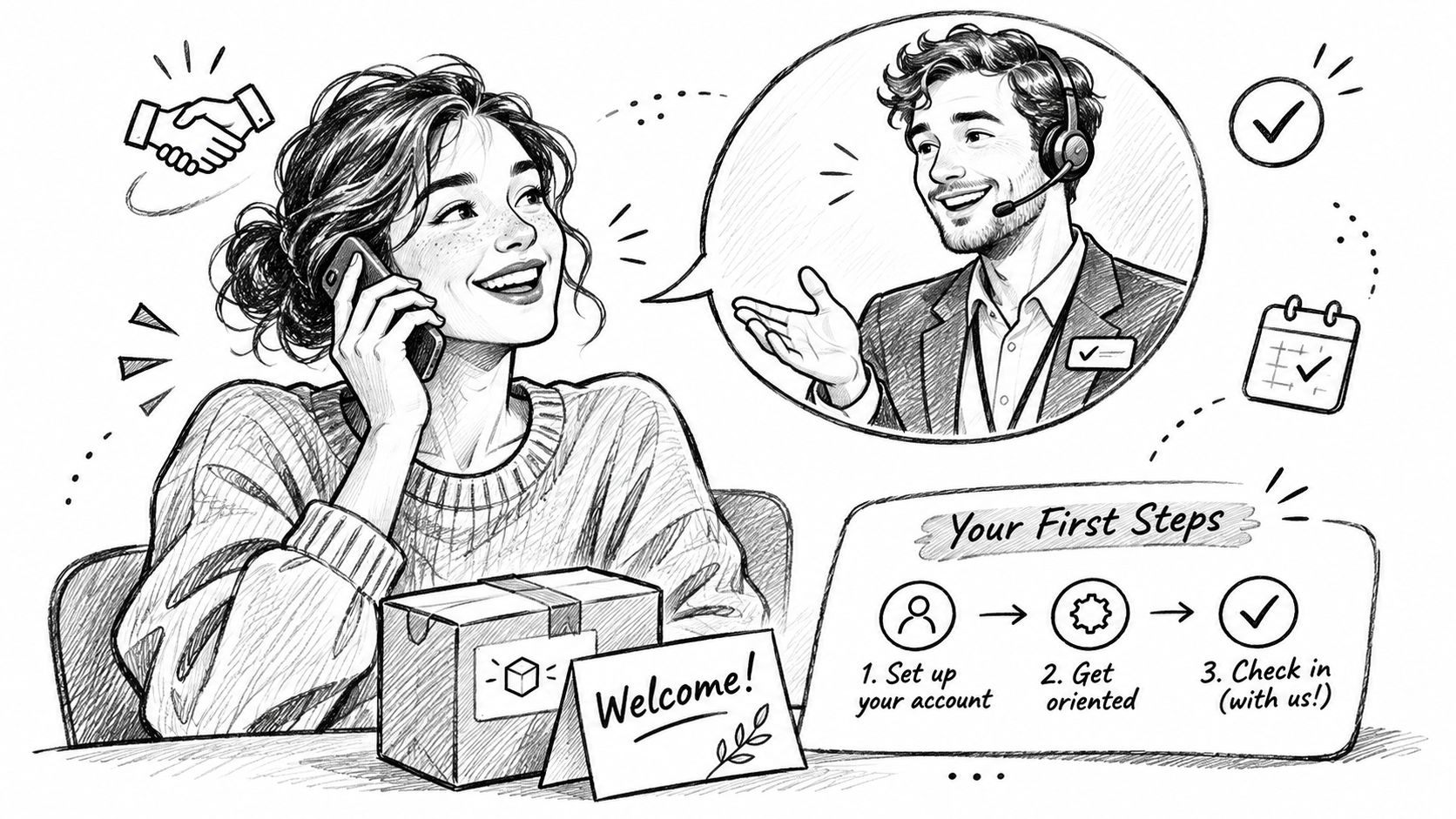
A buyer who has the keys but not a repair contact will either panic-call the agent or never call at all. Make one check-in in the first week or two. A real estate agency can confirm the keys, who handles repairs, and the out-of-hours number. An online store can call three days after delivery, confirm the parcel arrived, and answer the setup question. One call, plus a second only if they ask for it.
A 2017 Forrester Consulting study commissioned by Marchex, based on 213 U.S. marketing decision-makers, found that 54% of marketers reported customers who initiated an inbound call had a 28% higher retention rate. That is an association from marketer responses, not proof that every check-in produces that lift. A customer who will talk is still the one you shouldn't lose in week one.
Answer the usual first-week questions from your own pages and FAQs so the call stays short. Offer the next booking only after their question is finished.
The first week is for clarity. A pitch before the answer is how a new customer learns you don't listen.
6. Customer Feedback and Survey Calls
A survey call earns its keep only when someone owns the answers. Keep it to three to five questions and say how long it will take. A clinic can ask how likely the patient is to return and what one change would improve the visit. A subscription team can call customers who were just billed and ask why some are thinking about cancelling. Frederick Reichheld of Bain & Company introduced the Net Promoter Score as a single likelihood-to-recommend question in a 2003 Harvard Business Review article. Use it only if a named person reads the results, because a score with no owner is noise.
A 2021 market study reported that 44% of companies classified customers as very satisfied with phone interactions, and phone reached a satisfaction score of 0.55, higher than most other channels in that benchmark. The same Radial study named customer retention rate a priority metric for 47% of companies, next to time to resolution and customer effort. So log the reason they might leave and whether they came back, because a completed survey alone tells you little.
Work the file weekly. Send a billing complaint to billing the same day it lands. When you change something because of what callers said, tell them on the next contact. Say at the start that the call is automated, and act on a request to stop straight away. Survey phone calls are built for that short question set. NoChurn's take on churn feedback is a useful contrast for what people say once they have already decided to leave.
7. Segmented Offer and Re-Engagement Calls
A guest who stayed last spring doesn't want a generic midweek rate. Call that slice with a weekend offer in the season they already chose. An online retailer can ring one-time buyers about a single complementary accessory with a short deadline. Start with two or three segments, and expand only once those results are obvious.
The offer only works if the person on the list can tell, in one sentence, why it matches what they already bought.
The walkthrough below shows what a segmented re-engagement call looks like end to end, from the AI disclosure at the open to the logged outcome.
A pitch is telemarketing, and the consent bar sits higher than for a service reminder. Federal telemarketing rules require prior express written consent for telemarketing calls that use an artificial or prerecorded voice. A do-not-call request must generally be honored within no more than 10 business days, and people can revoke consent by any reasonable method. Keep promotional reactivation on its own track, apart from appointment reminders, and cap how often one person is called.
State the terms on the call. Log which offer each customer heard so the same deal never goes out twice. A campaign can run from your uploaded list, and each call opens by telling the person it is an AI, then records how the call ended so you see who said yes and who to ring next. I would still test two scripts until the first comparison is clear. Grouping customers by value and location keeps those slices small enough to read.
8. Missed Call and Enquiry Callback
A burst-pipe enquiry at night goes to whoever books a real slot first. Capture the name, number, and job, take the first open time, and text the confirmation while the caller is still deciding whether to dial the next plumber on the list. A real estate desk can return each property enquiry the next morning and record which viewings were booked. A clinic that logs the reason for the call can ring back between patients instead of losing the appointment to the practice that answered live.
In a field study of a bank contact center, only about 37% of customers offered a callback accepted it, about 90 to 93% of those who accepted answered when the callback arrived, and offering a preserved place in line or a callback cut average time waiting online by as much as 71%. Track offer uptake and answer rate separately. A weak connection rate can mean the offer was unclear, not that the dialler failed.
Promise a window you can hit. A missed callback is worse than a slower honest time.
Agree the window with the team and check it daily. Brief the next person from the transcript before they dial, so the caller never repeats the job. Pass safety issues and clearly angry callers to a human straight away, with the reason already written down. If a caller asks not to be phoned again, log it and keep them off every outbound list.
How each retention call type compares on timing, fit, and main risk
These eight calls sit on one lifecycle, from the first week after a sale to a lapsed customer's win-back. They share one consent record, one disclosure line at the start of each call, and one suppression file that every campaign respects. Timing anchors to a customer event, not a calendar date. The risk column names the failure that most often takes each call type down.
| Item | Typical timing | Best for | Main risk |
|---|---|---|---|
| Appointment Reminder and Confirmation Calls | One to two days before the appointment | Fewer no-shows, and slots freed early enough to refill | Calling too late to rebook a cancellation; leave enough lead time to fill the freed slot |
| Post-Service Follow-Up and Satisfaction Check | A few days after the service or visit | Catching problems while the job is still fixable | A complaint saved to a transcript with no owner; route every low score to a named person |
| Lapsed Customer Win-Back Campaigns | After a defined period of inactivity | Re-engaging customers who already know the business | Dialling numbers with no consent record or calling back people who opted out; suppress every refusal |
| Renewal and Subscription Reminder Calls | A set number of days before renewal | Stopping passive churn before the renewal date | Soft-pedalling a price rise; state the new amount and start date, then offer a person |
| New Customer Onboarding Check-In | Within the first week or two of the first purchase, booking, or sign-up | Resolving early confusion before it becomes a refund | Calling before first use; wait until the product is opened, then ask about one sticking point |
| Customer Feedback and Survey Calls | After a visit, purchase, or other relevant interaction | Spotting patterns across visits | Sending the full survey to the same regulars; cap frequency and act on what was raised |
| Segmented Offer and Re-Engagement Calls | When a relevant offer fits the customer segment | Reaching the customers most likely to accept an offer | Pushing an offer the segment already refused; check recent declines before the file runs |
| Missed Call and Enquiry Callback | Within minutes or the same day | Recovering enquiries while the customer is still deciding | Making the caller restate the whole job; return the call with the transcript open |
Read the risk column as a go or no-go check: where the fix is not in place, that call type is not ready to run. The inbound side uses the same setup. Dial Milo answers every call within one or two rings and never puts callers on hold, so campaign calls and callbacks run on one account without a queue.
Start With One Call Type and Measure the Result
Pick the gap that costs you most: empty chairs, lapsed regulars, or renewals that fail because nobody explained the date. Run one call type on a clean, opted-in list before you add a second. Record every ending: confirmed, rescheduled, not interested, opt-out, or needs a person. Honour the opt-out on voice and text the same day, and read the file weekly before you widen the audience.
The usual failure is a mixed list. Service reminders, win-backs, and offers get the same script, the same calling hours, and no suppression. Check three things before launch: the consent source is on the record, the call discloses the AI at the start, and each contact is scheduled in that person's local time inside the hours your rules allow. If any of the three is missing, do not start the file.
Keep the scorecard short. For each call, log the reason you dialled, the outcome, whether a person took over, and whether the customer kept the appointment, renewed, or came back inside the window you set. Dial counts flatter: a campaign can connect call after call while opt-outs climb in the background, so complaints, opt-outs, and blocked numbers sit on the same weekly page as recovered bookings. Say a win-back file returns three times as many opt-outs as recoveries in week one. That ratio points at the list or the offer, and no amount of extra calling fixes it.
The logging side is where tooling earns its keep. Dial Milo runs outbound campaigns for reminders, follow-ups, and win-backs and records how each call ended, so the weekly review shows who said yes and who to call next; its free reactivation ROI calculator estimates what calling dormant customers could return, and full pricing is published in one place.
Don't launch all eight call types at once. One measured customer retention call will teach you more than a noisy stack of scripts. If week one comes back mostly opt-outs, fix the list and the offer before you add minutes or widen the audience.
Keep reading

What Does It Mean to Screen a Call
What does it mean to screen a call? It means judging who deserves a live conversation, not the same thing as blocking, silencing or answering.
Read
Automotive Answering Service: How It Works for Repair Shops
Learn how an automotive answering service handles repair enquiries, bookings and after-hours calls, what it costs, and how to set one up in your shop.
Read
Answering Service for Insurance: Calls, Claims and Routing
An answering service for insurance can capture caller details, route claims and renewals to licensed staff, and follow up within compliance rules.
Read