The phone rings while your adviser is with a client. Another caller wants an update on an application, and your outbound list still needs renewal reminders. You need coverage, but you don't want an automated voice discussing an account with the wrong person or promising something your staff can't deliver.
A finance answering service should do more than pick up. It should keep a controlled record of what the caller asked, what was verified, what the service said and who now owns the next action.
What a Finance Answering Service Does
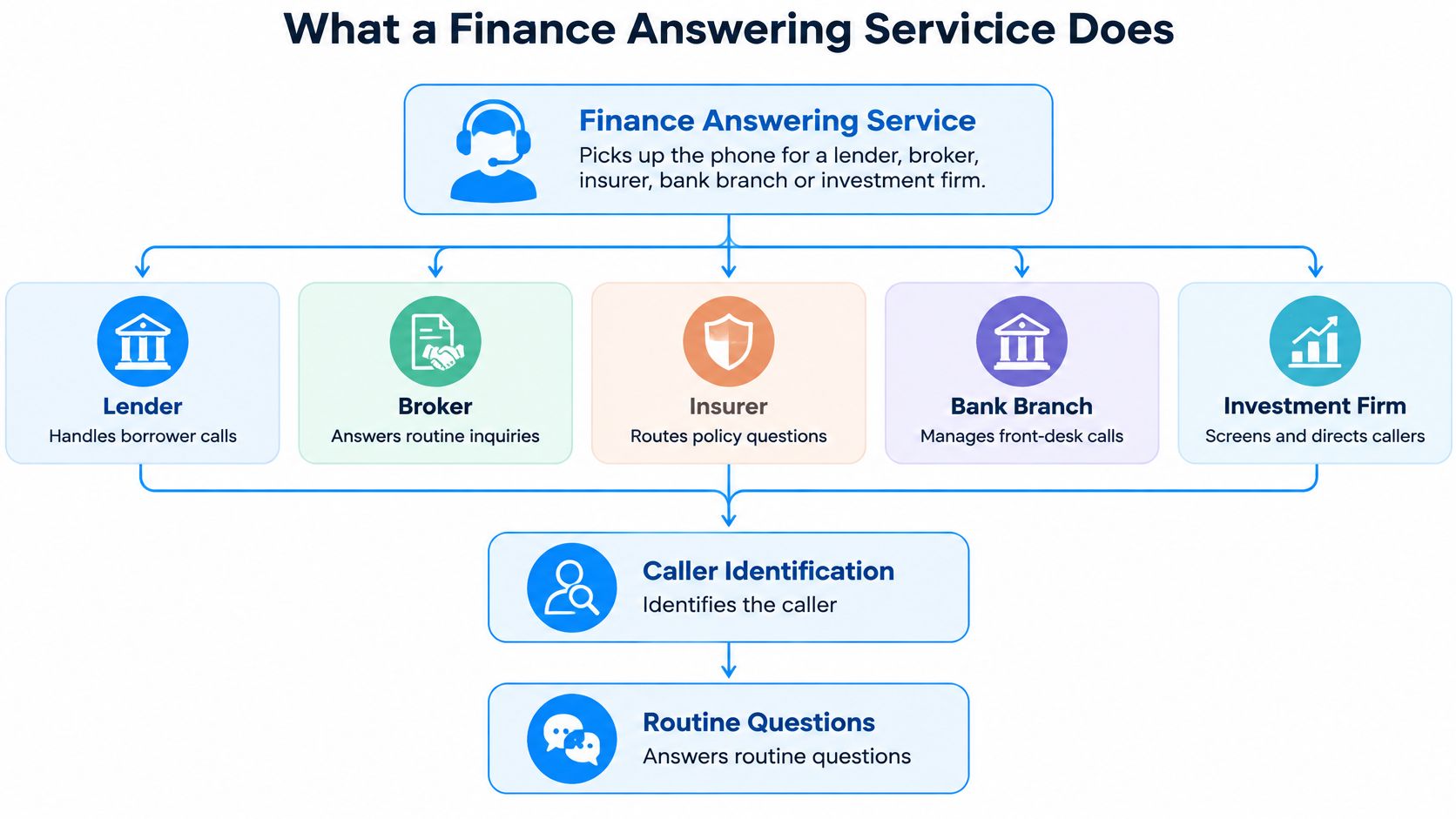
A finance answering service picks up the phone for a lender, broker, insurer, bank branch or investment firm. It identifies callers, answers routine questions from approved information, captures details, books or routes calls and records what happened.
Think of a lobby receptionist with a locked filing cabinet. The receptionist can greet anyone and explain opening hours. Opening the cabinet requires proof of identity. Your telephone workflow needs the same separation between public information and protected records.
Say an applicant rings after your office closes. The service can explain the general application process and arrange a callback without revealing whether a particular person has applied.
- Inbound work: Out-of-hours enquiries, applicant callback requests, adviser appointment booking, and routing complaints or fraud reports to staff.
- Outbound work: Payment and renewal reminders, lead follow-up, reactivation of lapsed customers, and short feedback surveys.
Telephone access is established, not new
Girobank introduced telephone banking in the United Kingdom in 1984, and First Direct began operating as a 24-hour branchless bank in 1989, according to the telephone banking history. Those services established the familiar pattern: a customer calls, verification precedes protected activity, and routine requests can be handled without a branch visit.
Dial Milo is an example of the current AI approach: Milo answers inbound calls 24/7, runs outbound campaigns and speaks 20 languages. For broader adoption context, the FruitPunch small business AI data is a useful companion to a workflow assessment, but adoption alone doesn't establish suitability for regulated calls.
Practical rule: Give the service four jobs: answer, verify, capture and hand over. Keep a record of each call.
Which Calls Can Be Automated and Which Need a Person
Finance call types and how far automation should go
| Call type | Automated handling | Human handover | Control to apply |
|---|---|---|---|
| Opening hours, branch or office details | Answer in full from the approved knowledge base | Not needed | Check the knowledge base is current |
| Application or claim process guidance | Explain the steps without any account data | Transfer or callback for specifics | Verify before discussing any account |
| Callback request or message | Capture name, number and reason | Staff member calls back | Read the number back to the caller |
| Account balance or transaction question | Verify the caller first, otherwise transfer | Trained staff | Log failed verification attempts |
| Payment, beneficiary or credential change | Refuse and escalate | Trained staff only | Human verification before any change |
| Complaint, suspected fraud, bereavement or vulnerability | Capture the facts and confirm a callback time | Priority human callback | Name an escalation owner |
| Investment, trading or lending advice | Do not answer | Licensed staff | Recording and disclosure where required |
Automation should stop where a mistake would cost the caller money, data or trust. That boundary matters more than whether the software can produce a fluent answer.
Move from public information to protected actions
Opening hours can be answered completely from an approved knowledge base. General application guidance can explain which documents applicants need, but it shouldn't confirm an individual's application status before verification.
For a callback request, capture the caller's name, number and reason, then read the number back. For an account question, use your approved authentication process before releasing information. A caller's knowledge of an address or reference number shouldn't automatically count as proof.
The threat isn't theoretical: a Modulate survey of finance and retail organizations found that 84% faced moderately to highly advanced voice attacks in the preceding year, while 49.4% used multi-factor authentication for phone transactions and another 49.4% used verification callbacks.
A request to replace beneficiary details belongs with trained staff, not an automated change tool. A distressed caller reporting suspected fraud needs a priority handover, not repeated attempts to complete a routine intake script.
Keep answers inside the approved scope
Financial conversations also take time for legitimate reasons. AmplifAI's financial-services contact-center benchmark reports an 8.0-minute median average handle time and 85% median first-contact resolution. Removing necessary verification to shorten a call is the wrong trade-off.
Our receptionist says when an answer isn't in the knowledge base, then takes a message, saves the caller as a lead or transfers the call. It doesn't invent an answer. Customers may not use the AI to provide medical, legal or financial advice without appropriate licensing and disclosures.
For implementation ideas, browse real workflow automation tactics from AI Tool Seekers, then apply finance-specific restrictions. Insurance operators can also use our answering service for insurance guide to frame policy-question intake separately from advice.
Write your own risk tiers before configuring the greeting: public information, message capture, verified account discussion and human-only action.
Privacy Rules for Caller Data and Call Recordings
A finance call can become evidence in a dispute, so treat each recording as a controlled record with a defined purpose, access rules and retention period. The applicable requirements depend on the firm, activity and jurisdiction.
In the United States, FINRA Rule 3170 guidance sets recording, supervision and retention requirements for covered firms. In the European Union, MiFID II Article 16(7) generally requires investment firms to retain relevant transaction or client-order communications, including those that do not produce a transaction, for at least five years.
Build the recording workflow deliberately
Separate administrative calls from conversations involving orders, quotes, solicitations, payments or investments. Give recording disclosures where required, and decide how to handle a caller who declines recording.
- Preserve the original audio with the transcript, timestamps and call identifier.
- Restrict access by role so staff can retrieve only records their work requires.
- Log access to show who listened to or exported a record.
- Protect retention settings from unauthorized changes and prevent deletion while a legal hold applies.
- Schedule permitted deletion instead of keeping sensitive material indefinitely.
Treat the transcript as a search index; the recording is the record. A transcription error can omit a qualifier, misread an amount or miss a disclosure that matters in a dispute.
Collect less, document more clearly
Collect only what is needed to route or resolve the enquiry. Don't invite callers to dictate passwords or security codes into a general-purpose message. For practical guidance on call recording consent rules for advisors, review the issues with compliance counsel and confirm which rules apply to your firm.
Before enabling recording, document which fields you collect, who can hear recordings, how long each record remains and when it is deleted. Then check that the configuration follows that policy. A written retention promise is ineffective if staff can download recordings into unmanaged folders.
Treat these as workflow requirements to verify, not features automatically guaranteed by an AI receptionist. Country, firm type and call purpose affect the rules and the controls your process needs.
Capturing Messages Staff Can Act On
Sample note: Identity unverified. Caller reports a declined card, provided no reference, and requests a callback before five. Callback time not yet confirmed.
A useful finance message helps the next employee find the relevant record and decide what action is authorized. It must distinguish what the caller said from what the business has verified. Authentication still applies before anyone discusses protected information.
| Field | What to capture | Why staff need it |
|---|---|---|
| Caller identity status | Verified, unverified or unknown | Shows what the staff member may discuss |
| Intent | The reason for the call in one line | Stops the caller repeating the story |
| Reference | Account, case or booking number if given | Lets staff find the record quickly |
| Requested action | What the caller wants done | Sets the work for the owner |
| Promised follow-up | What was said and by when | Keeps commitments visible |
| Deadline | The date or time the caller needs an answer | Sets callback priority |
| Escalation owner | A named person or team | Prevents messages with no owner |
A short label such as card problem leaves staff guessing. Record the request as check the declined transaction, and leave the reference blank if the caller gave none. Do not infer an account match from a familiar name.
Keep a requested deadline separate from a commitment. If staff have not accepted the callback time, record it as a caller request, not a promise. Once someone agrees to follow up, record that commitment and assign an owner.
Measure continuity, not message volume
Capgemini's 2025 banking research found that only 24% of customers were satisfied with contact-center interactions; reported frustrations included long waits (61%), inconsistent cross-channel communication (65%) and missing real-time updates between digital and in-person interactions (63%).
Message quality is easier to assess than message volume: can a colleague who did not hear the call locate the record and take the next authorized action without asking the caller to start over? If not, identify what the note is missing. For operational context, Dial Milo's AI receptionist can take messages, query a business-provided knowledge base, book calendar appointments, send follow-up SMS and transfer calls to a person.
Handing Calls to People Without Losing Context
Start a handover as soon as a caller asks for a person, the question falls outside approved information, or the call reaches a risk threshold that requires human judgment. The routing rules should also say what happens if nobody answers: where the call goes, what the caller is told, and how the unresolved request is tracked.
Set the handover sequence
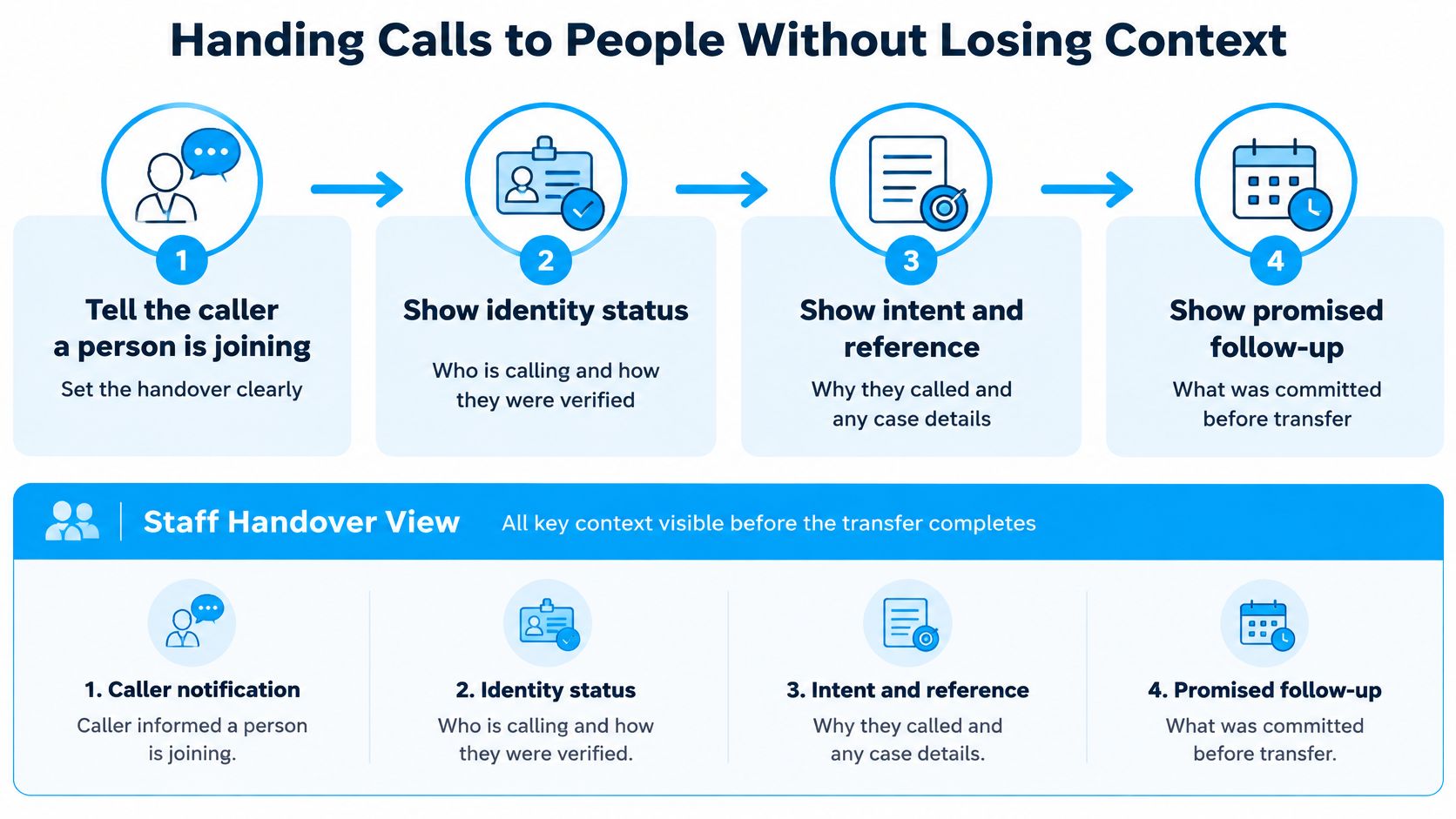
Tell the caller that a person is being contacted. If the transfer connects, give the recipient access to the existing call record before the conversation begins. If it fails, explain the next step and route the request to the designated queue or callback process.
A warm transfer is useful only if context travels with the call. The receiving employee should be able to distinguish what the caller reported from what the business has verified, then continue without asking the caller to start over.
Assign callback ownership before making a commitment
Complaints, bereavement, vulnerability and complex lending questions may require a trained person. Suspected fraud should follow the firm's approved urgent route, not an ordinary callback queue.
A callback time is a request until an employee accepts it. Make the commitment only after someone takes ownership and confirms the timing. The adviser can then review the existing record and complete any required verification before discussing account or application details.
Test failed transfers as well as successful ones. Confirm that the caller receives a clear next step, the unresolved request remains assigned, and staff can find the call record. A connected call without usable context is not a complete handover.
Measuring Results Against Benchmarks
A call can be short and still create more work if the customer has to call again. Set measures before calls go live, then compare similar types of calls rather than treating every queue as equivalent.
Establish a usable baseline
- Record the starting position: Track handle time, first-contact resolution, transfer rate, abandonment, escalation accuracy and post-call correction rate.
- Separate comparable cohorts: Compare automated and human-routed calls with similar intents and risk levels.
- Review conversations: Sample recordings and transcripts for invented fees, incorrect eligibility statements, missed fraud signals and incomplete disclosures.
- Count repeat contacts: Identify callers returning about the same unresolved matter instead of treating each call as unrelated demand.
Define resolution before reporting it. Booking a callback may complete the answering service's task, but it does not necessarily resolve the customer's underlying problem. Keep the call record and any correction linked to the outcome so staff can see what happened and why.
Connect each result to a change
| What you find | What to change |
|---|---|
| Transfers arrive without useful context | Require the missing handover fields |
| Callers abandon during verification | Remove unnecessary prompts or offer an approved alternative |
| Staff repeatedly correct answers | Narrow the knowledge base and remove ambiguous wording |
| Urgent cases enter routine queues | Rewrite escalation triggers and test borderline examples |
| Customers call again about the same issue | Check ownership, follow-up completion and inconsistent answers |
For outbound campaigns, compare results only when the lists, offers and calling windows are comparable. Change one script element at a time, then review the call outcomes alongside disclosures and complaints. A higher response rate does not justify weaker safeguards.
A shorter call isn't automatically a better call. A quick answer that makes the customer ring again hasn't saved the business work.
Aim for fewer repeat contacts while maintaining or improving resolution and satisfaction. Averages can hide serious errors, so review individual cases as well as overall results.
What a Finance Answering Service Costs and How to Compare
A finance business handling high call volumes needs to compare more than the price of answering each call. Include the cost of missed enquiries, staff follow-up and the time needed to correct incomplete records. The financial-services contact centre benchmark reports 498.3 calls per agent per month in its sample, compared with 346 across industries. It also reports average routing time of 35 seconds and outbound calls making up 76.9% of financial-services traffic.
Start with your own call volume, opening hours and staff costs. A free answering service cost calculator compares an in-house receptionist, a live answering service and an AI receptionist per month, per year and per call.
Compare the complete bill
For each option, use the same assumptions and compare the tasks completed. Include setup and recurring charges, call and message costs, and staff time for escalations and follow-up. Check current rates against the Dial Milo pricing page before estimating the total.
| Comparison item | Your in-house receptionist | Live answering service | AI receptionist |
|---|---|---|---|
| Monthly cost | Wages, cover and supervision | Monthly fee and included usage | Usage charges and number rental |
| Annual cost | Monthly cost × 12 | Monthly cost × 12 | Monthly cost × 12 |
| Cost per call | Monthly cost ÷ calls handled | Monthly cost ÷ calls handled | Monthly cost ÷ calls handled |
| Tasks included | Record what staff handle | Check what the service handles | Check booking, messages, transfers and follow-up |
| Human follow-up | Staff time for unresolved calls | Staff time for escalations | Staff time for escalations and exceptions |
Dial Milo uses prepaid, usage-based billing. Separate AI processing from telephone costs, and include any monthly number rental and human escalation time in your comparison.
A three-minute call is only a useful cost example if you know the applicable rates and what the call accomplished. Compare the total cost per answered call with the quality of its record: whether the caller's request, relevant details and next action are captured clearly enough for staff to proceed without asking the customer to start again.
Outbound Calls Need Consent, Opt-Outs and Local Hours
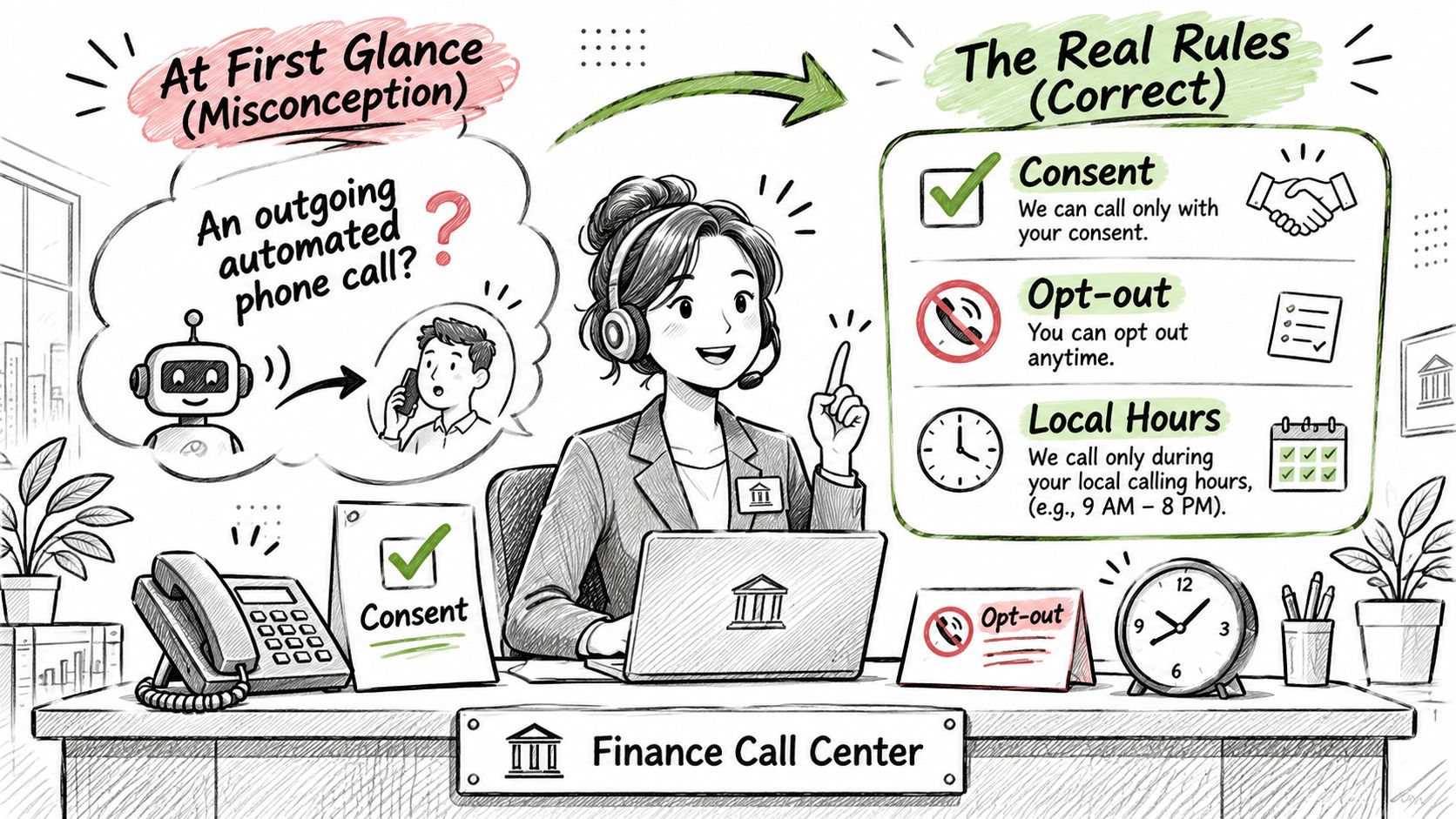
A phone number in your customer file is not permission for an automated promotional call. Confirm that each person agreed to the type of call you plan to make, and keep a record of the consent.
For US consumers, the FCC's robocall rules for callers generally require prior express written consent for AI or prerecorded telemarketing calls, along with an automated, interactive opt-out. Consumers may revoke consent at any time. Prerecorded telemarketing calls must announce opt-out instructions at the beginning and keep the opt-out mechanism available.
This applies to finance renewals, real estate lead follow-up, subscription win-backs and player reactivation. Treat each call as a controlled record: retain the permission, call purpose, outcome and any opt-out so staff can act on the same information later.
Check permission before uploading the list
Keep the consent wording, when and how the person agreed, and the business and purpose covered. Apply opt-outs to active campaigns promptly, and make sure suppression records carry over when lists are refreshed.
A lapsed customer list still needs a consent check. A past purchase or inactive account does not establish permission for unrelated promotional calls.
A salon contacting former clients should verify that each recipient agreed to the intended reminder or promotion. Appointment-reminder permission should not be stretched to cover unrelated offers.
Schedule for the recipient, not your office
The FTC's Telemarketing Sales Rule guidance requires applicable calling lists to be checked against the National Do Not Call Registry at least every 31 days and generally restricts home telemarketing calls to 8 a.m. through 9 p.m. at the recipient's local time, unless the consumer consented to different hours.
- Identify the call: State the business and disclose that the caller is an AI before asking questions or making an offer.
- Use the recipient's time zone: Schedule calls for the person's local time. Milo calls each player in their own local time.
- Limit exposure: Set a total or daily campaign cap so an unsuitable list cannot use more than the amount allocated.
- Check each market: Rules differ outside the US, and some calls need additional sector-specific review.
Before launch, verify that the call flow identifies the business, discloses automation, provides the required opt-out and records the recipient's response. The AI phone call laws guide can help organize that review; confirm the rules that apply to your business and location.
Confirm Your Call Rules Before Going Live
A caller asks to change account details, but cannot pass verification. The receptionist should know what to record, what not to promise, and exactly when to hand the conversation to a person. Put those rules into a launch checklist.
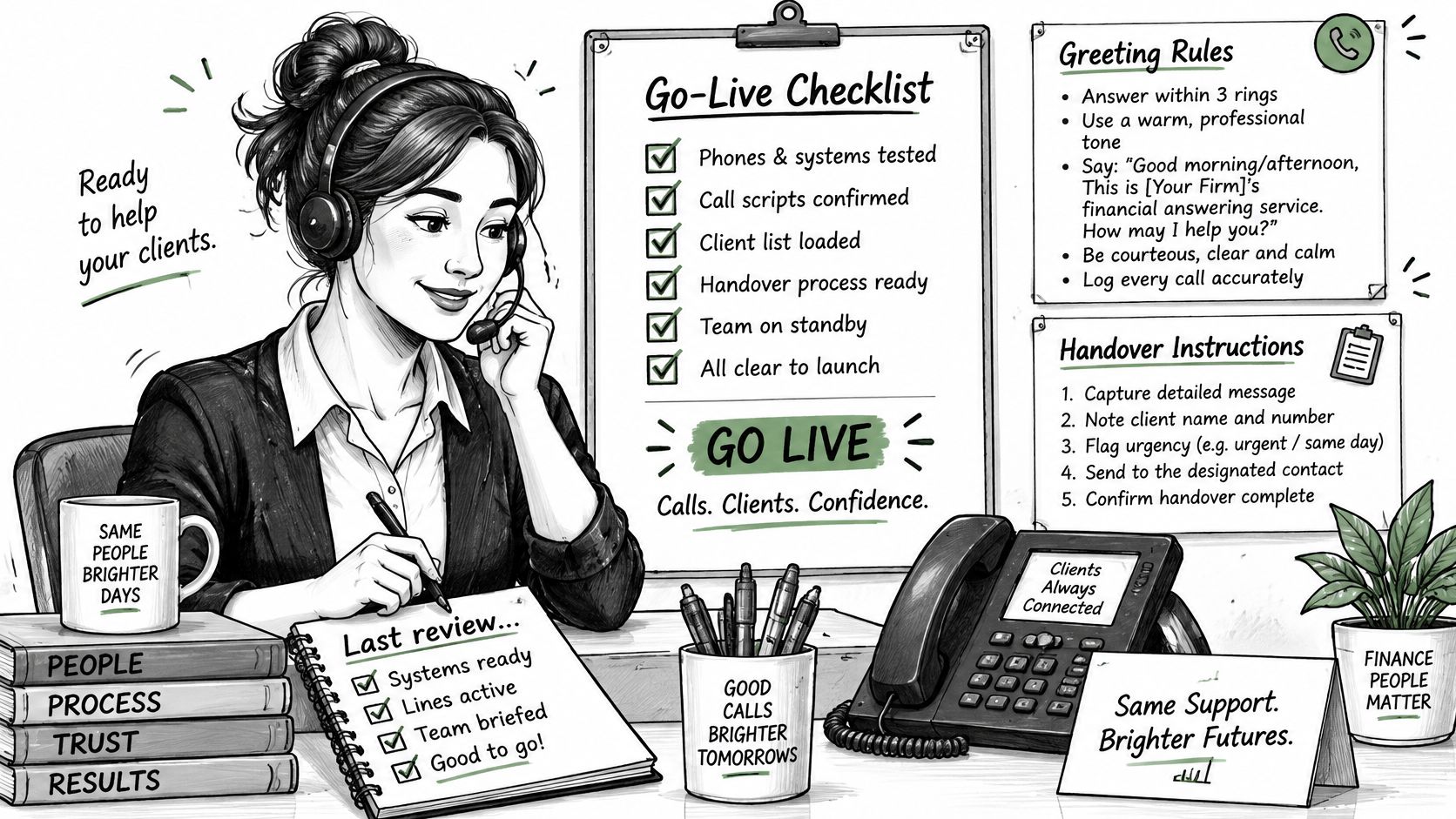
- Name an escalation owner and set only callback or transfer expectations your team can meet.
- Load current approved information on hours, prices, policies and FAQs. Remove content that could lead to personalized financial advice.
- Test a message, booking and warm transfer with staff. Include a failed-verification case and confirm the handover preserves the caller's details and reason for calling.
- Check number activation, forwarding, business hours and balance if calls are not answered.
Use the walkthrough alongside your own test calls.
Create an account to set up a receptionist from your website. Treat the generated setup as a draft and validate it before taking live finance calls.
Dial Milo offers around-the-clock inbound answering and outbound AI campaigns, with bookings, messages and human transfers in the same service. Visit Dial Milo to build a controlled call workflow, then test verification boundaries and handover records before putting customer conversations through it.
Keep reading
AI Answering Service Explained: How Calls Are Handled
Learn what an AI answering service does on every call, how bookings, handovers and outbound campaigns work, and what it costs.
Read
Customer Feedback Phone Calls That Get Honest Answers
Learn how to plan customer feedback phone calls, ask better questions, and turn each outcome into a clear follow-up.
Read
Answering Services for Funeral Homes: What They Cost and Do
Compare answering services for funeral homes by cost, after-hours coverage and urgent-call routing, and learn the price and consent rules to follow.
Read