The day after Hurricane Katrina struck in August 2005, telephone calls failed to connect at a scale no staffing plan could have absorbed, a breakdown the FCC chairman later described in an NTIA report on public-safety communications. Demand arrived in one enormous block, and the system underneath it had a ceiling.
A typical business will never face demand at that scale. It still meets the same wall in miniature. A storm, a billing run, a promotion or a week of missed appointments pushes more calls at the switchboard than it can carry, and the overflow does not wait politely. Callers hang up, dial again, or hand the job to whoever answers first.
Each abandoned call is unresolved demand, work that wanted you and reached someone else. Treating a surge as a triage and resilience problem changes what you measure and what you fix: the shape of the peak, the order calls get answered in, and the capacity waiting behind your lines. Another pair of hands helps, but only after you know where that ceiling sits.
What High Call Volume Means and What Causes It
High call volume means more calls arrive in a given window than your phone lines, phone system and staff can finish at that same moment. Some callers wait. Some hit a busy signal or a dropped connection. Some give up and call a competitor. None of that shows up in a monthly call count, which is why a calm average can sit on top of a broken half hour.
A single queue behind one till explains it better than any dashboard.
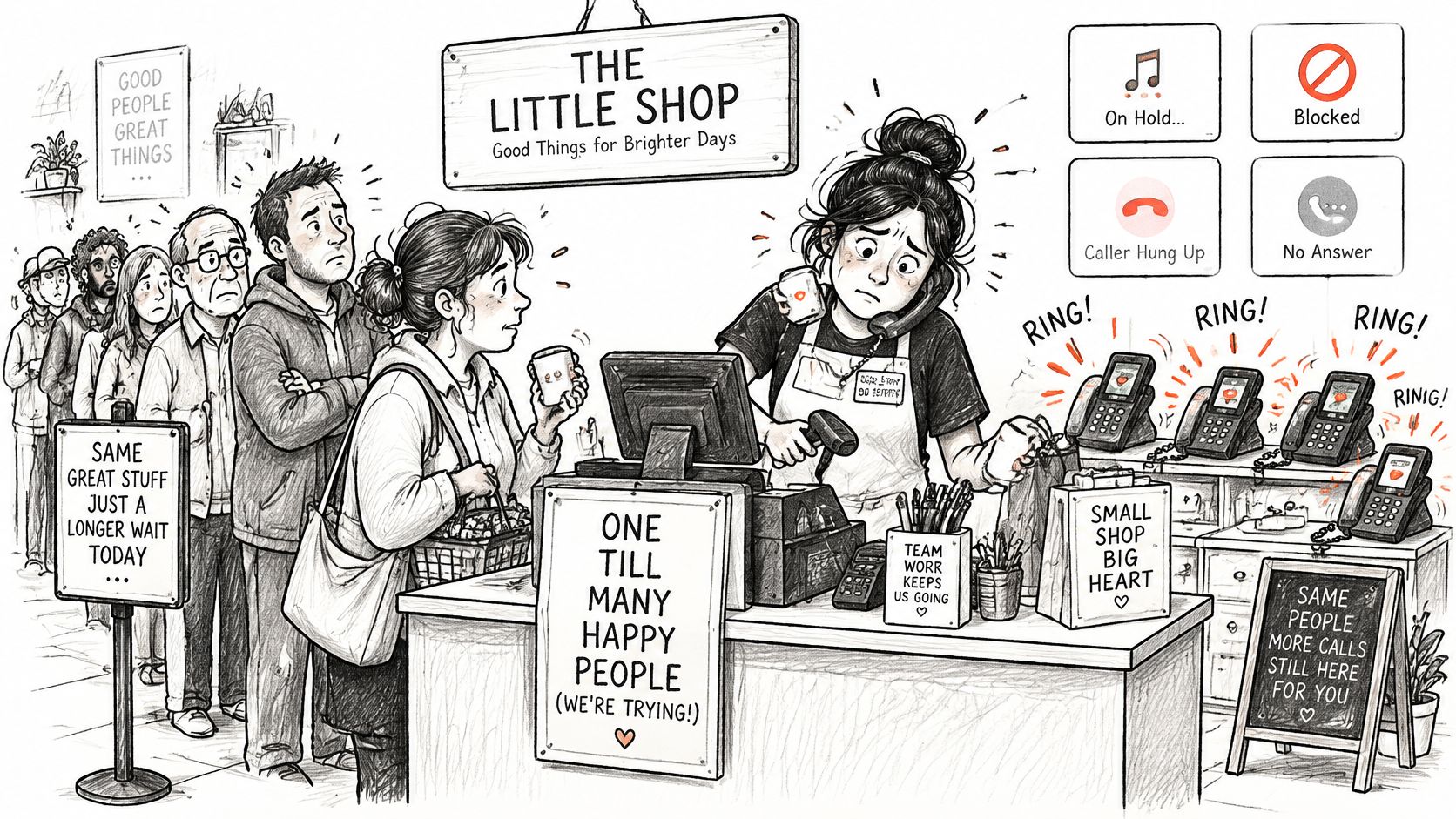
A small shop runs one till, one cashier and a steady trickle of customers all morning. She copes comfortably. At 11:40 a coach party of thirty walks in. By 11:45 the queue reaches the door, three people leave without buying, and one of them complains on the way out. The shop's daily average transaction count hasn't changed at all. The peak has, and the peak is what customers remember.
Why the peak decides the day, not the average
Call demand has a shape, and it's spiky. Calls bunch up after a weather warning, on the day a statement drops, in the ten minutes after a campaign email lands, or on the Monday after a long weekend. Your staffing and your phone system are flat: the same number of lines and people at 9am as at 2pm.
That mismatch is the whole problem. A business that answers comfortably on a Tuesday morning can abandon a third of its calls during a two-hour burst and never notice, because the weekly report looks normal. Every one of those abandoned calls is demand that arrived, went unresolved and walked away.
Here are the triggers that reliably produce those bursts.
Common call surge triggers by business type
| Surge trigger | Typical pattern | Example business |
|---|---|---|
| Weather or emergency event | Sudden spike in minutes | Plumber, electrician, clinic |
| Billing or renewal date | Predictable peak on set days | Subscription service, utility |
| Promotion or product launch | Short, intense burst | E-commerce store, salon |
| Missed appointment follow-up | Clustered callbacks | Dental practice, auto repair |
| Reopening after outage or closure | Calls stack up at opening | Restaurant, hotel |
How to tell a surge apart from a busy day
A busy day is long and steady. A surge has a distinct signature, and three signals separate them cleanly.
- Calls cluster into short windows. Pull your call data in 15-minute blocks rather than daily totals. A surge shows up as a wall of traffic between, say, 9:10 and 9:50, not as a heavy day overall.
- The same few questions repeat. When a storm knocks out power or a delivery date slips, most callers ask one of three things. Repetition is the giveaway that the surge is driven by an event rather than by growth.
- Abandoned calls rise while answered calls barely move. Your team is working at full speed and still losing people. That gap between offered and answered is the damage.
What Hurricane Katrina shows about capacity ceilings
Katrina remains the clearest documented case of a surge meeting a hard ceiling. Beyond the failed connections, the storm knocked out nearly 2.5 million BellSouth telephone lines across Louisiana, Mississippi and Alabama, along with 38 emergency 911 response centers and about 1,600 wireless transmission sites. The NTIA public-safety communications report recording those losses adds the detail that matters here: communications networks are generally engineered to serve roughly 10 to 15 percent of subscribers at one time.
That design assumption is the capacity ceiling in its purest form. Demand far beyond it produces blocking that no amount of courtesy or extra effort fixes, which is why the question that matters is never how many calls you get in a day but what happens when they arrive at once.
The four layers a surge breaks
Strip away the scale and the failure chain is identical for a dentist's office and a regional carrier. A surge hits whichever layer is weakest first, and it works down the stack as the peak continues.
- Carrier capacity. The public network between you and your customers has a designed ceiling. You don't control it, and during a regional event it may be the first thing to fail.
- Your phone system's concurrent-call limit. Many small business systems carry eight or twelve simultaneous calls. The thirteenth caller doesn't queue, they get a busy tone, and nothing appears in your reporting.
- The number of people who can answer right now. The number of people free to pick up at 9:15 on the Monday after a holiday, which is not the same as headcount.
- The rules that decide who is served first. Without one, the loudest or luckiest caller wins. The burst pipe waits behind the question about opening hours.
Three questions are worth answering before the next spike. What is my realistic peak, measured in calls per 15 minutes rather than calls per day? Which of those four layers fails first when the peak lands? And what exactly does a caller experience at that moment, a ring, a queue message, a voicemail box, or silence?
Measures That Show Your Lines Are Overloaded
Average speed of answer describes the typical caller. Abandonment describes the ones you lost. That's the distinction most reporting on the subject skips, and it's the one that tells you whether your phone system is coping or shedding demand.
Start with the shape of the relationship between waiting and giving up.
Answer time against caller abandonment
| Answer time | Abandonment rate | What it signals |
|---|---|---|
| 30-45 seconds | 7.1% | Benchmark starting point for abandonment |
| 60-90 seconds | 16.4% | More than double the abandonment for 15-45 extra seconds |
| Under 30 seconds | Likely lower than 7.1% | Measure your own line to set a baseline |
Those two benchmark figures come from the 2025 average speed of answer research compiled by Stealth Agents, and the jump between them is the most useful thing in the dataset. Waiting an extra 15 to 45 seconds more than doubles the share of callers who hang up. The relationship is nonlinear, which is why a small slip in answer time can cost a disproportionate slice of your demand.
The six numbers worth logging
- Abandonment rate by hour. Calculate it as abandoned calls divided by offered calls, multiplied by 100. Offered calls include the ones that gave up, which is why a system that only counts answered calls will always look healthier than it is.
- Abandoned calls by reason. Separate long waits from menu drop-offs and from callers who hung up before anything answered.
- Repeat calls from the same number within 24 hours. A high count means people are coming back for the same unresolved question.
- Transfers per call. Two or three transfers on a single enquiry is a routing problem dressed up as volume.
- Bookings recovered by callback or text. This is the number that shows revenue impact instead of queue behaviour.
- Answer rate. The simplest sanity check against everything above.
Set a threshold and review it weekly
Find the answer-time band where your abandonment starts to climb, and treat crossing it as a trigger for action rather than a monthly talking point. On a smaller line, run your offered-call volume and average handle time through an Erlang C staffing calculator to see what concurrency your current headcount covers.
Then build a fifteen-minute routine into each week. Export the previous week's hourly data, mark the three busiest windows, note the abandonment rate in each, and check how many of those callers rang back and when. Patterns appear fast, and they usually cluster around the same two or three hours.
The target to aim at: not the lowest average speed of answer, but the fastest safe resolution for every caller, whether that comes from a live answer, a callback, a text or a clean handoff to the right person.
How to Triage Calls During a Surge
The calls start at 8:04 on a Monday. By 8:30 the queue holds a burst pipe, two callers checking opening hours, a payment due today, six quote requests and a complaint that is getting louder. Another pair of hands helps only if someone has already decided which of those calls gets answered first.
That sorting problem shows up even in the settings where mistakes cost the most. A 2025 survey of 1,379 public-safety professionals found that 63% reported non-emergency calls making up 50 to 80 percent of their organization's call volume, while 88% had experienced a technology outage in the previous year, according to the third annual Pulse of 9-1-1 report. If routine demand dominates even in emergency services, it will dominate a dental practice or a plumbing firm too.
Adding people alone doesn't fix that. It helps only if calls are classified correctly, captured once and sent somewhere that can finish them. Every caller who gives up in the queue is also a request that still exists, just no longer counted. Here is the sorting logic that holds up under pressure.
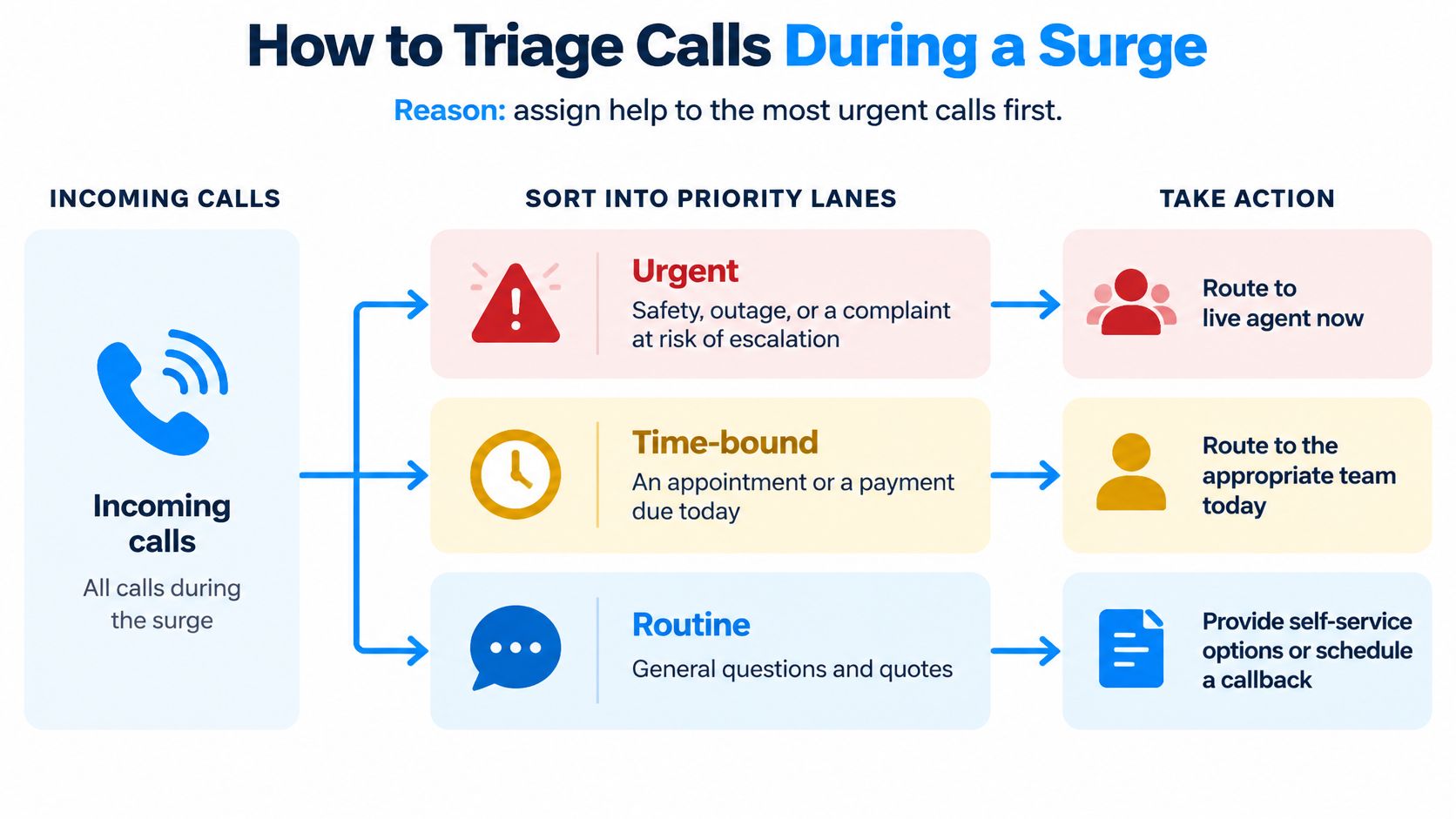
- Agree on three priority categories. Urgent means safety, an outage or a complaint at risk of escalation. Time-bound means an appointment or a payment due today. Routine means general questions and quotes. One shared definition stops staff guessing under pressure, and guessing is what parks the burst pipe behind the opening-hours question.
- Route each category to a different destination. Urgent goes to a person immediately. Time-bound goes to booking. Routine goes to a callback or a message. The common slip is sending everything into a single queue and hoping the team sorts it out, which guarantees the urgent calls wait alongside the rest.
- Capture the key details before any transfer. Name, callback number, job type, address and urgency. A short screening script at the start of the call does this in under a minute and means nobody has to repeat themselves.
- Say what's happening. Give the expected wait, name the alternative channel and say where updates appear. A caller with no information assumes the worst, and silence is the fastest route to an abandoned call.
- Offer a channel choice, not a single answer. Let each caller pick a callback, a text or a short web form. Choice converts an impatient hang-up into a resolved request later in the day, and it moves work out of the peak entirely.
- Keep a manual fallback ready. A shared spreadsheet or a paper log that three people can edit, for the day the phone system or booking tool goes down. The outage figure above should settle whether that day is hypothetical.
- Debrief after the spike, while the details are fresh. Count urgent calls that were misclassified, abandoned calls, repeat callers and transfers. Then change one thing in the categories and test it at the next peak.
A concrete way to start this week: pick your single busiest hour and log every call that gets tagged urgent. When the phones calm down, check each one against the three definitions in step 1. If more than a couple were routine or time-bound, the categories need tightening before the rota does. Note every hang-up during that hour as well, because each abandoned call is unresolved demand your queue stopped counting.
Consent and Disclosure Rules for AI Calls
Outbound AI calling in the United States sits inside rules that were written for earlier technology. In February 2024, the FCC confirmed that AI-generated humanlike voices fall under the Telephone Consumer Protection Act's rules for artificial or prerecorded voices, as set out in the FCC declaratory ruling on AI-generated voices. In practice, that means businesses generally need the called party's prior express consent before starting these calls, unless an emergency purpose or another recognised exemption applies.
Before any list goes live, these conditions should be true.
- Consent is recorded per contact, with its source and date. A CRM checkbox with no timestamp isn't evidence. Keep the form, the keypress log or the signed paper.
- Lists are segmented by call type and destination. FCC consumer guidance requires prior written consent, given on paper, through a website form or by telephone keypress, for prerecorded telemarketing calls to home or wireless numbers, and oral or written consent for autodialed or prerecorded calls and texts to wireless numbers, as explained in the FCC guide to stopping unwanted robocalls and texts. Reactivation, renewal, survey and lead-follow-up lists each need checking against that rule separately.
- The business identifies itself at the start. Name the company, say why you're calling, and disclose that AI-generated voice technology is being used.
- Opt-outs are honoured immediately and held on a suppression list. A request made at 10am shouldn't survive into the afternoon dialling run.
- Attempts are capped and timed to each contact's local time. Two or three attempts is a reasonable ceiling. Ten is a complaint waiting to happen.
- The list owner keeps the evidence. Software can enforce disclosure and opt-out handling, but the business still owns the lists and has to prove consent existed.
If any part of your list sits outside the US, the picture gets more layered, and provincial data privacy requirements explained by CloudOrbis Inc. covers what changes when contacts fall under regional rules. Keep a short written summary of what applies to you and check it against a reference guide to AI phone call laws before each campaign.
The records to hold afterwards are simple: consent source and date, scope of permission, call logs, every opt-out request and the disposition of each attempt. An unclear list should not be called at all.
Reducing Inbound Demand With Planned Outbound Calls
A large share of inbound calls is predictable in advance. Patients ring to confirm tomorrow's appointment, customers ring to ask where an order is, lapsed clients ring because a renewal notice arrived. Each of those calls exists because nobody contacted the customer first, at a time that suited the business rather than the customer.
Reminder outcome and the next action
| Reminder outcome | No-show rate | Next step |
|---|---|---|
| Live conversation | 3% | Close the task and log the outcome |
| Message or voicemail | 24% | Send a text reminder or make another permitted attempt |
| No answer | 39% | Schedule a further attempt within your calling rules |
Those figures come from a Veterans Affairs quality-improvement study of 250 primary-care patients with depression, reported by the VA Health Services Research and Development Service. It found a 3% no-show rate among patients who received live reminders, against 24% for message or voicemail reminders and 39% when nobody answered.
The lesson isn't only that reminders work. It's that the disposition of each attempt changes what you do next, and a campaign that can't tell a conversation from a voicemail can't act on either.
What each outcome should trigger
A live answer closes the reminder task. Log the outcome, stop the sequence for that contact, and don't call again about the same appointment.
A voicemail or message means the information arrived but the confirmation didn't. Send a text with the date, time and a one-tap way to change it, and allow one more permitted attempt if the appointment is far enough out to matter.
No answer is the weakest outcome of the three and deserves the fastest follow-up. Schedule a further attempt within your calling rules, spread across different days rather than different hours, because three attempts in one afternoon reach the same unanswered phone three times.
Practical rule: space retries so the second attempt doesn't land in your busiest inbound hour. A reminder call at 9:15 on a Monday competes with the very callers it's meant to prevent.
A sample week that spreads the load
- Monday morning: live reminder calls for the week's appointments, finishing before the inbound peak.
- Tuesday: quote follow-ups for anything older than three days, with a text fallback for voicemails.
- Wednesday: win-back calls to customers who haven't booked in ninety days.
- Thursday: feedback and survey calls, deliberately placed after the appointment rush.
- Friday: renewal notices and a review of which dispositions produced bookings.
One more source of avoidable demand is the status enquiry. If a meaningful share of your inbound calls is "where is my order" or "what's happening with my case", self-service status checks for injury clients show how much of that traffic a client-facing status page absorbs before anyone dials.
Confirm Your Call Plan Before the Next Surge
A call plan works like an emergency-department board: each arrival needs a destination before pressure rises. The goal is resilience at the failure point, with enough routes for the busiest window. Four decisions turn the measurements and triage rules into a process you can run next month.
- Export 90 days of hourly call data and mark the three busiest windows. Daily totals can hide the exact peak you are trying to fix.
- Compare abandonment in those windows with the answer-time band where callers begin hanging up. Treat every abandoned call as unresolved demand, then decide whether that window needs a new route, a callback path or more coverage.
- Assign each call category to a destination. Send urgent calls to a person, time-bound requests to booking, and routine enquiries to a callback or categorised message.
- Decide what happens after closing and during overflow. If no one owns that gap, give every call a defined outcome. An AI receptionist can answer around the clock, capture caller details, book into a calendar, send a confirmation text and transfer to a team member when a person is needed.
Dial Milo runs inbound reception and outbound campaigns on one account. Its receptionist answers within one or two rings, never places callers on hold, and every account includes unlimited concurrent calls. Billing is prepaid and usage based: only actual talk time is billed, prorated by the second, while unanswered outbound calls, voicemails, busy signals and silent disconnects are free. Its published rates are on the pricing page.
Settle your consent and disclosure steps before any outbound campaign goes live, then put the plan in motion through the signup page.
High call volume becomes manageable when you can see where it breaks: the peak window, the abandoned caller, the urgent request waiting behind a routine one. Give each demand category a destination, protect urgent calls with a human route, and make sure overflow and after-hours callers have an answer. A resilient plan measures what was missed, routes what arrives and follows up what remains unresolved.
Keep reading
Automated Outbound Calls: How They Work and Stay Compliant
Learn how automated outbound calls work, where they are common, and which consent, calling-hour and opt-out rules apply before you dial.
Read
Real Estate Lead Follow Up: 8 Ways to Win More Leads
Real estate lead follow up that works: 8 practical strategies for calls, texts, timing, AI campaigns and long-term nurture to turn enquiries into viewings.
Read
How a Survey Phone Call Works and Stays Compliant
Learn how a survey phone call is structured, why response rates mislead, and which consent, timing and attempt rules to follow before you dial.
Read