The most repeated advice about survey phone calls is to keep dialling until the sample looks big enough, then trust the percentage on the summary slide. That advice confuses volume with measurement. A survey phone call is an instrument, and its output is only as good as the way it was designed, conducted and logged.
Finishing 400 interviews while keeping no record of who refused, who was never reached and which groups are missing produces a number, not evidence. A smaller run where every dial ends in a code can tell you more, because you can see the shape of what's absent.
The stages, the call types, the attempt limits and the consent rules all feed one question: can you defend the result? Everything below works from that question.
Anatomy of a Survey Phone Call, Stage by Stage
A survey phone call is a standardized interview conducted by telephone in which every respondent hears the same questions in the same order. Standardization is the whole point. The moment two respondents get different questions, or the same questions in a different order, their answers stop being comparable and the totals stop meaning anything.
Say a salon decides to find out how its appointments go. Two days after a visit it rings the client with six questions. The opening names the salon, states that this is a three-minute satisfaction survey and asks whether now is a good time. That permission check comes before any question, and a client who is driving gets a callback slot instead of a rushed interview. The screener then confirms the person had an appointment in the last week, so a wrong number exits politely rather than rating a service they never received.
The core questions rate the booking, the wait and the stylist on a five-point scale, each with a don't know option so nobody is pushed into an opinion they don't hold. The close thanks the person and says what the answers will change: the wait at peak hours, the booking reminder, the Saturday stylist roster. Six questions, one purpose, no sales pitch.
| Stage | What happens | What to record |
|---|---|---|
| Opening | Name the sponsor, state the purpose and the expected length | Contact ID and time of call |
| Consent check | Confirm the person can talk now and agrees to take the survey | Consent status before any question |
| Screener | Ask the eligibility questions in a fixed order | Eligible or ineligible |
| Core questions | Ask the standardized questions with don't know and refusal options | Each answer as given |
| Close | Thank the person and state how the answers will be used | Completed interview or breakoff point |
| Disposition | Log how the call ended | Code: completed, refusal, no answer, voicemail, ineligible or abandoned |
The last stage decides the first five
Disposition looks like admin and is really the measurement. Every call has to end with a code, because completed interviews, refusals, no answers, voicemails and ineligible contacts are different events, and each one says something different about who is missing from your final data.
A list of 300 completes with no disposition trail can't be weighted, audited or explained to anyone who asks how the sample was built. With the trail, you can show a client, a regulator or your own team exactly where the sample thinned out.
Before you write a question: sketch your own call in these six stages and fill the record column for each one. A stage you can't describe is a stage that won't be measured.
Survey Phone Call Use Cases by Business Type
Choose the decision first, then the group to call. A survey that can't change something specific is a survey nobody will act on, and respondents hear that in the first ten seconds.
The list below pairs common business types with the moment that makes a call worth taking:
- Trades, salons and clinics: a short post-visit call within a few days of the appointment, rating the booking, the wait and the provider.
- Hotels and e-commerce teams: call after a stay or a delivery to find out which step failed, from check-in to the courier handoff.
- Auto dealers and repair shops: ask whether the vehicle was fixed on the first visit or came back.
- Real estate teams and law firms: call after a closing or the end of a matter to measure how clients felt about communication and pace.
- Insurers: survey policyholders once a claim is settled, while the settlement is still fresh.
- Subscription businesses: call people who cancelled and record the main reason for leaving in their own words.
- Research and customer-feedback teams: larger samples on opinion or satisfaction, where probability sampling and weighting matter most.
Notice the pattern: every entry ties the call to a recent event and a decision, whether that's fixing a service step, repricing a plan or weighting a sample. Operators in regulated sectors, iGaming included, carry licence conditions on top of the consent rules, so the compliance team signs the script before the list moves anywhere.
Write three things down before you dial: the decision the answers will change, the group you'll call, and the record showing those contacts agreed to hear from you. Dial Milo can run these as outbound AI campaigns: it discloses the AI at the start of each call, answers questions, and records a transcript and outcome for every contact. The questions and the list stay with you.
Live, Automated and AI Survey Calls Compared
Three methods dominate outbound survey work, and each one fails in a different place. The right choice depends on who asks the questions, what the instrument can measure, and where it breaks.
Live interviewer calls suit complex or sensitive questions. A trained person can probe a vague answer, notice confusion and rephrase without changing the meaning, which is what an open question about a failed delivery or a difficult claim needs. The cost is human: every completed interview carries staff time, quality depends on training and supervision, and a large sample multiplies both.
Automated keypad surveys handle one to three short single-choice questions with no staffing at all, and that is the ceiling. A keypad cannot follow up when someone gives a surprising answer, or explain a term the respondent does not recognise, so every question has to survive on its own wording.
AI voice agents hold a conversation, take a follow-up question and keep the wording identical across thousands of calls, which makes them the closest thing to an interviewer at list scale. They also bring obligations. The voice has to be disclosed as an AI at the start of the call, opt-outs have to be handled inside the call, and the list has to be screened against the applicable do-not-call registers, such as the TPS and CTPS in the UK, unless valid consent overrides them. Households have grown used to machine voices, and the latest voice assistant adoption data is a fair way to calibrate how ordinary that now feels.
| Method | Who asks the questions | Best for | Main limit |
|---|---|---|---|
| Live interviewer | Trained person | Complex or sensitive questions with probing | Highest cost per completed interview |
| Automated keypad | Recorded voice and keypad | One to three short, single-choice questions | No follow-up on unexpected answers |
| AI voice agent | Disclosed AI voice | Large volumes with branching questions and a fixed script | Needs consent records, disclosure and monitoring |
| Text or web follow-up | Respondent completes online | Reaching people who missed the call | Changes the mode and who responds |
The decision rule that keeps you honest
Pick live calls when the answer depends on probing. Use keypad when the question is a single choice. Choose an AI agent when volume is large, questions branch, and the script has to hold word for word across every call.
The fourth row deserves a caution of its own. People who answer a phone differ from people who fill in a form, so a phone result cannot be compared directly with a web result. Keep one mode for a series, or report the two halves separately.
Cost follows the same logic. Live interviews carry staff cost per completed interview, while an AI campaign bills on talk time: Dial Milo runs on prepaid billing where you pay per answered minute of conversation, prorated by the second, and outbound calls nobody answers are free, including voicemails, busy signals and silent disconnects. The published rates sit on its pricing page. If you are weighing a one-way recorded blast against a two-way agent, this breakdown of voice broadcasting versus AI calls covers where each earns its place. Whichever method you pick, the mode is part of the instrument, so record it alongside the results.
Call Attempts and Calling Hours That Protect Data
Contact attempts are a setting to optimise, not a number to maximise. In its cell-phone task-force recommendations, AAPOR suggests roughly six to ten total attempts as a modest upper range, because a mobile number is a personal device and repeated calling starts to feel like harassment.
The trade-off is measurable. A federal travel survey pretest that extended its permitted attempts from nine to nineteen cut the households reached by ring or no answer on every call from 8% to 4%, while almost 30% of attempts landed on an answering machine, as the Federal Highway Administration pretest report sets out. More varied contact opportunities recover people; they never eliminate the bias that comes from who chooses to answer.
The calling window and the abandonment ceiling
Timing is the second limit, and in the United States it's written into the rulebook. The Telemarketing Sales Rule generally bars outbound calls to a home before 8 a.m. or after 9 p.m. in the local time of the place being called, unless the person agreed to other hours, according to the FTC's compliance guide.
The same guide defines an abandoned call as one where a person answers but isn't connected to a sales representative within two seconds after finishing their greeting. A telemarketer relying on the safe harbour has to document compliance and keep the abandonment rate at 3% or less. Survey calls with a sales element fall inside that window, so schedule in local time and treat the ceiling as a campaign setting.
| Rule | Value | Applies to |
|---|---|---|
| Total attempts per mobile number | About 6 to 10 | Survey calls to personal mobile phones |
| Attempt design in a federal travel survey pretest | Nine to nineteen attempts | Multi-attempt household survey design |
| Calling window for home calls, U.S. | 8 a.m. to 9 p.m. local time of the person called | Calls that include a sales pitch |
| Abandoned call threshold, U.S. | Connect to a representative within 2 seconds of the greeting | Automated and dialer calls that include a sales pitch |
| Maximum abandonment rate for safe harbor, U.S. | 3% or less, with documented compliance | High-volume telemarketing campaigns |
Check abandonment daily. The rate drifts within a week of a script change or a staffing gap, and it's the one figure that turns a dialler setting into a compliance question.
Consent and Screening Rules for Outbound Survey Calls
Outbound rules organise around a single question. What kind of call is this, and what did the person agree to?
Live calls need screening, not just consent
For live marketing calls in the UK, the Information Commissioner's Office guidance on planning direct marketing requires numbers to be screened against the Telephone Preference Service, or the Corporate Telephone Preference Service for corporate subscribers, before any call. A business may call a number on either register only where the subscriber specifically consented to that business's live calls. A direct objection from the person stops future marketing calls even when the number was never registered.
Automated calls raise the bar
Automated calls carry a stricter test. Under the ICO's telephone marketing rules, the recipient must have specifically consented to automated marketing calls from that business, and general marketing consent or consent to live calls isn't enough. Every automated call must identify the caller, give a contact address or freephone number, and display the caller's number or an alternative contact number.
Bought-in lists are where programmes break. The ICO's guidance on using marketing lists limits recorded calls to people who specifically consented to that type of call from that caller. Keep consent source, consent type, opt-out status and screening date on every record rather than treating an uploaded number as callable.
Recording adds a second layer. If your team records interviews for quality checks, whether it's illegal to record someone without consent depends on where you and the respondent are sitting.
| Call type | Consent required | Screening required | Identification |
|---|---|---|---|
| Live marketing or survey call | Specific consent for live calls from that business, or the number is not on TPS or CTPS | TPS or CTPS, plus the business's own do-not-call list | Caller identified on the call |
| Automated marketing call | Specific consent to automated calls; general or live-call consent is not enough | Own suppression list and consent records | Caller, contact address or freephone number, and displayed number |
| Bought-in list, any call type | Each person specifically consented to that caller's call type | TPS screening and suppression list before use | Same as the call type used |
| Person who objects directly | No further calls | Added to the internal suppression list | Not applicable |
Build the suppression list before the first dial and record consent against each number. If you're moving a survey programme onto automated dialling, our guide to automated outbound calls covers the operational pieces that sit alongside consent records. For US lists, the calling window and abandonment limits above apply on top.
How to Write a Survey Call Script People Finish
A survey script is a measuring instrument, and the opening is where it gets calibrated. Breakoffs tend to cluster early in the call, and the opening earns more of the blame than the questionnaire does. A respondent who doesn't know who is calling, why, or how long it will take hangs up, and no clever question further down the script recovers that call.
The sequence below is the one that survives contact with real respondents.
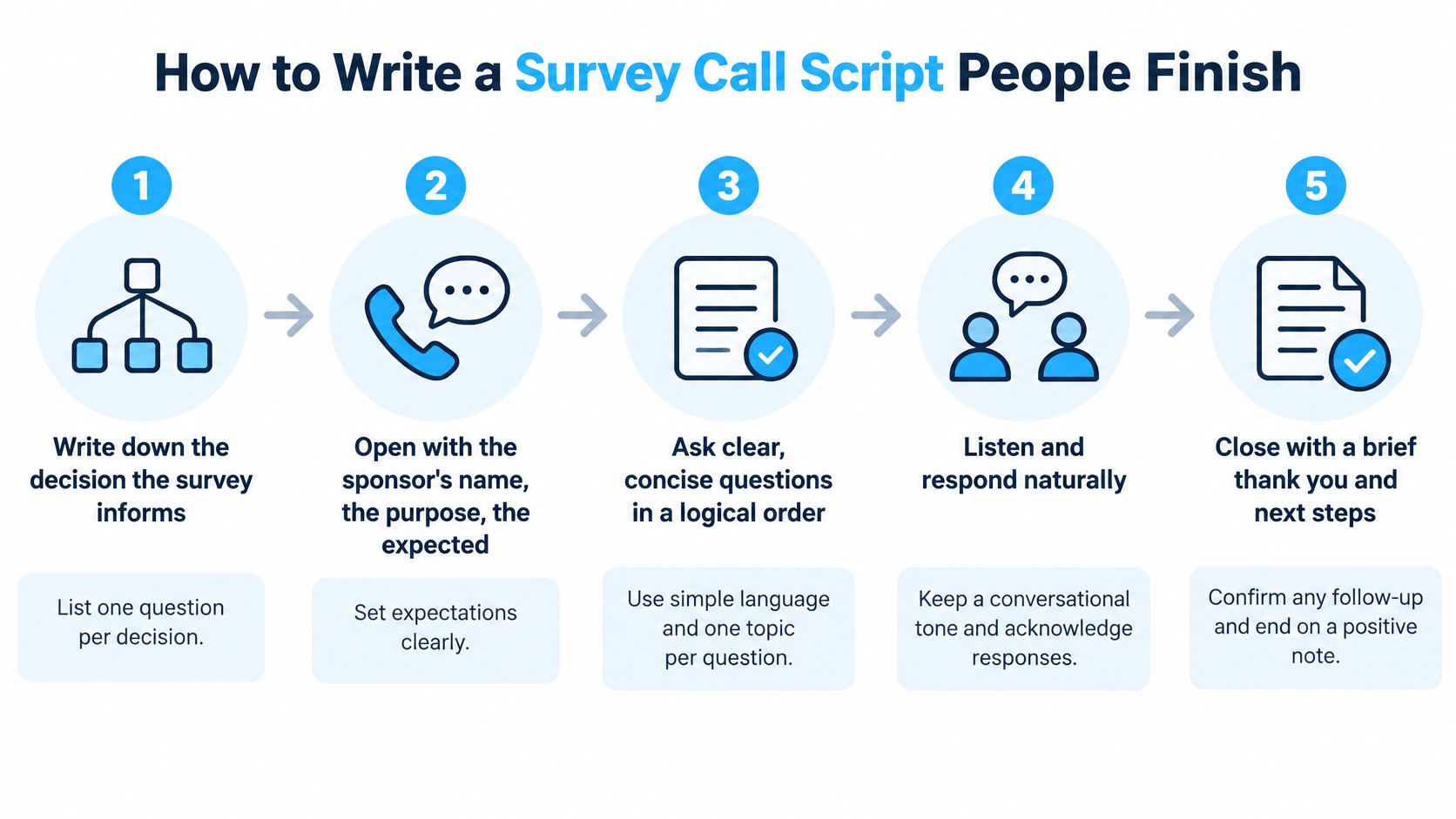
- Write the decision down first. One survey, one decision, one question per decision. A question that doesn't feed the decision costs you respondents and buys nothing.
- Open with the sponsor, the purpose and the length. For an automated call, say plainly that an AI is speaking. A vague opening like "we're just doing a quick survey" reads as a sales call, and people hang up on sales calls.
- Screen before asking anything of value. Ineligible people should exit in two questions, politely. Dragging a wrong number through four irrelevant questions wastes their time and your budget.
- Use neutral wording and one idea per question. "How satisfied were you with the wait and the staff?" is two questions in a coat, and the answer means nothing. Split it, add explicit don't know and prefer-not-to-answer options, and keep the order fixed.
- Offer a language choice and an accessible route. A missing language option excludes people rather than merely inconveniencing them. Offer to repeat a question, schedule a callback or send a text alternative, and accommodate hearing or speech difficulties without making the person explain themselves twice.
- Cut to fit the time you promised. If a pilot runs eight minutes after a three-minute opening, the script is the problem, not the respondents. Trim questions until the recorded call length matches the length you stated in step two.
- Pilot on a small batch and read the transcripts. The breakoff point is the finding. When hang-ups cluster at one question, rewrite that question or move it later, then run the pilot again.
- Close by saying what happens next. Thank the person and name the change their answers will feed. A respondent who believes the answer went somewhere cooperates again.
Treat a missed call as unknown contact status, not a refusal. Multi-country research reported first-wave response rates of 0.27% in Bangladesh, 0.63% in Colombia and 2.63% in Uganda, rising in later waves to 62.02%, 69.61% and 73.02% respectively, according to a study published in Scientific Reports. Those definitions differ from national survey conventions, but the pattern asks the right question: was the first attempt missed through disinterest, or through unfamiliar caller identity, timing, language or network access?
If you want a starting structure, our AI call script templates show how the opening, screener and close fit together on one page.
If you would rather hear the flow than read it, this walkthrough covers the same sequence.
Reading Response Rates and Results Without Fooling Yourself
A single response rate can't tell you whether a phone survey is trustworthy. The rate works like a final grade on a three-stage exam: it multiplies who was reached, who agreed and who finished, so one number hides three different failures. Report six figures together instead: response rate, cooperation rate, refusal rate, breakoff rate, contact rate and weighted benchmark error.
| Figure | What it counts | What a weak value tells you |
|---|---|---|
| Response rate | Completed interviews out of all eligible cases | How much of the sample produced data at all |
| Contact rate | Eligible cases the interviewer reached | The failure is reach rather than willingness |
| Cooperation rate | Completes among the people contacted | The request itself is losing people |
| Refusal rate | Refusals among eligible cases | How hard the survey is to agree to |
| Breakoff rate | Interviews started but never finished | The script loses people mid-call |
| Weighted benchmark error | Gap between weighted estimates and known benchmarks | Bias the other five figures cannot see |
Why the headline figure moves
Reach and participation have changed a lot in a generation. Pew Research Center reported in its assessment of the representativeness of public opinion surveys that the response rate for a typical U.S. telephone survey fell from 36% in 1997 to 25% in 2003, 15% in 2009 and about 9% by 2012, and that in one 2012 comparison a conventional five-day survey of 1,507 adults reached 9% while a longer field period and extra participation efforts lifted it to 22% among 2,226 adults. Effort and calendar buy response; that is a design choice.
Design details move the figure as much as the population does. A 2014 Pew methodology report on a nationally representative U.S. telephone survey of 6,224 people aged 16 and older recorded a response rate of 10% for the landline sample and 13% for the cellular sample, as described in the full methodology study. Same survey, two frames, two answers.
Federal programmes sit at the other end of the range. The National Health Interview Survey reported 41.3% for 2025, while state-level BRFSS rates had a median of 43.3% and ranged from 34.6% to 65.0%, per the CDC's 2025 data quality report. Mode matters too: Pew's 2025 National Public Opinion Reference Survey completed most of its interviews online and on paper, with the telephone arm finishing only a small share.
What a response rate leaves out
The spread between those federal surveys and a typical commercial poll shows why a low figure can still sit on reliable data: the populations and designs differ more than the underlying quality does. Representativeness comes from coverage. Use both landline and mobile frames, since a single frame leaves gaps, then split completion and refusal by frame, geography, time window and attempt number.
Callback results work like a dimmer switch for effort. If completion rises with each attempt, the callbacks are recovering real respondents and the extra dials earn their cost. If completion stays flat while refusals climb, the marginal attempt buys nothing and it is time to stop.
Where response differs across known groups such as age or region, weight the estimates to a benchmark and publish the disposition counts beside the findings. When a weighted percentage finally lands on a slide, Statlyst's survey statistic explainer is a useful second pair of eyes on the base and the margin.
The four questions to ask of any phone survey: who was contacted, who answered, who finished, and which groups are underrepresented in the final data.
Confirm Your Survey Call Plan Before You Dial
A survey call plan is ready when it passes five checks. Each one maps to a stage of the call or a rule already covered, so treat the list as a final gate rather than new work.
- Screened list: every number checked against the register that applies, such as the TPS or CTPS in the UK, unless consent overrides it, with consent source, consent type and opt-out status stored on the record.
- Disclosure: the script names the sponsor and, where an AI is speaking, says so in the opening sentence.
- Caps: attempt limits and calling windows set per number, with a stop rule that fires automatically.
- Disposition: every call ends in a code, including voicemails and ineligible contacts.
- Pilot: transcripts read before the full list goes out, with the breakoff point identified by question.
Then test the instrument on yourself. Call the number, ask the questions your customers will ask, and read the transcript to check every setting before anything goes live. If the pilot transcripts show breakoffs clustering on one question, fix that question rather than widening the sample.
Dial Milo handles the outbound side once the plan passes: it calls your list for surveys and feedback, tells each person at the start of the call that it is an AI, and records how every call ended so you see who said yes and who to call first. You can hear it in a free 60-second browser demo, run a 20-call pilot, then pay per answered minute, with unanswered calls free and prepaid balances that do not expire. Start at the signup page.
Keep reading
Answering Service for Insurance: Calls, Claims and Routing
An answering service for insurance can capture caller details, route claims and renewals to licensed staff, and follow up within compliance rules.
Read
Real Estate Lead Follow Up: 8 Ways to Win More Leads
Real estate lead follow up that works: 8 practical strategies for calls, texts, timing, AI campaigns and long-term nurture to turn enquiries into viewings.
Read
High Call Volume: What It Means and How to Manage It
Learn what high call volume means, what causes it, and how to manage caller demand with triage, callbacks and compliant outbound calls.
Read