An answering service for insurance shouldn't try to answer every insurance question. The safer design is narrower: capture facts, preserve their source, and send decisions to authorized people. The NAIC's adopted AI governance bulletin emphasizes data quality, lineage, integrity, and oversight, not faster responses. For an agency or claims team, a well-documented handoff matters more than an automated answer that sounds confident.
Which Insurance Calls to Automate and Which to Route
Capture facts and route decisions. Never let the answering line decide coverage. Apply that rule to each call type before writing the greeting or uploading policy documents.
Routine requests are the easiest place to start. An approved document can be sent through an authorized delivery process, and an appointment can be booked with a text confirmation. Neither task should require the system to interpret policy wording or change the customer's insurance.
Call types, what to capture and when to route
| Call type | Capture on the call | Handling | Route to a person when |
|---|---|---|---|
| Policy status or document request | Policy number, contact details, document type | Send approved document or text link | Document is not in the knowledge base |
| Appointment or callback booking | Name, phone, preferred time, policy number | Book in calendar and send text confirmation | No slot works for the caller's preferred times |
| New claim (first notice of loss) | Policy number, loss date, location, incident type, parties, damage | Capture full record and create adjuster task | Injury, fire, theft or ongoing danger |
| Emergency or injury report | Caller name and callback number | Immediate transfer, no automated triage | Always, or direct the caller to emergency services |
| Coverage or policy interpretation | Policy number and exact question | Log question and take message | Always, to licensed staff |
| Quote request | Name, contact details, property or vehicle details, current carrier | Capture details and schedule licensed callback | Always, for pricing and binding |
| Billing or payment question | Policy number, invoice date, description of issue | Log and route to billing | Disputed amount or cancellation threat |
| Complaint | Name, policy number, issue summary, desired outcome | Open a complaint case | Caller is upset or asks for a supervisor |
| Renewal or policy change | Policy number, change requested | Capture the change and queue for review | Change affects coverage or premium |
Make escalation interrupt the script
A new claim needs a complete record, but urgent routing takes precedence over completeness. Don't make an injured caller finish a questionnaire before reaching someone.
Say a caller reports a rear-end collision at 10 p.m. and mentions a neck injury. The system captures the policy number and location if readily available, transfers immediately, and sends the available transcript to the claims queue. It doesn't continue asking about vehicle damage while the caller waits.
Coverage questions and quotes follow a different path: preserve the exact question and arrange a licensed callback. Billing disputes need a billing owner, while cancellation threats and distressed complaints need someone authorized to act.
Bridge Global's resource on virtual agents for claims and policyholders provides useful context for separating service workflows from insurance decisions. For staffing and overflow planning, our guide to handling high call volume addresses the operational side.
With Dial Milo, our receptionist takes caller details, warm-transfers to an owner or team member when needed, and texts the business about each call. If an answer isn't in the knowledge base, it says so and takes a message, saves the caller as a lead, or transfers instead of inventing an answer.
Configuration rule: Read the route-to-a-person column first. Set those conditions before the first live call.
Why Phone Calls Still Decide Insurance Satisfaction
47% of insurance consumers still used the phone to communicate with insurers in 2025, according to Insurity's Digital Experience Index, as reported by The CLM. A missed call can therefore interrupt an active service relationship, not just lose a new enquiry.
A UK insurance contact-centre study published by Genesys found voice remained the most-used channel for resolving insurance issues, with 57% of insurance companies relying on voice calls for all customer-service interactions; only two-thirds of customers contacting an insurer digitally had their issue resolved. The practical lesson is straightforward: customers may reach the phone after another channel hasn't helped.
Answering isn't the same as resolving
A policyholder who can't understand a claims update needs clarification, not another generic acknowledgement. If the telephone line also fails, staff may receive another call or message about the same unresolved issue.
An effective answering service identifies the enquiry as a claim, billing issue, renewal, or policy change and leaves a usable record for the right employee. That makes the next contact purposeful rather than another attempt to establish why the customer called.
Availability helps only when someone owns the work created by the call.
After-hours coverage matters for evening loss reports, weekend renewal questions, and early-morning billing enquiries. Our receptionist answers every call within one ring, 24/7, but operators still need an accountable destination for each recorded request.
What to Capture on Every Insurance Call
Use a schema, not a paragraph of free-form notes. A transcript preserves the conversation, but staff also need labeled fields they can scan and validate.
An analysis of NAIC closed-complaint data published by Dimension Labs reported that claim handling represented 65.2% of insurance complaints in 2024, equivalent to 39,680 complaints. Intake won't settle a disputed claim, but it should prevent staff from starting their follow-up without the basic facts.
Intake fields and what each one is for
| Field group | Fields | Why it matters |
|---|---|---|
| Identity | Policy number, claim number, full name, callback number, preferred contact method | Lets staff find the file without a callback |
| Incident | Date, time, location, incident type, police or incident report | Gives the adjuster the facts needed to open the claim |
| Parties | Other drivers or parties and their contact details if known | Identifies everyone who needs follow-up |
| Severity | Injuries, emergency status, ongoing damage | Triggers an immediate transfer |
| Consent | Recording consent, AI disclosure acknowledged | Creates a record that required disclosures were made |
| Source | Caller-provided, system lookup or staff-confirmed | Shows which fields staff can trust |
Validate facts without coaching answers
Start with identity and a reliable callback number. Don't treat possession of a policy number as sufficient authorization to disclose private account information. Use the agency's approved authentication process before releasing documents or account-specific status.
For an incident, ask separately about date, time, and location. If the caller says the accident happened last Tuesday on the main road, request the calendar date and nearest intersection. Preserve uncertainty when the caller doesn't know, rather than converting a guess into a confirmed fact.
Build validation rules into the intake process:
- Dates: Flag impossible dates and future loss dates for clarification.
- Identifiers: Check policy-number format without inventing missing characters.
- Locations: Replace vague descriptions with an address, intersection, or identifiable landmark.
- Unknown details: Mark information as unknown and assign follow-up rather than blocking submission.
- Provenance: Label each value as caller-provided, system lookup, or staff-confirmed.
Keep disclosure events separate from marketing consent. A caller acknowledging that they're speaking to AI doesn't automatically authorize future promotional calls.
Give the adjuster a usable handover
Our AI-answered calls are recorded and transcribed, with recordings and transcripts stored against the customer's account for review. Configure access and retention around the information those calls contain, and ensure required recording disclosures and consent are handled before collection.
Attach the intake summary, outstanding questions, and escalation reason to the assigned task. The test is practical: an adjuster who never heard the call should be able to make the next call without asking the policyholder to repeat the entire incident.
Where Automation Must Stop for Advice, Coverage and Emergencies
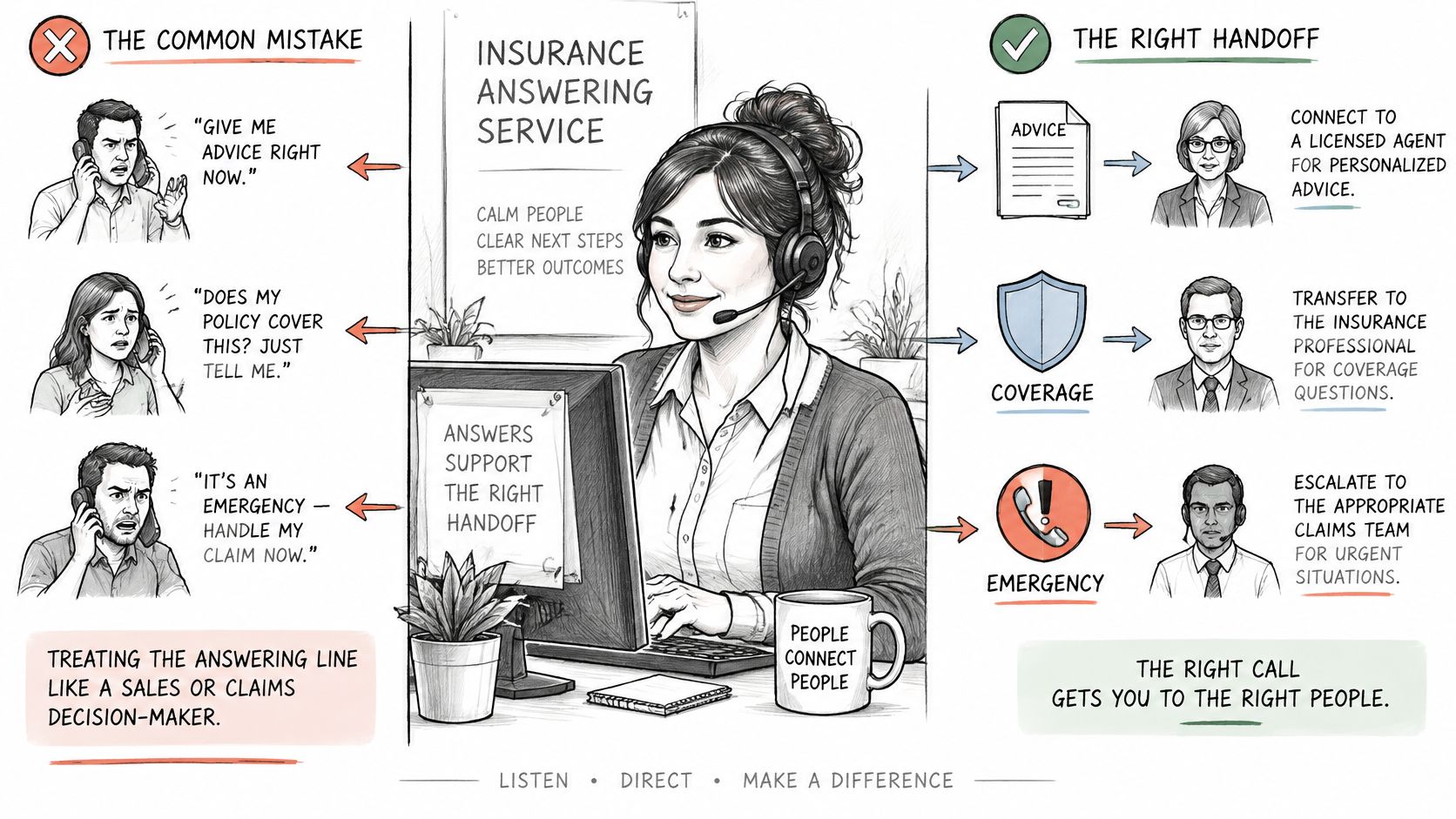
The common mistake is treating an answering line as a sales representative or claims decision-maker. A fluent response isn't authority to interpret a contract. Keep coverage determinations, claim liability decisions, pricing, underwriting, and binding outside the automated workflow.
The NAIC AI Model Bulletin states that insurer decisions or actions supported by AI must comply with applicable insurance law and identifies risks including inaccuracy, unfair discrimination, data vulnerability, and inadequate transparency. Automation doesn't remove the insurer's obligations.
Separate service information from advice
In the United States, insurance solicitation, negotiation, policy recommendations, and binding can require a licensed producer, a boundary discussed in Leadfriendly's insurance AI guide. Have counsel identify the applicable licensing requirements rather than assuming an automated voice can perform whatever a staff member does.
Approved service content can explain office hours, where to upload documents, or how to request a callback. It shouldn't infer whether an exclusion applies, recommend limits, or suggest a settlement is fair.
For example, a caller asks whether flood damage is covered. Capture the loss details and exact question, then assign a licensed callback. Don't answer yes or no based on a general FAQ.
For background reading, AMPM Restoration Services offers guidance to help property owners understand your Florida policy limits. Such educational material can help a caller prepare questions, but it isn't a substitute for reviewing their actual policy with authorized staff.
Keep emergency handling explicit
Our AI receptionist isn't trained to dispatch emergency responders. The business must configure prompt human transfer for potential emergencies and clearly tell callers about alternative emergency channels; anyone facing an active emergency should dial emergency services directly.
Use these hard stops:
- Interpretation or dispute: Transfer requests to explain coverage wording or challenge a decision.
- Bodily injury or active danger: Stop routine questioning and activate the emergency handoff.
- Sensitive information: Move health details and sensitive financial information into an approved human or secure workflow.
- Professional advice: Don't configure medical, legal, or financial advice without appropriate licensing and disclosures.
Before launch: Have counsel or the carrier's compliance team approve both the script and the escalation list.
Retain script and knowledge-base versions, escalation reason codes, and human-review records. Include privacy, security, audit access, and regulator cooperation in vendor due diligence, rather than evaluating only how natural the voice sounds.
How to Set Up Intake Routing and Human Handoff
A hybrid service lets customers reach a person when they need one. In Insurity's 2025 survey of more than 1,000 U.S. adults, 48% preferred digital-first insurance service with the option to speak with someone, while only 15% preferred a fully digital experience. Routing is where that option becomes real: the receptionist captures intake, and a person owns every decision the script cannot cover.
Establish the line and approved content
Connecting the line is the fast part. Insurance-specific routing and compliance review deserve separate attention before you send production calls to it.
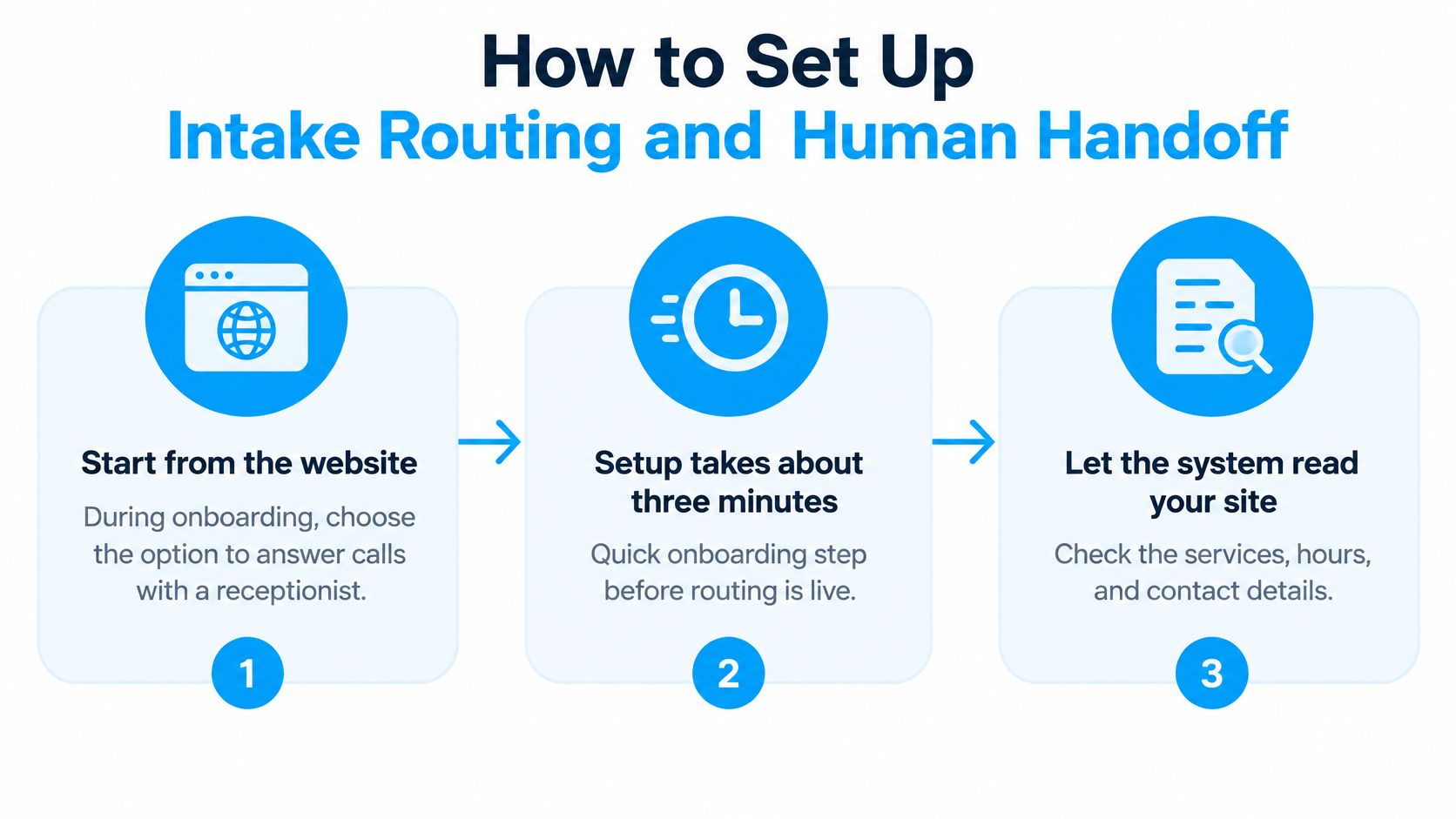
- Start from the website. On the first onboarding screen, choose Answer my calls for a receptionist. Milo can build its knowledge base from your website, FAQs, and uploaded documents such as price lists and policy summaries, without manual scripting, so the main work is approving your insurance workflow rather than configuring software.
- Let the system read your site, then review the drafted services, hours, and contact details. Remove outdated claims instructions and wording that could be mistaken for a coverage promise.
- Connect a number. Choose a local or toll-free number for Milo to answer, or forward your existing business line. If calls don't reach the receptionist, check number activation, forwarding, business-hours configuration, and balance first.
- Upload approved product summaries, claims FAQs, office hours, and escalation contacts. Check each service answer against current carrier instructions and policy wording, and keep superseded documents out of the live knowledge base. If an answer isn't in the knowledge base, the receptionist should say so and take a message or transfer, never improvise one.
- Configure disclosures and opt-outs. Turn on AI disclosure and the applicable recording disclosure, then verify what happens when someone declines recording or asks not to receive further calls. The toggles implement your settings, so your compliance review should decide the wording they use.
Test the handoff, not just the greeting
- Name the recipient for each call type and an after-hours backup. Use our explanation of warm transfers versus cold transfers to decide what context the receiving employee needs before speaking.
- Choose caller languages. Enable each language your operation will use and test all of them. Check that urgent phrases, names, locations, and callback instructions survive the handoff accurately.
- Run five test calls: a routine document request, a new claim, an injury report, a coverage question, and a complaint. Include a caller who interrupts, doesn't know their policy number, or asks for a person immediately. For each type, confirm what the receptionist captured and at what point the person took over.
- Review the records. Calls are recorded and transcribed, and both are stored against the account, so compare each transcript and outcome with your routing table. Correct any answer that exceeds approved content, and confirm the assigned employee received the notification and could find the supporting record.
Add transfer rules for distress, accessibility needs, repeated failed contact attempts, and catastrophe-related urgency. Offer an achievable callback window, and make someone responsible for missed callbacks.
A successful greeting proves very little. A successful test ends with the right person receiving enough information to act, including when the primary recipient doesn't answer.
Outbound Follow-Up, Renewals and Win-Backs Within the Law
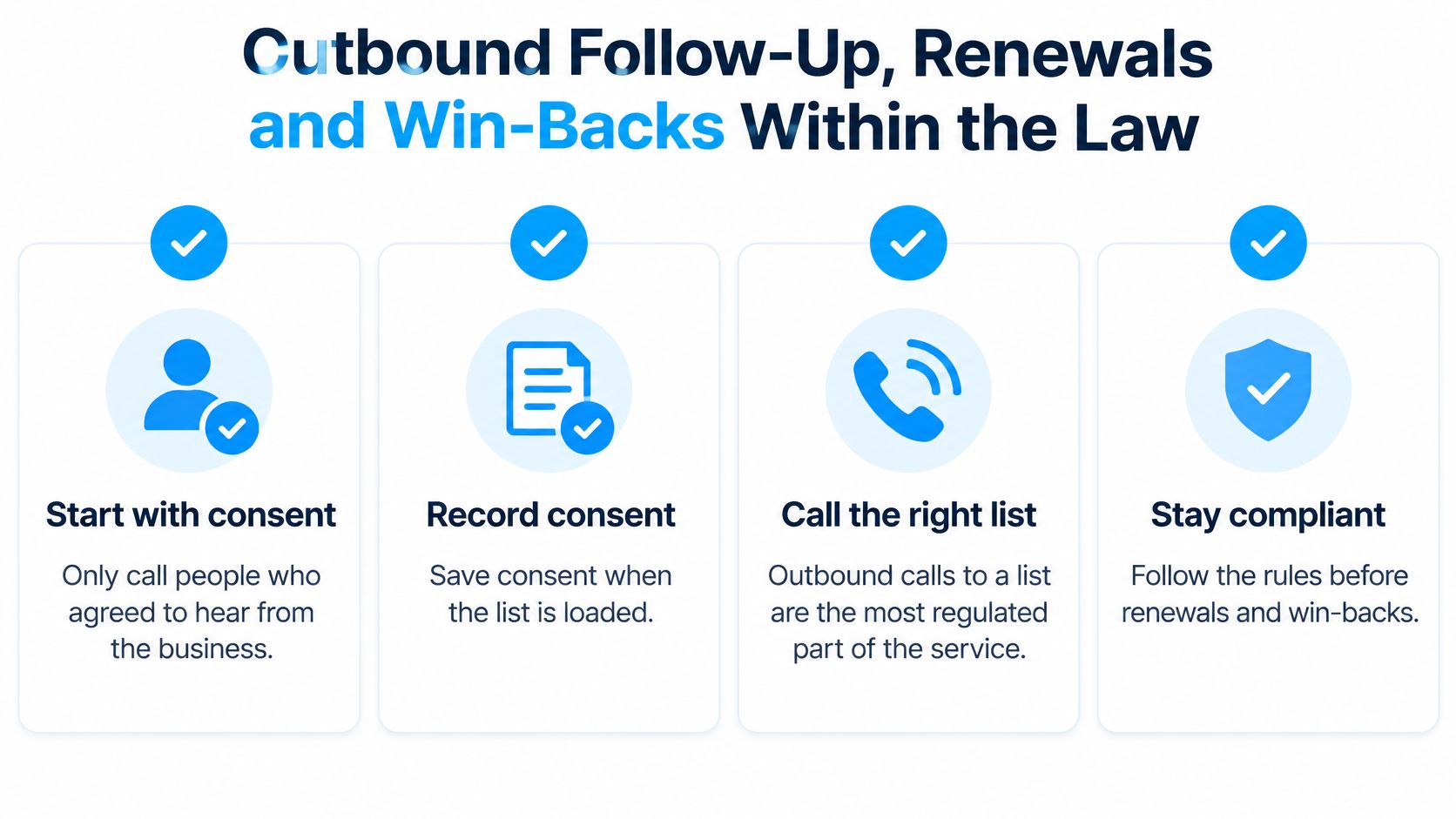
Only call people who agreed to hear from the business, and save that permission when loading the list. An existing policy, an old quote, or a purchased lead does not by itself establish the consent your campaign requires.
On February 8, 2024, the FCC confirmed that AI-generated human-like voices fall within the TCPA's artificial-or-prerecorded-voice restrictions, requiring prior express consent for covered calls unless an emergency purpose or recognized exemption applies. Calling the system a receptionist does not change the technology involved.
Put campaign controls ahead of volume
Identify the business, disclose the AI, and explain the purpose: a renewal reminder, quote callback, document request, or feedback survey. Separate service communications from marketing, and have counsel review the consent standard for each campaign before the first dial.
For covered US telemarketing to consumers' homes, the FTC's Telemarketing Sales Rule guidance generally limits calls to 8 a.m. through 9 p.m. in the recipient's local time without consent to other hours and requires calling-list updates against the National Do Not Call Registry at least every 31 days. Apply relevant state and sector-specific rules as well.
Dial Milo campaigns disclose the AI, handle opt-outs through configurable compliance toggles, call each contact in their own local time, and record how every conversation ended. A campaign can run renewal reminders, follow-ups and win-backs against your list, make the offer, and answer questions from the knowledge base you provide.
Our guide to automated outbound calls explains the broader campaign workflow. For customers confused about a termination notice, Policy Quail's guide for drivers facing policy cancellation provides educational context. Explaining what a non-renewal means for that driver's coverage is still a licensed conversation, so route those callers to staff rather than letting the campaign improvise an answer.
Turn outcomes into assigned work
Every campaign call should end in a recorded outcome and a named owner. A reminder that reaches a satisfied policyholder is finished. A reminder that surfaces a coverage question has only started.
Call outcomes and the follow-up each one needs
| Call outcome | What it means | Next action |
|---|---|---|
| Requested callback | Caller wants a person to call back | Create a callback task with the caller's preferred window |
| Not interested | Caller declined the offer | Record the outcome and exclude from the same campaign |
| Do not call | Caller asked to stop | Suppress across all lists and keep the opt-out separate from uploads |
| Question needing advice | Caller asked about coverage, pricing or options | Route to licensed staff with the transcript attached |
| No answer or voicemail | Call did not connect | Retry only where permitted, in the contact's local time; unanswered outbound calls are free |
| Claim or complaint raised | Caller reports a loss or dissatisfaction | Open a case and route to the claims or complaints queue |
If a renewal reminder reaches someone who says stop calling, suppress the number across campaigns. Keep that suppression independently of uploaded lists so a replacement file can't restore permission.
The same discipline applies at the advice boundary. When an outbound caller asks whether a lapse affects their coverage or which limit to choose, the campaign's job is finished: capture the question, attach the transcript, and hand it to a licensed agent. An AI voice answering coverage questions on a win-back call carries the same exposure it would on an inbound line.
Decide Your Intake Setup and Start a Test Line
Dial Milo is prepaid and usage based, with no subscription tiers, so an agency can test one narrow intake workflow before moving the main line. All accounts receive the listed product features, including unlimited concurrent calls. Send billing concerns to hello@dialmilo.com first, and allow 48 hours for investigation and response.
Compare total cost at your expected call volume, not the entry balance alone. Include the phone number rental, answered-call charges, text confirmations, staff time reviewing exceptions, and any manual entry still needed in the agency system.
Dial Milo billing characteristics for an insurance answering line
| Item | Billing treatment | Notes |
|---|---|---|
| Account | Prepaid, pay as you go | No subscription tiers; listed features are included |
| Phone number | Monthly rental charge | Choose a local or toll-free number, or forward your business line |
| Talk time | Usage based | AI processing and telephone costs are separated, with call charges visible in the dashboard |
| Text message | Usage based | Used for confirmations and follow-ups after caller details are captured |
| Unanswered outbound call | No charge | Applies when nobody answers |
| New account | Prepaid balance | Start with a small balance while testing |
| Unused balance | Does not expire | Add funds gradually as the trial proves out |
Budget for a controlled trial
A controlled trial should be sized by the calls you expect Milo to answer, the messages it should send, and the handoffs your team must review. Judge it on record quality and routing accuracy as well as cost: whether the caller reached a human when required, whether disclosures played where needed, and whether the transcript shows a clean capture rather than a guessed answer.
The free answering service cost calculator compares an in-house receptionist, a live answering service, and an AI receptionist per month, per year, and per call. Use it to frame the alternatives, then run a test line that answers 24/7, uses your documents and FAQs, books into a calendar, sends follow-up texts, records and transcribes calls, and warm-transfers when a person is needed.
Set the boundary before launch: automated intake captures facts, while advice, coverage decisions and emergencies go to authorized people. Configure AI and recording disclosures where your jurisdiction requires them, route potential emergency calls promptly to a human, and make sure callers know the direct emergency channel.
Dial Milo offers round-the-clock inbound answering and outbound AI campaigns, with calendar bookings, text confirmations, and human transfers when needed. Visit Dial Milo to build an insurance test line that captures the facts, documents the outcome, and leaves regulated decisions with your authorized team.
Keep reading

Real Estate Lead Follow Up: 8 Ways to Win More Leads
Real estate lead follow up that works: 8 practical strategies for calls, texts, timing, AI campaigns and long-term nurture to turn enquiries into viewings.
Read
High Call Volume: What It Means and How to Manage It
Learn what high call volume means, what causes it, and how to manage caller demand with triage, callbacks and compliant outbound calls.
Read
How a Survey Phone Call Works and Stays Compliant
Learn how a survey phone call is structured, why response rates mislead, and which consent, timing and attempt rules to follow before you dial.
Read