The call lands at 4:40 on a Friday. A homeowner wants a quote for a water heater, then mentions that the last technician left a mess and she wants to talk to someone about it. Your receptionist puts her through to the office manager, who picks up with "Thanks for holding, how can I help?" and the homeowner starts the whole story again, from the leak.
That moment is where transfers either earn their keep or cost you the job. The routing itself is easy. What's hard is deciding, before the call happens, whether the next person needs a briefing or just a destination.
Most businesses never make that decision explicitly. The phone system has a transfer button, someone presses it, and the caller absorbs whatever friction follows. A warm transfer vs cold transfer choice made deliberately, per call type, is a cheaper fix than almost anything else you can change about your phone line.
Warm vs Cold Transfer at a Glance
A cold transfer, also called a blind transfer, sends the caller straight to another person, extension or queue with no briefing, so the receiver knows only what the phone system or CRM already shows. A warm transfer, also called an attended or assisted transfer, keeps the first person on the line long enough to explain who is calling, why, and what has already been tried, then joins the caller to the receiver.
| Factor | Cold transfer | Warm transfer |
|---|---|---|
| Also called | Blind transfer | Attended or assisted transfer |
| Briefing before connection | None | Receiver briefed on caller and reason |
| Caller repeats details | Often | Usually not |
| Speed of connection | Fastest | Slower by the briefing time |
| Best fit | Predictable queues and demand surges | Escalations, urgent or high-value calls |
| If receiver does not answer | Depends on voicemail, queue or dropped call | Original party can retry or take a message |
The image below is the version worth pinning next to the phone.
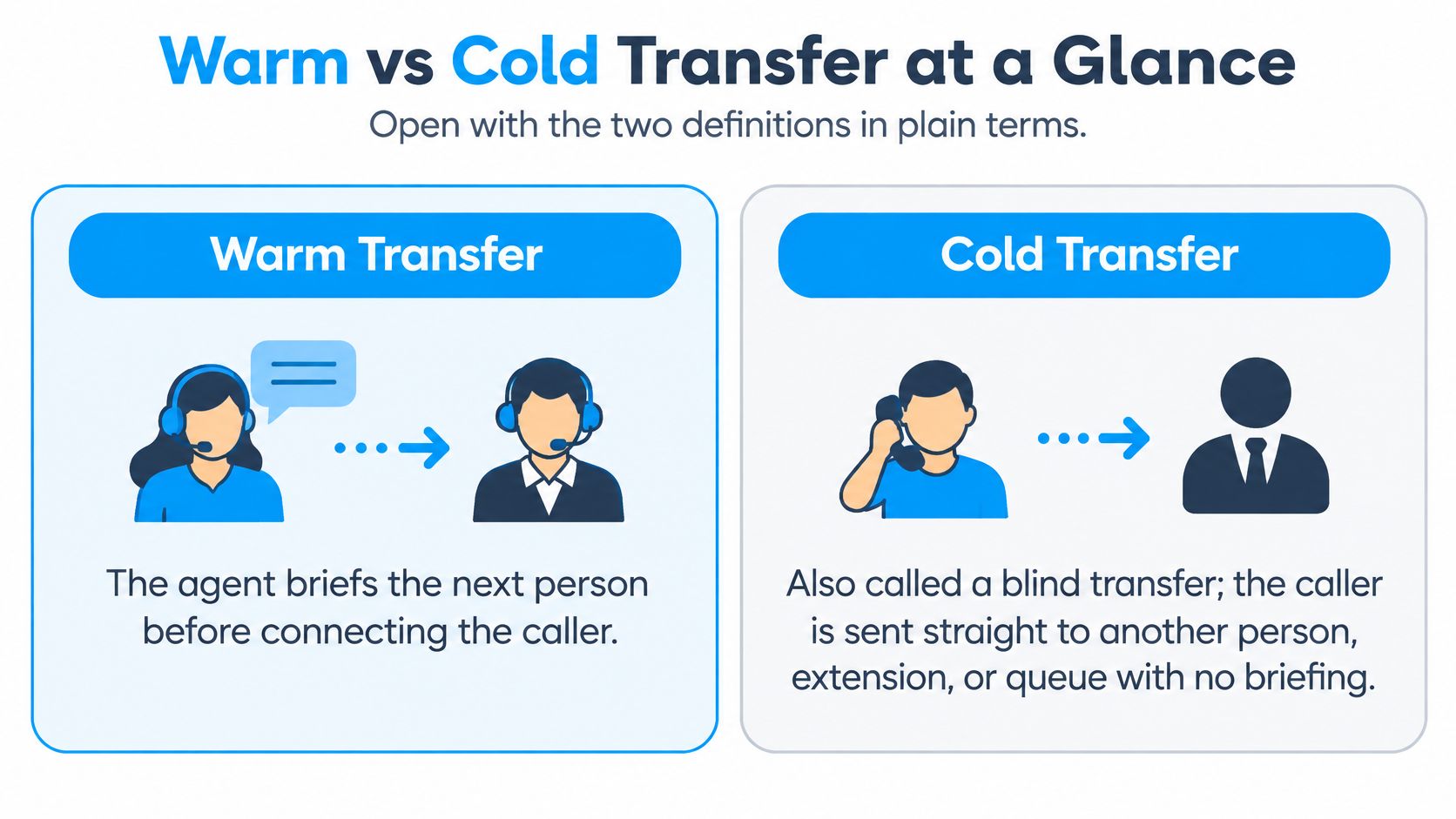
Read that table as a starting point, not a verdict. The right answer depends on two things about a specific call: how complex the request is and how fast the caller needs a human. A caller asking for opening hours needs speed. A caller whose boiler is leaking into a ceiling needs a person who already knows the address, the appliance and what the last technician did.
The same logic holds when software answers first. An AI receptionist either drops the caller into a queue cold, or it captures the details during the conversation, summarises them, and hands over a call that's already half solved. Same trade, different operator.
If you want the mechanical side set out at more length, including how front desks handle consent and hold time, this explanation of how warm transfers differ from cold transfers is a useful companion read.
Before you touch any settings, do one small piece of prep. Write down the three calls your business transfers most often. For a dental practice that's usually an insurance question, a scheduling exception and an emergency. For a trades business it's a quote, a warranty claim and an urgent repair. Mark each one warm or cold using the table above. You now have a policy instead of a habit.
How Each Transfer Works, Step by Step
A transfer does two jobs at once: it moves the call, and it decides what information moves with it. The briefing step is where both the context and the delay come from. Here is each flow, spelled out.
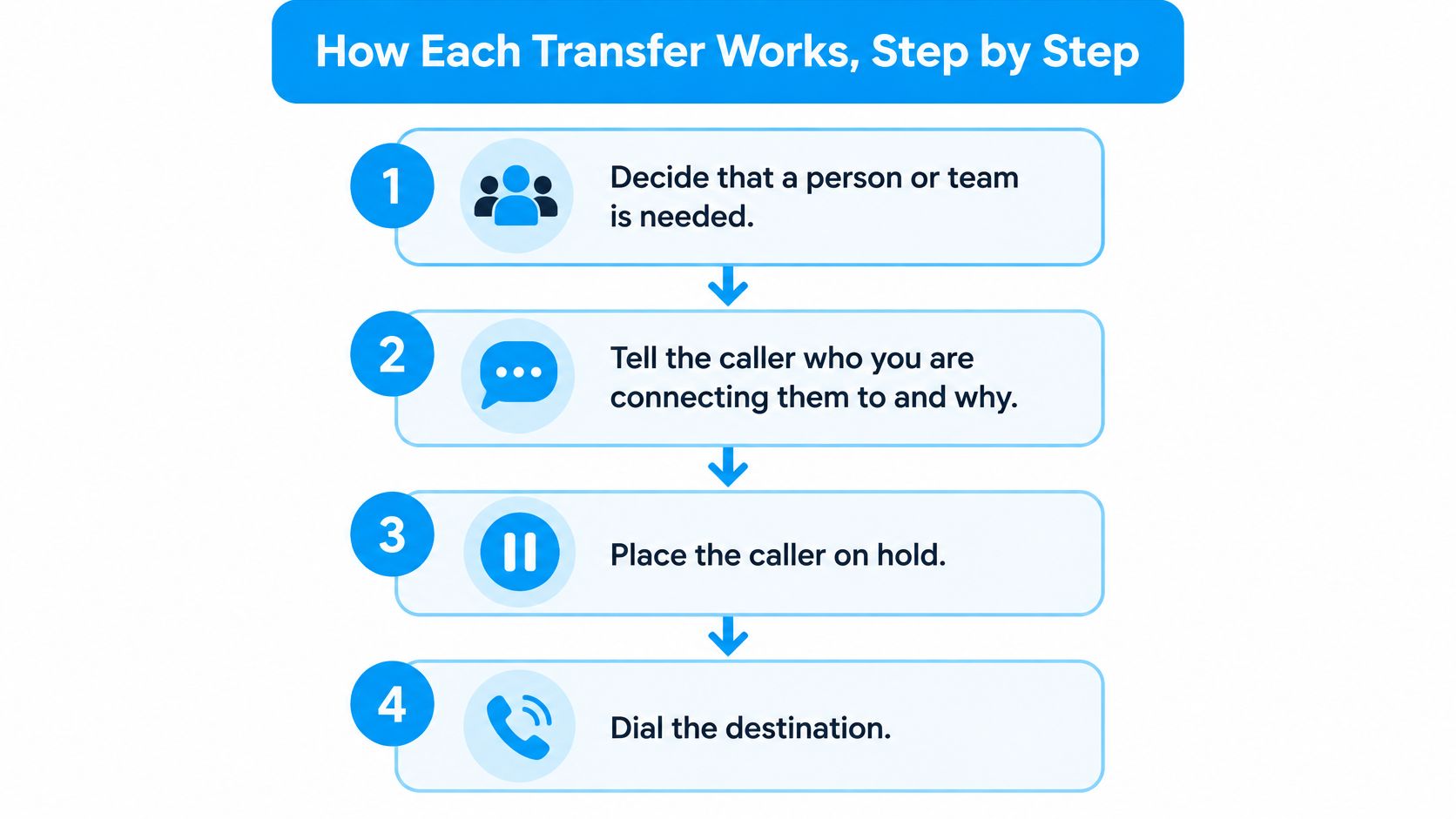
The warm path, in seven steps:
- Decide that a person or team is needed.
- Tell the caller who you're connecting them to and why.
- Place the caller on hold.
- Dial the destination.
- Brief the receiver on the caller's name, purpose and what has already been tried.
- Confirm the receiver accepts the call.
- Join the caller to the receiver and leave the line.
Steps four to six are where the interval lives, and they're the reason a warm transfer holds two call legs open at once. Step two is the only part the caller hears before the handoff, so keep it to a sentence. "I'm putting you through to Sam, who handles warranty claims, and I'll give her the details so you don't have to repeat them" does more work than a long apology.
The cold path, in five steps:
- Pick the destination from a routing rule.
- Send the caller directly to it.
- End the original call leg, with no briefing.
- The receiver answers with only what the system shows.
- If nobody answers, the outcome depends on that destination's voicemail, queue or dropped call.
That last step is the one that bites. A cold transfer leaves the ending to whoever configured the destination, which is often nobody in particular. If the number rings out, the caller lands in a voicemail box or a queue they didn't choose, and nothing they already explained travels with them.
Compare what arrives at the other end. A warm handoff delivers the caller plus a brief: name, issue, what's been tried. A cold one delivers the caller alone, with whatever the phone system displays, usually a number and maybe an account tag. Everything else has to be said again, and on a bad day it gets said to a ringing line.
When software runs the handoff, the warm path is the one to build. Milo can warm-transfer a caller to the business owner or a team member when the situation calls for it, following the same sequence a trained receptionist would, and it texts the business about each call. Whatever answers first, decide the fallback before the call happens: a callback promise or message capture, chosen in advance rather than left to chance.
For a wider look at how voice systems handle call legs, routing and handoffs, this overview of AI telephony for customer support covers the plumbing.
The test I'd run this week: walk both sequences through with a colleague playing the caller, once warm and once cold, and have the receiver deliberately not answer the first time. You learn more from watching the fallback fire than from watching the successful path work.
Speed, Context and Failure Risk Compared
Benchmark work attributed to SQM Group, drawn from more than 500 North American contact centers, found that about 19% of contact-center callers get transferred to another agent. Transferred callers gave top satisfaction ratings 12% less often and reached first-contact resolution 14% less often than callers whose calls were handled without a transfer.
Each of those measures tells you something different, and none of them tells you everything:
| Measure | What it captures | What it leaves out |
|---|---|---|
| Transfer rate | How often calls change hands at all | Whether the handoff itself was clean |
| Top satisfaction ratings | How the caller scores the experience afterward | Whether the problem behind the call was solved |
| First-contact resolution | Whether the matter closed on that call | Issues that genuinely needed a second person |
The figures do not prove the transfer caused the drop. Callers who need a transfer often arrive with harder problems, older accounts or an issue someone already failed to fix, so the transfer may be a symptom rather than the cause. What the numbers establish is narrower: when a call changes hands, continuity is the thing at risk.
Speed is where this comparison gets misread. A cold transfer is faster at the moment of the handoff: the call moves in seconds. A warm transfer takes longer at that moment, then earns the time back because the receiver opens the call already knowing the name, the problem and what has been tried. Measure speed to resolution, not speed to handoff. A caller who connects in seconds and then spends the following minutes retelling the story has not been served quickly.
A transfer is also a data decision, not only a routing one. A cold transfer moves the audio and leaves every fact behind. A warm transfer sends the audio plus a briefing, so you are choosing which caller details travel out of the first conversation along with the call. The briefing is what removes the repeat questions, and it is also what decides how much of the caller's information the second person hears.
Each path fails differently. A cold transfer fails: the caller lands in a queue, a voicemail or the wrong extension, and the log still shows a completed handoff. A warm transfer fails in the open, because the receiver either accepts the call or doesn't, and the caller hears which it was.
What callers judge: nobody on the other end of the line knows whether a briefing happened. They know whether they had to tell the story twice.
That is why the useful metric is not the transfer rate on its own. Track two things from your own call records. First, how often a caller repeats details after a transfer, which shows up as duplicated questions, re-verification of an email or phone number, or a transcript where the same facts appear twice. Second, how often the receiver closes the matter on that same call rather than promising a callback. A handoff that ends in a callback has not failed yet, but it sits half a step behind one that resolves in the moment.
Set a baseline before changing anything, because a handoff that drops is expensive in the same way as a call nobody answers: the enquiry existed, the intent was real, and the business paid for the marketing that produced it. Once you have a baseline, change one call type at a time. Moving every route to warm on a Monday tells you nothing except that the queue got longer.
Which Transfer Fits Each Call Situation
The decision rule is about what the receiver needs in order to act, not how important the customer is. If the next person would have to ask the caller to repeat something, warm it. If they wouldn't, cold is fine.
| Call situation | Transfer type | Why |
|---|---|---|
| Routine routing to a known department | Cold | Receiver already knows the purpose |
| Urgent repair or emergency booking | Warm | Receiver must act quickly and needs the detail |
| Billing dispute or refund request | Warm | Explaining the history avoids repeat questions |
| Qualified sales lead | Warm | Lead context shapes the first sentence |
| Surge period with a long queue | Cold | Speed relieves the queue |
| Medical, financial or gambling-related caller | Warm, with disclosure | Continuity and clear consent together |
| Outbound campaign call where the customer asks for a person | Warm | Receiver hears the reason for the call before speaking |
Take the cold rows first, because they're the ones operators overcomplicate. Routine routing to a known department is a solved problem: the caller picked "accounts" from a menu, the receiver answers accounts calls all day, and a briefing adds thirty seconds to a call that needed none. Surge periods work the same way in reverse. When the line is stacked, a fast cold handoff beats a careful one, because a caller who's still waiting is a caller who's already decided to try your competitor.
The warm rows carry more weight. An urgent repair is a call where the receiver must act in the first ten seconds, so the address, the appliance and the access instructions need to arrive before the greeting does. A billing dispute is a history problem. If the customer has to explain that they were charged twice, and that they already spoke to someone on Tuesday, and that the refund was promised then, you've spent the goodwill you had. A qualified sales lead is a different flavour again: the receiver's opening sentence depends entirely on what the lead said, and a lead who repeats their requirement twice is a lead who starts wondering whether anyone is listening.
Working rule: if the transfer protects a decision, an amount of money or a sensitive detail, brief the receiver. If it protects nothing but the route, don't.
Medical, financial, employment and gambling calls deserve their own line because continuity and consent have to be handled together, not traded off. A warm transfer can carry the verified identity and the reason for the call, but the caller still needs to know who's picking up and what's being shared before they're connected.
For outbound work the picture shifts slightly, because the caller didn't dial in. Milo campaigns call the business's list for reminders, follow-ups and win-backs, make the offer, answer questions, and record how each call ended. When a customer on one of those calls asks for a person, the warm path is the right default, since the receiver needs to know which campaign the call came from and what was already promised.
Your task here is short. List the five situations that generate the most transfers in your own business and write a warm or cold default beside each one.
What to Share in a Handoff and What the Caller Hears
A transfer succeeds when the receiver gets enough information to act and the caller understands what is being passed on. That makes the handoff a data-handling decision, not just a routing choice. A warm transfer can carry the caller's identity, intent, authentication status and the actions already taken, so the caller does not have to start over. A cold transfer leaves that context behind and may force the caller to verify everything again.
Share the issue and the account details needed for the next step. Do not send the full transcript because it exists. The standard for a good handoff is continuity without unnecessary disclosure.
Build the handoff record with four parts.
A short summary, not a transcript. Three to five lines covering the issue, the account and what has already been tried. Long briefings bury the important detail and place personal information in more places.
Verified caller details only where the task needs them. A billing dispute needs an account reference. A rescheduling needs a name and a booking. Neither needs a date of birth read aloud to a stranger.
A clear notice before the connection. Tell the caller who or what has handled the call, where it is going and which details will be shared.
A fallback. Settle the backup before the transfer begins: a callback, a message or another team. If nobody picks up, the caller should not be left waiting while the business improvises.
"I'm an AI assistant for this business. I'm passing your appointment question to a team member and will share only the details they need. If they can't take the call, we'll arrange a callback."
That wording identifies the AI, names the destination, limits the shared data and explains what happens if nobody answers. Milo's receptionist warm-transfers calls to the owner or a team member when a person is needed and texts the business about each call.
The same principle applies to the transfer record after the call. Give the receiver access to the fields needed to continue the conversation. Keep the full transcript and any sensitive details out of that view unless the task requires them. This reduces the amount of information copied between systems while still preserving the context that prevents the caller from repeating themselves.
If you are deciding how much of this work should sit with a phone system, the breakdown of what an AI answering service captures and passes on is a useful reference.
Finish with two concrete decisions. Write a one-sentence disclosure in your own words, then list the fields the receiver may see. Anything outside that list stays out of the handoff.
Cost and Handling Time for Each Transfer Path
Three costs sit inside every transfer, and only one of them shows up on a phone bill.
Talk time. A warm transfer keeps the originating party on the line during the briefing, so it burns minutes a cold transfer skips. Lost enquiries. A failed handoff costs far more than the seconds it saved, because a caller who has to start over is often a caller who doesn't. Repeat calls. A misrouted cold transfer generates a second call, and a second call is a full call's worth of cost for a fraction of the value.
The trade itself is standard call-center math: warm transfers take longer but carry the caller's context across, while cold transfers are faster and earn their keep during demand surges, when queue relief matters more than handoff quality. Neither path is cheaper in the abstract. The question is which cost you'd rather carry, because the briefing seconds are what buy the context. Skip them and the caller pays the difference by repeating their details to the next person, which is the slowest and most irritating way to move data between two parties on a call.
Where billing is transparent, this is easy to model. Dial Milo runs prepaid, usage-based billing rather than subscription tiers, with AI processing and telephone costs charged separately and each call's charge visible in the dashboard. Unanswered outbound calls aren't billed, prepaid balances don't expire, and a transfer to a person is billed for the outbound leg of the transferred part only, at the destination's rate. If Milo hands a call to your team, the AI charge stops at the transfer.
Run the worked example with your own rate. Say the briefing runs 30 seconds: that's half a minute of outbound talk at whatever the destination's rate happens to be. Set it against one repeat call: the marketing spend that produced the enquiry, the staff minutes on the second call, and the chance the caller books with someone else in between. Half a minute of talk time against that is not a close decision.
If you're benchmarking a transfer-aware service against a plain answering service, this breakdown of answering service cost sets out the components.
Set Your Transfer Rule Before the Next Call
One default rule covers most businesses. Use a warm transfer whenever a decision, an amount of money or a sensitive topic is involved, and a cold transfer for predictable routes and surge periods. Everything above is detail hanging off that sentence.
Default policy: the working rule you settled on when matching transfers to call types, applied word for word.
Write it down and put it where whoever answers the phone can see it. Apply it to the AI as well as to people, because a routing rule stored only in someone's head disappears the week they take holiday.
Then draw a line between transfer policy and compliance. They are separate obligations that get confused constantly. In the US, the Federal Communications Commission's guidance on robocalls says callers generally need prior express written consent for telemarketing robocalls, and the commission has confirmed that AI-generated human voices fall within the Telephone Consumer Protection Act's artificial-voice restrictions. Consent can be given electronically, whether through a website form or a telephone keypress, but each telemarketing robocall must also offer an opt-out mechanism, and consumers may revoke permission at any time in any reasonable manner.
A transfer to a live person changes none of that. Escalating a call to a human is a service decision. It creates no consent and cures nothing: a missing opt-out stays missing, and a number that should have been suppressed stays callable. Three things have to exist independently of your transfer rule: consent records showing what each contact agreed to, a suppression process that removes opt-outs and do-not-call requests promptly, and a transfer policy that treats escalation as a step on top of the campaign's consent basis.
Practically, that means the person building the campaign and the person answering the transferred call need the same view of the record. If a customer says "take me off your list" during a warm transfer, that instruction has to reach the suppression list the same day, not the next time someone exports a spreadsheet.
Once the rule exists and the compliance basics are in place, testing is cheap. Sign up at the Dial Milo sign-up page, point it at your website, and it drafts a receptionist script from your pages using your services, opening hours and prices. Billing is prepaid and usage-based, so the first warm transfer you review costs you a few minutes of credit rather than a contract.
Then listen to one transferred call from each side. You will hear quickly which of your routes were warm all along and which ones had been making customers repeat themselves.
A failed transfer rarely comes from the button itself. It comes from transferring without a briefing and hoping the next person works it out. Dial Milo answers inbound calls around the clock and runs outbound campaigns on your own list, and when a call needs a person it warm-transfers to you or a team member and texts the business about the call, so nobody starts the story twice. Visit Dial Milo to set up a receptionist or campaign and hear a transferred call on your own line.
Keep reading
What Does It Mean to Screen a Call
What does it mean to screen a call? It means judging who deserves a live conversation, not the same thing as blocking, silencing or answering.
Read
AI Appointment Setter for Inbound and Outbound
See what an AI appointment setter does on inbound and outbound calls, how booking works, and what to check before you trust it.
Read
Real Estate Cold Calling Script: 7 Examples That Work
Seven adaptable real estate cold calling script examples for FSBOs, expired listings, buyer follow-up and more, with objection handling and compliance tips.
Read